
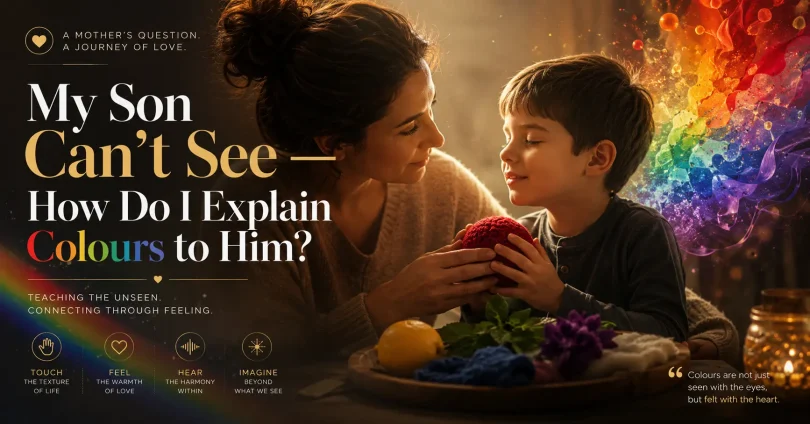
When parents first realize their child may never experience colours visually, one question often follows almost immediately:
“My Son Can’t See How Do I Explain Colours to Him?”
It is a deeply emotional question.
You may worry that your son will feel left out when people talk about blue skies, green grass, or colourful clothes. You may wonder whether teaching colours even matters if he cannot physically see them.
The truth is this:
Blind children can absolutely learn and understand colours — just differently.
Colours are not only visual experiences. They also carry meaning, emotions, sensations, cultural associations, and social importance. Your son can build a rich understanding of colours through touch, temperature, sound, emotions, memories, smells, and everyday experiences.
This guide explains exactly how to help a blind child understand colours in a natural, meaningful, and stress-free way.
Can a Blind Child Understand Colours?
Yes.
A blind child may not experience colours visually, but they can still understand:
- What colours represent
- How people use colours in daily life
- Emotional meanings connected to colours
- Cultural symbolism of colours
- Which colours objects usually have
For example, your son may understand that:
- Grass is green
- Fire trucks are red
- Snow is white
- The night sky is black
He may not “see” these colours, but he can still build strong mental and emotional associations with them.
In many ways, learning colours for a blind child is similar to learning abstract concepts like:
- Time
- Freedom
- Love
- Music
These things are understood through experience and meaning, not only sight.
Why Teaching Colours Still Matters
Some parents avoid talking about colours because they fear it will upset their child.
In reality, avoiding the topic can create confusion later in life.
Colours are everywhere in language and society:
- “Feeling blue”
- “Green with envy”
- “Red flag”
- “Black tie event”
- “Golden opportunity”
Your son will hear colour references constantly in:
- School
- Books
- TV shows
- Conversations
- Music
- Social situations
Teaching colours helps him:
- Understand conversations better
- Feel included socially
- Build confidence
- Understand descriptions in stories
- Communicate naturally with others
Colour knowledge is part of understanding the world.
The Best Way to Explain Colours to a Blind Child
The key is simple:
Connect colours to experiences your child already understands.
Instead of trying to describe how a colour “looks,” describe:
- How it feels
- What it reminds people of
- What emotions it creates
- What sensations it connects to
This makes colours meaningful instead of abstract.
How to Describe Individual Colours
How to Explain Red
Red is often associated with:
- Warmth
- Heat
- Energy
- Excitement
- Danger
- Love
You could say:
- “Red feels warm like standing near a fire or feeling the sun on your skin. It’s a strong and energetic colour.”
Things associated with red:
- Fire
- Blood
- Roses
- Stop signs
- Hot objects
How to Explain Blue
Blue is usually calm, peaceful, and cool.
You could say:
- “Blue feels calm like cool water, soft rain, or a quiet evening.”
Things associated with blue:
- Ocean
- Sky
- Rain
- Peacefulness
- Calm music
Blue is often emotionally connected to relaxation.
How to Explain Green
Green is strongly connected to nature and freshness.
You could say:
- “Green feels fresh like grass after rain or leaves moving in the wind.”
Things associated with green:
- Trees
- Plants
- Nature
- Growth
- Fresh air
Green often represents life and health.
How to Explain Yellow
Yellow is bright, cheerful, and energetic.
You could say:
- “Yellow feels happy like sunshine warming your face or hearing children laughing.”
Things associated with yellow:
- Sunshine
- Happiness
- Warm mornings
- Smiles
- Energy
How to Explain Black
Black is often described as deep, quiet, or powerful.
You could say:
- “Black feels quiet and still, like nighttime when everything becomes calm.”
Things associated with black:
- Night
- Darkness
- Silence
- Elegance
- Mystery
How to Explain White
White is usually connected with softness, cleanliness, and peace.
You could say:
- “White feels smooth and peaceful like fresh snow or a soft blanket.”
Things associated with white:
- Snow
- Clouds
- Clean spaces
- Peace
- Quietness
Use Real-Life Experiences to Teach Colours
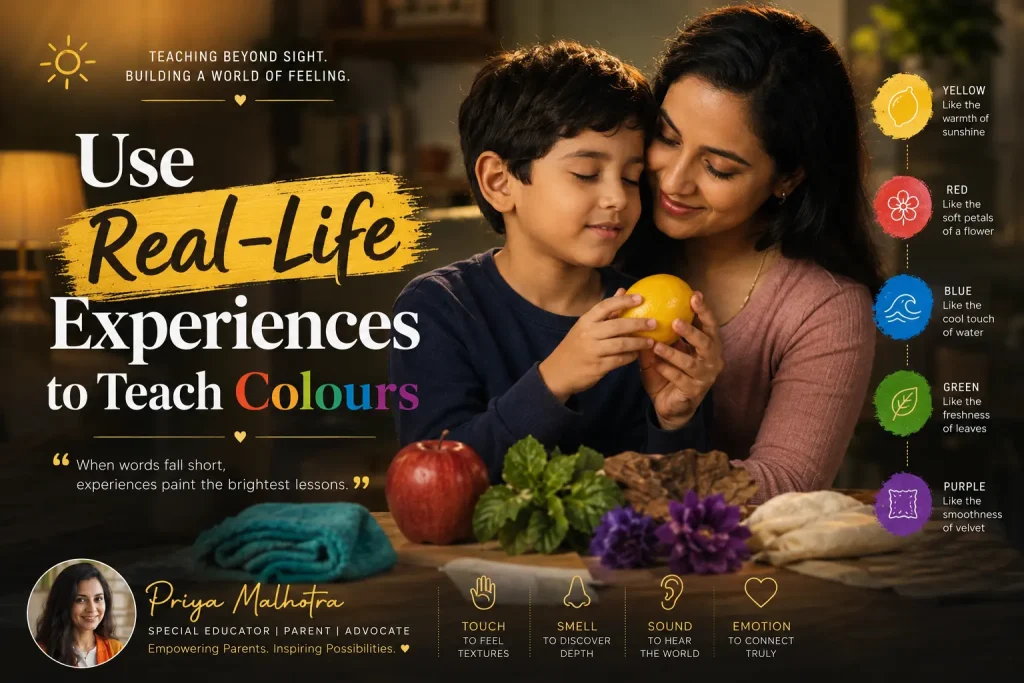
The best colour lessons happen naturally during everyday life.
During Meals
Talk about food colours:
- Red apples
- Green cucumbers
- Yellow bananas
- Brown bread
Even if your child cannot see the colours, repetition builds understanding.
Example:
“This strawberry is red. People usually think of red as sweet, bright, and energetic.”
During Outdoor Walks
Nature creates excellent opportunities for colour learning.
Talk about:
- Green grass
- Blue sky
- Brown tree bark
- Yellow flowers
Connect colours to:
- Smells
- Temperatures
- Textures
- Sounds
During Clothing Choices
Describe clothing colours naturally:
- “Your blue sweater”
- “Your black shoes”
- “Your white shirt”
As your son grows older, this helps him:
- Match clothing independently
- Understand fashion
- Communicate confidently with others
Use Music and Sound Associations
This is one strategy most articles never explain properly.
Many blind children naturally connect colours with sounds, rhythms, or musical moods.
Examples:
- Red may feel like loud drums
- Blue may feel like soft piano music
- Yellow may feel like cheerful singing
- Black may feel like deep bass sounds
Music helps make colours emotionally memorable.
Teach the Emotional Meaning of Colours
Colours are emotional symbols in human communication.
Helping your son understand these emotional meanings improves:
- Social understanding
- Communication
- Story comprehension
- Emotional intelligence
Examples:
- Red = excitement, warning, passion
- Blue = calmness, sadness
- Green = nature, freshness
- Yellow = happiness, energy
- Black = seriousness, mystery
- White = peace, purity
This gives colours deeper meaning beyond physical appearance.
Common Mistakes Parents Should Avoid
Avoid Saying “You Can’t Understand Colours”
This can limit confidence and curiosity.
Your child absolutely can understand colours conceptually.
Avoid Overcomplicated Explanations
Young children do not need scientific explanations about light wavelengths.
Simple emotional and sensory descriptions work best.
Avoid Teaching Too Many Colours at Once
Start with:
- Red
- Blue
- Green
- Yellow
Then gradually introduce others later.
Avoid Turning Learning Into a Test
Do not constantly quiz your child.
Instead:
- Talk naturally
- Repeat casually
- Make learning enjoyable
Activities That Help Blind Children Understand Colours
Sensory Colour Box
Create small boxes linked to colours.
Example:
Red Box
- Warm fabric
- Cinnamon scent
- Loud music clip
Blue Box
- Cool smooth stones
- Water sounds
- Soft fabric
This creates strong sensory associations.
Storytelling With Colours
Describe colours while reading stories.
Example:
“The hero wore a red cape, which made him seem brave and powerful.”
This teaches symbolic meaning naturally.
Colour and Emotion Games
Ask:
- “Which colour feels calm today?”
- “Which colour feels exciting?”
This builds emotional understanding.
How Blind Adults Often Understand Colours
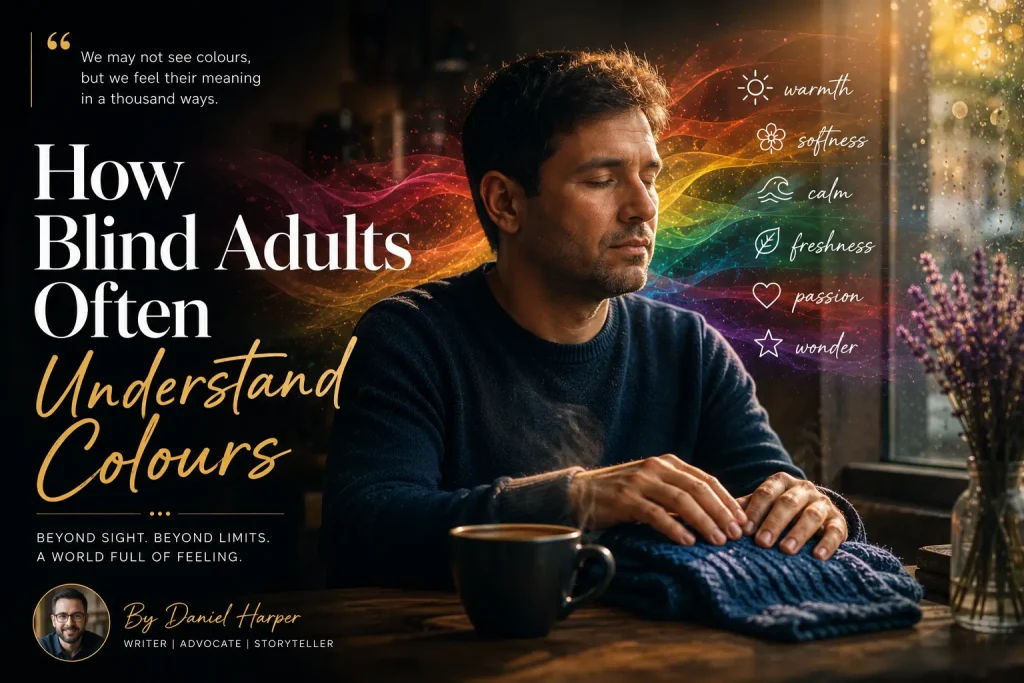
Many blind adults develop highly personal understandings of colours.
Some connect colours to:
- Temperatures
- Emotions
- Personal memories
- Music
- Smells
- Textures
There is no single “correct” way for a blind person to understand colour.
Your son may eventually create his own unique colour associations.
That is completely normal.
Should You Talk About Visual Things Often?
Yes.
Do not avoid visual language.
Blind children benefit from hearing natural descriptions such as:
- “The sunset looks orange tonight.”
- “Your friend has brown hair.”
- “The flowers are bright yellow.”
This helps them:
- Participate in conversations
- Understand books and media
- Build vocabulary
- Feel socially included
Avoiding visual language can unintentionally isolate them from everyday communication.
What Experts Say About Teaching Colours to Blind Children
Child development specialists and vision educators agree that blind children benefit from:
- Rich descriptive language
- Sensory learning
- Emotional associations
- Natural conversation
- Real-world context
Research shows that blind children build concepts through experience, not sight alone.
The brain is highly adaptable.
Children who are blind often develop deeper sensory awareness and strong conceptual understanding when parents consistently describe the world around them.
Frequently Asked Questions
Can blind children imagine colours?
Children born blind may not imagine colours visually, but they can still understand their meaning, symbolism, and emotional associations.
Is it confusing to teach colours to a blind child?
No. In fact, avoiding colours may create more confusion later because colours are used constantly in everyday language.
At what age should I start teaching colours?
You can begin naturally introducing colours during toddlerhood through conversation, play, food, clothing, and stories.
What is the easiest colour to explain first?
Red is often easiest because it connects strongly to warmth, heat, energy, and strong emotions.
Can blind children enjoy colourful books and stories?
Yes. Rich descriptions, textures, sounds, and emotional storytelling make colourful stories meaningful and enjoyable.
Final Thoughts
If your son cannot see, you may feel unsure how to explain something so visual.
But colours are much more than what people see.
- They are feelings.
- They are experiences.
- They are emotions, temperatures, sounds, memories, and meanings.
Your son does not need eyesight to build a beautiful understanding of colours.
What matters most is not giving him a perfect visual explanation.
What matters is helping him feel connected to the world around him.
Through your words, experiences, love, and patience, he can learn that colours are part of life — and that life is still full of richness, imagination, and wonder.
You May Also Like It:
How Do I Use Search Live to Identify the Signs Showing on My Car Dashboard?
How Can I Get a New Gas Pipeline Connection? What Should I Do to Make the Process Easier?
how to identify if the pashmina shawl i am buying is genuine?