
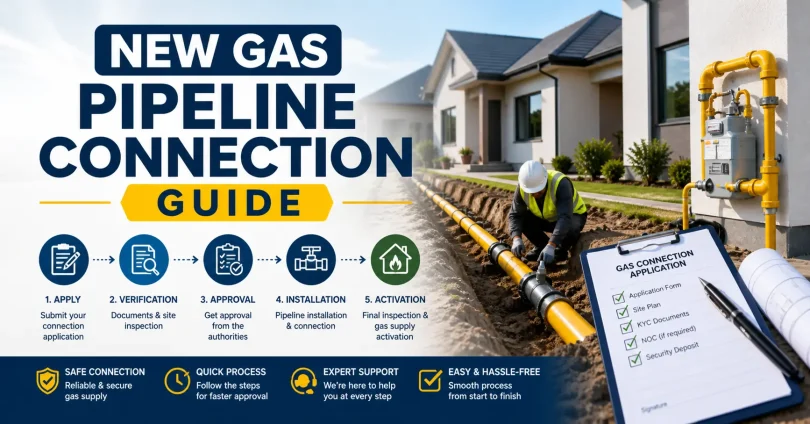
How to Get a New Gas Pipeline Connection:
Access to clean, continuous, and affordable cooking fuel is no longer a luxury — it is a necessity for millions of households across India. While LPG cylinders have served households for decades, Piped Natural Gas (PNG) connections are fast becoming the preferred choice for homeowners, tenants, and commercial establishments alike.
Getting a new gas pipeline connection may seem complicated at first, but the reality is that the process has been significantly streamlined in recent years. With the right information, the right documents, and a clear understanding of the steps involved, you can secure your connection quickly and without unnecessary delays.
This comprehensive guide covers everything you need to know — from understanding what a PNG connection is, to finding the right provider in your area, completing the application, preparing your documents, understanding the costs involved, and getting the connection installed without any hassle.
What Is a Gas Pipeline Connection (PNG)?
A Piped Natural Gas (PNG) connection supplies natural gas directly to your home, office, or commercial establishment through a network of underground pipelines. The gas is metered at your premises, meaning you pay only for what you consume — much like your electricity bill.
Natural gas supplied through pipelines is primarily methane, which is lighter than air. This is a key safety advantage: in the event of a leak, methane disperses quickly upward into the atmosphere rather than settling near the floor, as LPG (propane and butane) does.
PNG vs. LPG: A Quick Comparison
| Feature | PNG (Piped Natural Gas) | LPG (Cylinder) |
| Supply | Continuous via pipeline | Requires cylinder refill |
| Safety | Methane disperses upward | LPG settles near floor |
| Convenience | No booking or delivery needed | Must schedule delivery |
| Billing | Pay-per-use (metered) | Pay per cylinder |
| Risk of shortage | Negligible | Possible during peak demand |
| Environmental impact | Lower carbon emissions | Higher carbon emissions |
| Installation cost | One-time setup fee | Subsidised cylinders available |
Who Can Apply for a New Gas Pipeline Connection?
A gas pipeline connection is available to a wide range of applicants, including:
- Homeowners with residential properties in gas-pipeline-covered localities
- Tenants with a valid rental agreement and landlord permission
- Housing societies and apartment complexes applying collectively
- Commercial establishments such as restaurants, hotels, bakeries, and offices
- Industrial units using gas for manufacturing or heating processes
The most important eligibility factor is not who you are — it is where you live. The gas pipeline network must already exist in your locality, or your service provider must have plans to extend the network to your area in the near future.
How to Find the Right Gas Provider in Your Area
India has a well-established network of City Gas Distribution (CGD) companies that supply piped natural gas across different states and cities. The Petroleum and Natural Gas Regulatory Board (PNGRB) is the central regulatory body that oversees and authorises these entities.
To find the right provider for your area, you can visit the official PNGRB website (www.pngrb.gov.in), select your state and district, and identify the authorised entity supplying gas in your locality.
The table below lists the major piped gas providers in India along with their primary service areas:
| Gas Provider | Primary Service Areas |
| Indraprastha Gas Ltd (IGL) | Delhi NCR, Noida, Ghaziabad, Gurugram, Rewari, Ajmer, Pali |
| Mahanagar Gas Ltd (MGL) | Mumbai, Thane, Navi Mumbai, Mira-Bhayandar, Raigad |
| Gujarat Gas Limited (GGL) | Gujarat (widest network), parts of Maharashtra and Haryana |
| Adani Total Gas Limited | Ahmedabad, Vadodara, Faridabad, Khurja, Assam, Chhattisgarh, Karnataka |
| Maharashtra Natural Gas Ltd (MNGL) | Pune, Pimpri-Chinchwad, Chakan, Talegaon, Hinjewadi |
| GAIL Gas Limited | Bengaluru, Dewas, Sonipat, Meerut, Varanasi, Ranchi |
| Indian Oil-Adani Gas (IOAGPL) | Chandigarh, Ernakulam, Prayagraj, Bulandshahr, parts of Kerala and Bihar |
| Torrent Gas | Chennai, Jaipur, Pune (rural), parts of Uttar Pradesh and Punjab |
| Aavantika Gas Limited (AGL) | Indore, Ujjain, Gwalior, Pithampur, Madhya Pradesh |
Note: Service area coverage is continuously expanding. Always confirm availability directly with the provider or on the PNGRB portal before initiating your application.
Step-by-Step Process to Get a New Gas Pipeline Connection
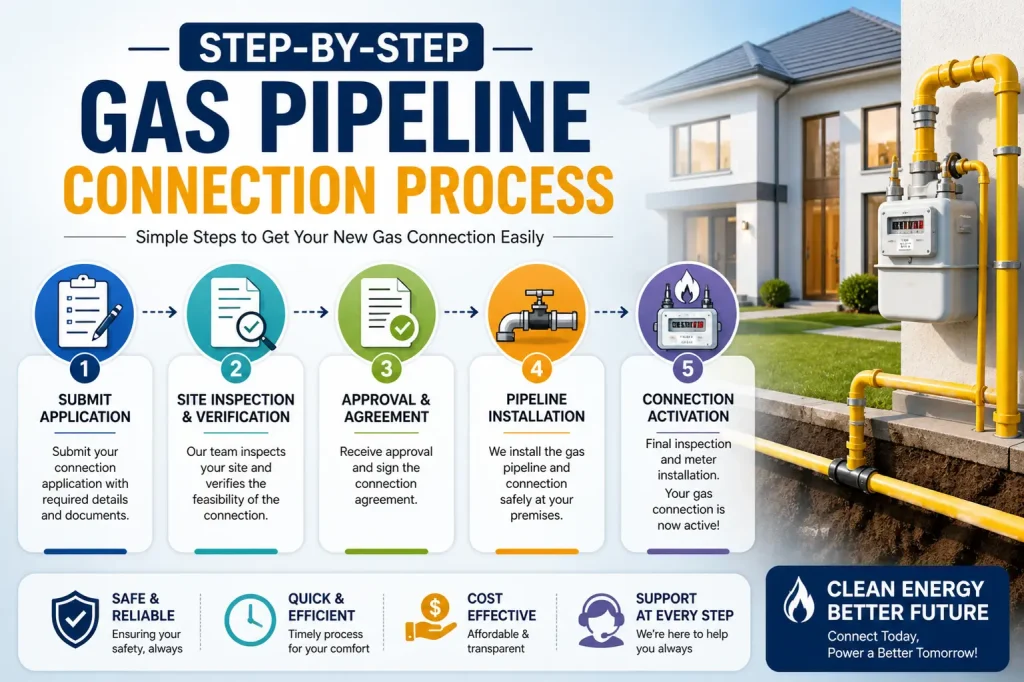
The overall process is straightforward when you follow each step carefully. Here is a complete walkthrough:
Step 1: Check Pipeline Availability in Your Area
Before anything else, confirm that your locality is covered by the gas distribution network. You can do this by:
- Visiting the official website of your local gas provider
- Calling the customer care helpline
- Checking the PNGRB website to identify your authorised provider
- Asking your neighbours or housing society secretary
If the network is not yet available, you can still register your interest. Many providers prioritise network expansion to areas where multiple applicants have expressed demand.
Step 2: Choose Your Application Mode — Online or Offline
Most gas providers now offer a fully digital application process. The online route is faster, more convenient, and creates a traceable record of your request.
Online Application
- Visit the official website of your gas provider
- Navigate to ‘New Connection‘ or ‘PNG Connection Enquiry‘
- Fill in the required details: name, address, contact number, and type of connection
- Upload scanned copies of supporting documents
- Pay the registration and security deposit fees online
- Receive an application reference number for tracking
Offline Application
- Visit the nearest customer care or area office of the gas provider
- Collect and fill in the physical application form
- Submit documents in person along with the fees
- Collect an acknowledgement receipt with your application number
Step 3: Prepare and Submit Your Documents
Incomplete or incorrect documentation is the single most common reason for application delays. Prepare all required documents before you begin the application.
| Document Category | Accepted Documents |
| Identity Proof (any one) | Aadhaar Card / PAN Card / Voter ID / Passport / Driving Licence |
| Address / Ownership Proof (any one) | Latest electricity bill / Property sale deed / Municipal tax receipt / Allotment letter |
| For Tenants | Rental agreement + Landlord NOC + Landlord ID proof |
| For Apartment / Society | NOC or approval letter from Residents Welfare Association (RWA) or builder |
| Government Housing | First 5 pages of sale deed or allotment letter |
| Photographs | 2 recent passport-size photographs |
Important: Ensure that all documents are self-attested. If applying as a tenant, the landlord must provide a No Objection Certificate (NOC) and a copy of their own identity proof.
Step 4: Pay the Required Fees
After submitting your application and documents, you will need to pay the applicable charges. These typically include a refundable security deposit, a registration fee, and installation charges.
| Fee Component | Approximate Amount |
| Security Deposit (Refundable) | Typically INR 5,000 – INR 10,000 depending on provider and city |
| Registration / Application Fee | INR 500 – INR 2,000 (varies by provider) |
| Installation / Pipeline Charges | INR 0 – INR 5,000 (often waived during promotional periods) |
| Gas Meter Charges | Usually included in the installation package |
| Internal Piping (if required) | Charged per meter by the contractor |
Important: The security deposit is fully refundable at the time of disconnection. Some providers occasionally waive installation charges during promotional drives or in areas where they are actively expanding their network. Always confirm the exact fee structure with your provider at the time of application.
Step 5: Technical Inspection and Feasibility Assessment
After payment, the gas provider’s technical team will visit your property to:
- Assess the feasibility of connecting your premises to the main pipeline
- Check structural access and routing for the internal pipeline
- Verify safety compliance of your premises
- Inspect the kitchen setup and appliance compatibility
If your premises are found to be technically feasible, the installation process begins. If not, the provider will inform you of the reason, and your security deposit will typically be refunded as per company policy.
Step 6: Pipeline Installation and Meter Setup
Once the feasibility check clears, the provider’s licensed technicians will carry out the installation. This includes:
- Laying the service pipeline from the main distribution line to your premises
- Installing the gas meter and pressure regulator
- Setting up internal pipework to the kitchen and other appliances
- Installing safety shut-off valves
- Converting or inspecting existing gas appliances for PNG compatibility
After installation, the technician will conduct a final pressure test and safety check before the gas supply is activated. You will receive a customer ID and a welcome kit with billing and safety information.
Step 7: Activation and First Bill
Once installation is complete and the safety checks are cleared, your gas connection is activated. Your first bill will typically arrive after 30 days, reflecting your consumption from the date of activation. The billing cycle may vary by provider — some bill monthly, others bimonthly.
Timeline: How Long Does It Take?
The processing time for a new gas pipeline connection depends on several factors, including infrastructure availability in your area and the current volume of applications. Here is a general guideline:
| Scenario | Estimated Timeline |
| Pipeline already exists in your area | 2 to 4 weeks from application approval |
| Pipeline extension required (group application) | 4 to 12 weeks |
| New network expansion area | 3 to 6 months or longer |
| During promotional / fast-track drives | As fast as 1 to 2 weeks |
Proven Tips to Make the Gas Connection Process Easier and Faster
Tip 1: Apply as a Group Through Your Housing Society
When multiple households in a building or residential complex apply together, gas providers are significantly more motivated to accelerate installation. Many providers prioritise areas with bulk demand because it makes network expansion economically viable. If you live in an apartment complex, coordinate with your RWA or society secretary to submit a collective application.
Tip 2: Prepare All Documents Before You Start
The single biggest cause of delay is incomplete documentation. Prepare and scan all your documents before you open the application form. Keep both original and self-attested copies ready for the physical inspection. If you are a tenant, get the landlord NOC in writing before you apply.
Tip 3: Apply Online for a Faster and Traceable Process
Online applications are processed more efficiently than offline ones. They also give you a reference number that allows you to track your application status in real time. Avoid visiting the office unless absolutely necessary, as it can slow things down.
Tip 4: Stay Available for the Technical Inspection
The technical team will contact you to schedule an inspection visit. If you miss or delay this appointment, it can add days or even weeks to the process. Keep your phone accessible and confirm the visit date promptly.
Tip 5: Verify That Your Gas Appliances Are PNG Compatible
Most modern gas stoves are compatible with both PNG and LPG, but the burner nozzle size may differ. PNG operates at a lower pressure than LPG, so the nozzle must be replaced or adjusted by a qualified technician. Inform the installation team in advance so they bring the correct equipment.
Tip 6: Use Only Official Channels for Communication
Always apply through the official website or authorised customer care office of the gas provider. Fraudulent messages claiming to offer faster connections in exchange for payments have been reported. Never share your Aadhaar or bank details with unofficial sources. If you are unsure about a communication, call the official customer care number to verify.
Tip 7: Track Your Application and Follow Up Proactively
After submitting your application, note your reference number and check your application status regularly through the provider’s website or app. If there are no updates after two weeks, contact the customer care helpline proactively. Prompt follow-up often accelerates the process.
Government Incentives and Subsidies for Switching to PNG
The Government of India has been actively encouraging households to transition from LPG to piped natural gas as part of its broader clean energy and energy security strategy. Several incentives have been introduced to make the switch more attractive:
- Waived or reduced installation and connection charges in select cities during promotional periods
- Priority network expansion in areas with high demand registration
- Subsidised internal piping charges in government housing schemes
- Special incentives for early adopters in newly networked areas
Incentive availability varies by city and provider. Contact your local gas provider or check the PNGRB website for the latest information on applicable benefits in your area.
Post-Connection: Gas Safety Tips Every Household Should Know
Your responsibilities do not end after the connection is installed. Here are essential safety practices every PNG household must follow:
- Never leave the gas burner unattended when it is lit
- Always close the shut-off valve near the meter when the kitchen is not in use, especially at night
- Ensure your kitchen is adequately ventilated — never use the gas stove in a sealed room
- If you smell gas, do not switch on any electrical device, do not light a flame — open all windows immediately and call your provider’s emergency helpline
- Schedule an annual maintenance check with a licensed technician from your gas provider
- Do not attempt to repair or modify the pipeline, meter, or regulator yourself — always call a certified technician
- Check your gas bill regularly; a sudden spike in consumption may indicate a leak
- Install a gas leak detector in your kitchen for an added layer of protection
What If PNG Is Not Available in Your Area?
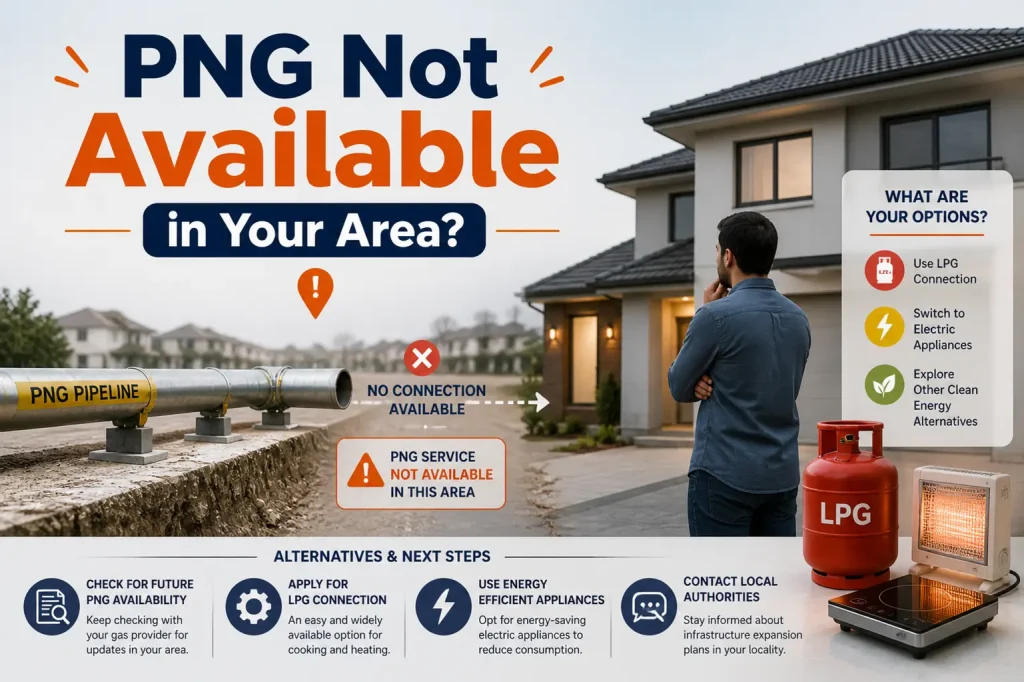
If the pipeline network has not yet reached your locality, you still have options:
- Register your interest formally with the local gas provider — recorded demand influences network expansion priorities
- Organise a collective demand registration drive in your neighbourhood or housing society
- Check the PNGRB Authorised Entity Gazette notifications for planned expansion timelines in your district
- Contact your local municipal councillor or MP, as infrastructure expansion is often linked to civic development plans
Many providers have expanded networks to new areas specifically because a cluster of residents formally registered their interest and created documented demand. Your application matters even before the pipeline arrives.
Common Problems and How to Solve Them
| Common Problem | Solution |
| Pipeline not available in the area | Register interest; organise collective demand; check PNGRB expansion plans |
| Application rejected due to incomplete documents | Prepare all documents as per the checklist before reapplying |
| Delay in technical inspection scheduling | Follow up proactively with customer care; confirm appointment two days in advance |
| Landlord refusing to give NOC | Show the landlord that PNG improves property value and eliminates cylinder storage risks |
| Appliances not working properly after connection | Call the provider’s service helpline — nozzle adjustment is usually a quick fix |
| Receiving fraud calls about the application | Verify all communications through the official customer care number only |
FAQs
Q1. How long does it take to get a new gas pipeline connection?
If the pipeline infrastructure already exists in your area, the process typically takes 2 to 4 weeks from the date of application approval. In areas where network expansion is needed, it can take anywhere from 4 to 12 weeks. Group applications from housing societies often receive faster processing.
Q2. Can tenants apply for a gas pipeline connection?
Yes, tenants can apply for a new gas connection. They are required to submit a valid rental agreement and a No Objection Certificate (NOC) from the property owner, along with the landlord’s identity proof. Some providers also require the landlord to co-sign the application.
Q3. Is the security deposit refundable?
Yes. The security deposit collected at the time of registration is fully refundable when the connection is permanently disconnected. It is held interest-free by the provider during the active connection period.
Q4. What appliances can run on PNG?
PNG can power kitchen gas stoves, gas water heaters (geysers), space heaters, gas-fired ovens, tandoors, and commercial kitchen equipment. Your appliances may need a minor nozzle adjustment during installation to work optimally at PNG pressure.
Q5. Is piped natural gas cheaper than LPG?
In many cities, PNG rates are comparable to or lower than subsidised LPG prices per unit of energy. Since PNG is billed on actual consumption, households that use gas conservatively often pay less overall. However, pricing varies by city and provider. Check the current tariff on your provider’s official website.
Q6. What should I do if I smell gas in my house?
If you detect a gas smell, immediately close the shut-off valve near the meter, open all doors and windows for ventilation, do not switch on or off any electrical appliance, do not light any flame, and leave the premises. Call your provider’s emergency helpline from outside the building.
Q7. Can I get a PNG connection for a commercial establishment?
Yes. Gas providers offer separate commercial and industrial connections. The application process is similar to domestic connections but may involve additional documentation, a higher security deposit, and a different tariff structure. Contact your provider’s commercial customer care team for specific guidance.
Q8. What happens if my application is rejected?
If your application is rejected, the provider must inform you of the specific reason. Common reasons include technical infeasibility, incomplete documentation, or pipeline unavailability. You can address the stated issue and reapply. If you believe the rejection is incorrect, you can escalate the matter to the PNGRB.
Q9. Can I transfer a gas connection when I move to a new address?
A PNG connection is attached to a specific premises, not a person. If you move, you will need to apply for a fresh connection at your new address. You may also apply for a permanent disconnection at your old address and request a security deposit refund.
Q10. How do I pay my PNG gas bill?
Most gas providers offer multiple payment options, including online payment through their website or mobile app, net banking, UPI, and payment at authorised collection centres. Some providers also offer auto-debit and standing instruction options for hassle-free bill payment.
Conclusion
Getting a new gas pipeline connection is a well-structured, accessible process that any household or business can navigate successfully with the right preparation. The key steps are simple: verify availability, choose your provider, submit a complete application with all required documents, pay the applicable fees, cooperate with the technical inspection, and follow up proactively if needed.
Piped Natural Gas is safer, more convenient, environmentally cleaner, and more cost-effective in the long run than traditional LPG cylinders. As India continues to expand its gas distribution network rapidly under national energy policies, millions more homes are now within reach of this upgrade.
Do not wait for the pipeline to come to your door — register your interest today, organise a group application in your building or society, and take the first step toward a cleaner, uninterrupted, and hassle-free gas supply for your home.
You May Also Like It: