
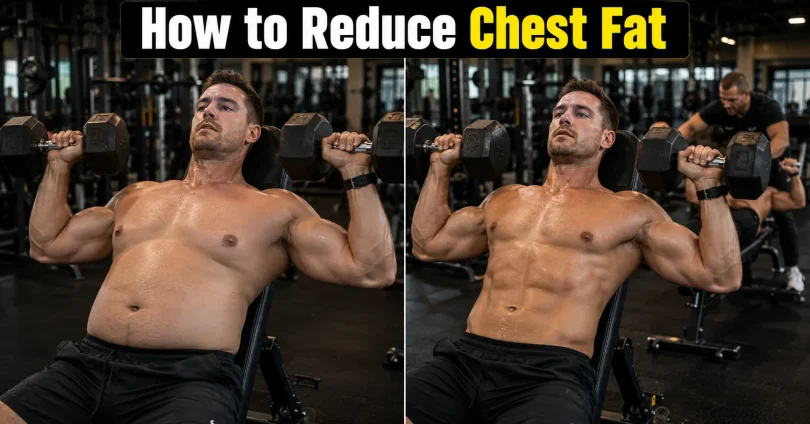
Direct Answer
How to reduce chest fat by combining a modest calorie deficit (300 to 500 calories a day), strength training two to four times a week to build the pectoral muscle underneath the fat, and enough cardio to raise your weekly activity total. Chest fat cannot be spot-reduced, but consistent training paired with better sleep, lower alcohol intake, and patience over 8 to 16 weeks reliably tightens and flattens the chest. If the tissue feels firm or disc-like rather than soft, that is likely gynecomastia, not fat, and it needs a doctor’s opinion rather than a workout plan.
I have coached enough people through this exact frustration to know the real problem isn’t motivation. It’s that most advice online recycles the same five push-up variations and calls it a plan. Let’s actually fix that.
Why Your Chest Holds Fat Longer Than Other Areas
Here’s something almost none of the popular guides mention: fat cells aren’t identical everywhere on your body. Chest and lower-belly fat cells carry more alpha-2 adrenergic receptors, which slow down fat release, compared to areas like the face or forearms that carry more beta-2 receptors, which speed it up. That’s a biochemical reason your chest is often one of the last places to lean out, even when your waist is already shrinking.
Add to that a few practical realities I see over and over in clients:
- Fat distribution is genetically wired. Two people can eat identically and lose fat from completely different places first.
- Estrogen-to-testosterone ratio matters more than total body fat. Fat tissue itself produces an enzyme called aromatase, which converts testosterone into estrogen. More chest fat can mean more local estrogen activity, which in turn encourages the body to store more fat right there. It’s a loop, not a one-time event.
- Age changes the starting line. Testosterone drops roughly 1% per year after 30 in most men, so a 45-year-old and a 22-year-old doing the identical program will not see identical timelines.
- Insulin resistance plays a quiet role. Chronically high insulin (from a diet heavy in refined carbs) pushes the body toward fat storage mode rather than fat-burning mode, and chest tissue responds to this the same way belly fat does.
None of this means you’re stuck. It means the plan needs to work with your biology, not against it.
Chest Fat, Gynecomastia, or Postural Sag? The 3-Way Check Most Articles Skip
Most competitor articles compare only two things: fat versus gynecomastia. But there’s a third, very common cause that gets missed entirely: postural muscle sag, where weak, stretched chest and shoulder muscles combined with a rounded upper back make the chest look droopy even at a normal body fat percentage. I’ve seen lean guys convinced they had “man boobs” when the real issue was years of desk-hunching.
Here’s how to tell the three apart at home:
| Check | Chest Fat | Gynecomastia | Postural Sag |
|---|---|---|---|
| Feel | Soft, evenly squishy | Firm, rubbery, disc-shaped lump under the nipple | Soft tissue, but shape changes when you stand tall |
| Location | Spread across the whole chest | Centered directly behind the nipple, often one-sided | Lower pec area, worse with rounded shoulders |
| Pinch Test | Pinches easily, no resistance | Feels like pinching a coin or button | Pinches like normal skin, improves with posture correction |
| Changes When You Flex or Stand Up Straight | Minimal change | No change | Noticeably tightens and lifts |
| Pain or Tenderness | Rare | Sometimes, especially early on | No |
| Best Fix | Calorie deficit + strength training | Medical evaluation | Scapular and upper-back strengthening, posture correction |
| Timeline to See Change | 8–16 weeks | Varies, may need treatment | 4–8 weeks |
If you’re not sure after this check, don’t guess. A five-minute visit to a doctor is faster than months of the wrong approach.
The Diet Approach That Actually Moves the Needle
Forget “clean eating” as a strategy. What actually reduces chest fat is a sustained calorie deficit your body can’t easily compensate for. Here’s how I set this up with clients:
- Calculate your maintenance calories, then subtract 300 to 500. Bigger deficits feel faster but usually fail within three weeks because hunger wins.
- Protein first, always. Aim for roughly 1.6 to 2.2 grams per kilogram of bodyweight. Protein preserves the muscle you’re building underneath the fat, so your chest firms up instead of just shrinking and sagging.
- Don’t fear carbs, fear liquid sugar. Sodas, juices, and flavored coffees are the single biggest silent contributor to stalled progress I see. They spike insulin without filling you up.
- Track for two weeks minimum before adjusting anything. Most people misjudge their intake by 20 to 30%. A simple food log (even in your phone’s notes app) fixes this faster than any supplement.
A Realistic Sample Day
| Meal | Example | Why It Works |
|---|---|---|
| Breakfast | Greek yogurt, berries, and a handful of almonds | High in protein, helps keep insulin levels steady |
| Lunch | Grilled chicken or tofu, brown rice, and a large portion of vegetables | Balanced macronutrients and high volume for better fullness |
| Snack | Apple with a tablespoon of peanut butter | Helps curb the common 4 PM sugar craving |
| Dinner | Fish or lean beef, roasted vegetables, and a small portion of potatoes | Protein-focused meal that helps keep calories in check |
| Drink | Water, black coffee, or unsweetened tea | Eliminates hidden liquid calories |
There’s no magic “chest fat diet.” It’s the same fat-loss diet that works everywhere else on your body, applied with consistency.
Training Plan: Building the Muscle Under the Fat
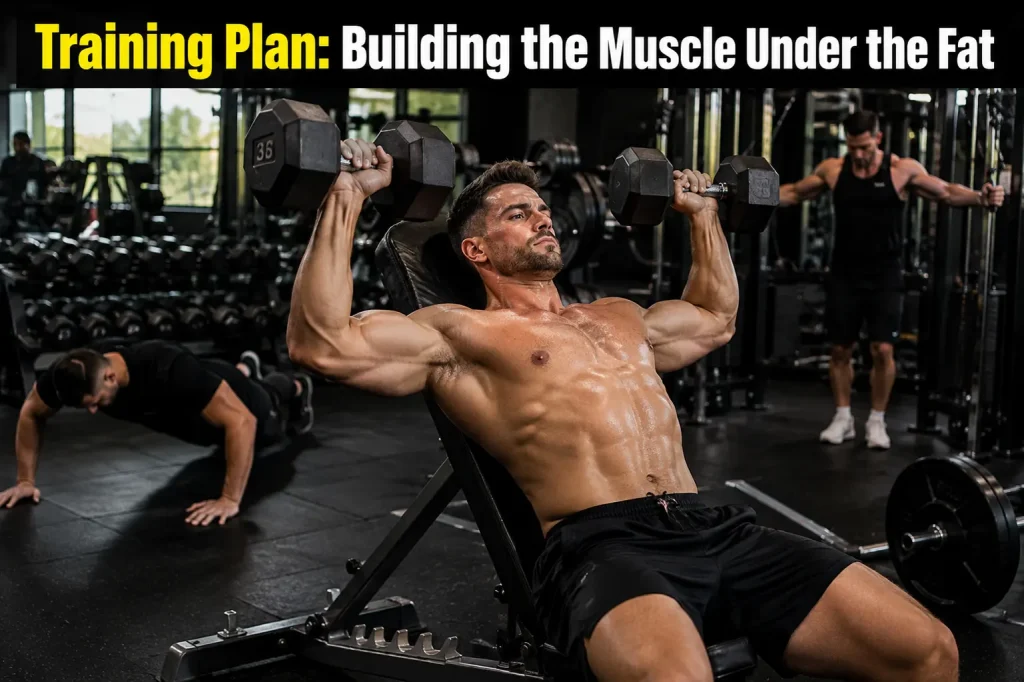
Doing endless push-ups will not “burn” chest fat directly, because you cannot choose where your body pulls energy from. What targeted training does do is build the pectoral muscle underneath, so as your overall body fat drops, the chest looks tighter, fuller, and more defined instead of just flatter and deflated.
Here’s a structure that has worked consistently for the people I’ve trained, not just a list of exercises:
- Frequency: Train chest directly 2 times per week, with 48 hours between sessions for recovery.
- Session A (Strength focus): – Barbell or dumbbell bench press: 4 sets of 6 to 8 reps – Incline dumbbell press: 3 sets of 8 to 10 reps – Weighted or assisted dips: 3 sets of 8 to 12 reps
- Session B (Hypertrophy and definition focus): – Cable or machine chest fly: 3 sets of 12 to 15 reps – Push-ups (feet elevated for extra challenge): 3 sets to near-failure – Cable crossover, low-to-high angle: 3 sets of 12 to 15 reps
- Progressive overload is non-negotiable. If you do the same weight and reps every week for two months, your chest has no reason to change shape. Add small increments in weight or reps every one to two weeks.
- Don’t skip your back. This is the part almost every guide leaves out. Weak upper-back muscles (rhomboids, rear delts, lower traps) let your shoulders round forward, which pushes your chest into that same droopy silhouette we covered in the postural sag section above. Two sets of face pulls or rows after every chest session fixes this over time.
Cardio: How Much, and Which Kind Actually Helps
Cardio’s job here isn’t to “melt” chest fat specifically. It’s to widen your daily calorie deficit without you having to starve yourself. Both approaches below work, and combining them tends to beat either one alone:
- Steady-state cardio: 150 to 300 minutes per week of brisk walking, cycling, or swimming at a pace where you can still hold a conversation.
- Interval training (HIIT): 2 sessions per week of 20 to 25 minutes, alternating 30-second hard efforts with 60 to 90 seconds of easy recovery.
If you’re short on time, prioritize daily walking over gym cardio. A simple habit like a 30-minute walk after dinner adds up to roughly 150 to 200 extra calories burned daily, which compounds fast over a month.
The Overlooked Levers: Sleep, Alcohol, and Hormones
This is the section most competitor content treats as an afterthought. In my experience, it’s often the deciding factor between someone who plateaus and someone who doesn’t.
- Sleep under 6 hours regularly raises cortisol and drops testosterone, both of which push your body toward storing fat in the chest and midsection rather than burning it. Aim for 7 to 9 hours, and treat it as part of the plan, not a bonus.
- Alcohol does double damage. It’s calorie-dense (7 calories per gram), and heavy or regular drinking measurably lowers testosterone while nudging estrogen up, which is exactly the hormonal direction that encourages chest fat storage. Cutting from daily drinking to twice a week alone has visibly changed clients’ chest composition within a month.
- Get a hormone panel if progress totally stalls. If you’ve trained hard and eaten right for three-plus months with zero change, ask your doctor about a basic panel checking testosterone, estradiol, and thyroid function (TSH). Conditions like hypothyroidism or low testosterone can quietly sabotage an otherwise perfect plan.
- Certain medications are chest-fat culprits. Some antidepressants, anti-androgens, and even certain blood pressure medications can promote fat or glandular tissue growth in the chest. If you started a new prescription around when you noticed changes, mention it to your prescriber rather than assuming it’s just diet.
What to Realistically Expect, Week by Week
Nobody gives you an honest timeline, so here’s one based on typical client progress:
| Timeframe | What Usually Happens |
|---|---|
| Week 1–2 | Mostly water weight shifts. Clothes fit slightly looser, but the chest usually looks about the same. |
| Week 3–4 | Visible fat reduction often starts around the waist first, while the chest typically lags behind. |
| Week 6–8 | The chest begins to look noticeably tighter, especially in photos taken under the same lighting conditions. |
| Week 10–12 | More definition appears beneath the nipple line, and the pectoral muscles become more visible when flexed. |
| Week 16+ | For most people, the chest catches up with the rest of the body’s fat loss, provided they maintain a consistent diet and training routine. |
Chest fat is genuinely one of the last areas to respond for most body types, so don’t judge your progress by your chest alone in the first month. Use a tape measure, progress photos, and how your shirts fit instead of just the mirror.
When Diet and Exercise Aren’t Enough: Medical Options
If you’ve been consistent for several months and the tissue is still firm, still centered around the nipple, or simply isn’t responding, it’s worth exploring clinical options rather than pushing harder on the same plan.
| Option | Best For | What It Involves | Recovery Time |
|---|---|---|---|
| Liposuction | Soft, diffuse chest fat that persists despite diet and exercise | Small incisions are made to suction out excess fat under local or general anesthesia | Light activity in 1–2 weeks; full recovery typically takes 4–6 weeks |
| Surgical Excision (Gland Removal) | True gynecomastia with firm glandular tissue | Removal of glandular tissue through a small incision, sometimes combined with liposuction | Usually 2–3 weeks; compression garment is required during recovery |
| Hormone Therapy | Gynecomastia caused by a diagnosed hormonal imbalance | Medication to correct the underlying testosterone-to-estrogen imbalance | Ongoing treatment monitored by an endocrinologist |
| Non-Invasive Fat Reduction (e.g., Cryolipolysis) | Mild, localized fat pockets in otherwise fit individuals | Controlled cooling gradually reduces fat cells over several weeks | No downtime; visible results typically appear within 8–12 weeks |
None of these are shortcuts around a bad diet. They’re tools for the specific cases diet and training genuinely can’t fix, mainly true gynecomastia or stubborn fat pockets in someone already at a healthy body fat percentage.
Common Mistakes That Quietly Stall Progress

- Chasing “chest fat burning” supplements or creams. There is no topical or oral product with credible evidence of spot-reducing chest fat. Save the money.
- Doing chest exercises daily. More isn’t better here. The muscle needs 48 hours to recover and rebuild; daily training without progression just adds fatigue.
- Ignoring posture correction. As covered earlier, a droopy-looking chest is sometimes a back and shoulder problem wearing a chest costume.
- Weighing yourself daily and getting discouraged. Weight fluctuates 1 to 2 kg daily from water and food volume alone. Weekly averages tell the real story.
- Quitting right before visible change. Based on the timeline above, weeks 4 to 6 are the most common point people give up, right before the chest typically starts catching up.
Frequently Asked Questions
Can you lose chest fat without losing fat everywhere else?
No. Spot reduction isn’t physiologically possible. Your body decides where to pull stored fat from based on genetics and hormones, not where you’re doing exercises. A full-body fat loss approach is what eventually reveals a leaner chest.
How long does it realistically take to see chest fat reduction?
Most people notice visible change starting around week 6 to 8, with clearer definition by week 12 to 16, assuming a consistent calorie deficit and regular training. Chest fat typically responds later than belly or facial fat.
Do chest fat burning pills, creams, or wraps actually work?
No credible clinical evidence supports any topical product or supplement for spot-reducing chest fat. Sweat wraps only cause temporary water loss, and fat-burning creams don’t penetrate deeply enough to affect fat cells.
Is it normal for one side of the chest to be fattier than the other?
Mild asymmetry is common and usually harmless, tied to dominant-hand muscle development or minor genetic variation. A sudden, one-sided, firm lump is different and warrants a medical check rather than assumption.
Will losing chest fat leave loose or saggy skin?
It can, especially with rapid weight loss or in older skin with less elastin. Losing fat gradually (0.5 to 1% of bodyweight per week), staying hydrated, and keeping up chest and back strength training all help skin retract better than crash dieting does.
Can women use the same approach to reduce chest fat?
The core principles, a calorie deficit, strength training, and cardio, apply to women too. The key difference is that breast tissue in women includes glandular and fatty components regulated by estrogen, so overall fat loss reduces the fatty portion, but breast size and shape are also strongly influenced by genetics and hormonal cycles that training cannot override.
What’s the fastest realistic way to reduce chest fat?
There’s no genuine 7 or 10-day fix for fat, only temporary water-weight tricks that don’t last. The fastest sustainable path is a firm but reasonable calorie deficit (500 calories a day), training chest and back twice weekly, daily walking, and consistent sleep, which typically shows first visible results within 3 to 4 weeks.
Conclusion
Reducing chest fat comes down to a handful of things done consistently rather than any single trick: a real calorie deficit, direct chest and back training twice a week, enough overall movement, decent sleep, and controlled alcohol intake. Chest tissue tends to respond slower than your waist or face, so judge progress over months, not days, and use measurements and photos rather than the mirror alone. If what you’re feeling is firm, one-sided, or painful rather than soft and even, treat that as a signal to see a doctor rather than push harder in the gym. For everyone else, the plan above, applied patiently, works.
You May Also Like It:
How to Reduce Heat in the Body