You’re holding a shawl. The seller says it’s Pashmina. It feels soft. The price sounds reasonable. But something in the back of your mind asks: how to identify if the pashmina shawl i am buying is genuine?
You are right to wonder. The global market is flooded with fake “Pashmina” — synthetic blends, viscose wraps, and wool-acrylic mixes that all carry the same label but deliver none of the warmth, softness, or heritage of the real thing. Fraudulent products account for an estimated 70–80% of shawls sold under the Pashmina label worldwide.
This guide gives you every test, trick, and insider fact you need to identify a genuine Pashmina shawl — whether you’re shopping in a store in Srinagar or browsing an online marketplace from your couch.
What Is Genuine Pashmina? (The Science Behind It)
Genuine Pashmina is made from the ultra-fine undercoat fiber of the Changthangi goat — a rare breed native to the high-altitude Changthang plateau in Ladakh, India, where temperatures plummet to −40°C (−40°F). The goat grows this incredibly fine inner layer to survive the brutal cold, and once a year, during spring, herders hand-comb it out during the natural shedding season.
This fiber — called pashm (Persian for “soft gold“) — is then hand-cleaned, hand-spun into yarn, and woven on traditional wooden looms by skilled Kashmiri artisans. A single shawl requires the fiber from 2–3 goats and up to 180 hours of skilled labor to complete. That is why the words “genuine” and “cheap” can never exist together for Pashmina.
The Fiber Science: Why Pashmina Feels Different
The amazing softness of real Pashmina is not just marketing — it is because of science.
- 12–16 microns – Pashmina fiber thickness
- 70 microns – Average human hair
- 18–24 microns – Regular wool
- About 180 hours are needed to hand-weave one shawl
Pashmina fibers are 4–6 times finer than human hair, so thin that machines cannot process them. That’s why they must be made by hand. Any fiber thicker than 19 microns is not considered real Pashmina.
Cashmere vs. Pashmina — Are They the Same?
This is one of the most common points of confusion — and sellers exploit it constantly. Here is the simple truth:
The Key Difference
All Pashmina is cashmere, but not all cashmere is Pashmina. “Cashmere” is a broad term for the undercoat of any cashmere goat. “Pashmina” refers specifically to the finest grade of cashmere (12–16 microns) from the Changthangi goat of Ladakh, hand-processed by Kashmiri artisans. Standard cashmere (16–19 microns) comes from China, Mongolia, or Iran and is machine-processed.
So when a seller says “it’s 100% cashmere” — that doesn’t automatically mean it’s Pashmina. Ask specifically about fiber diameter, origin, and production method. A genuine Pashmina will have clear answers. A fake one won’t.
7 Foolproof Tests to Identify Genuine Pashmina
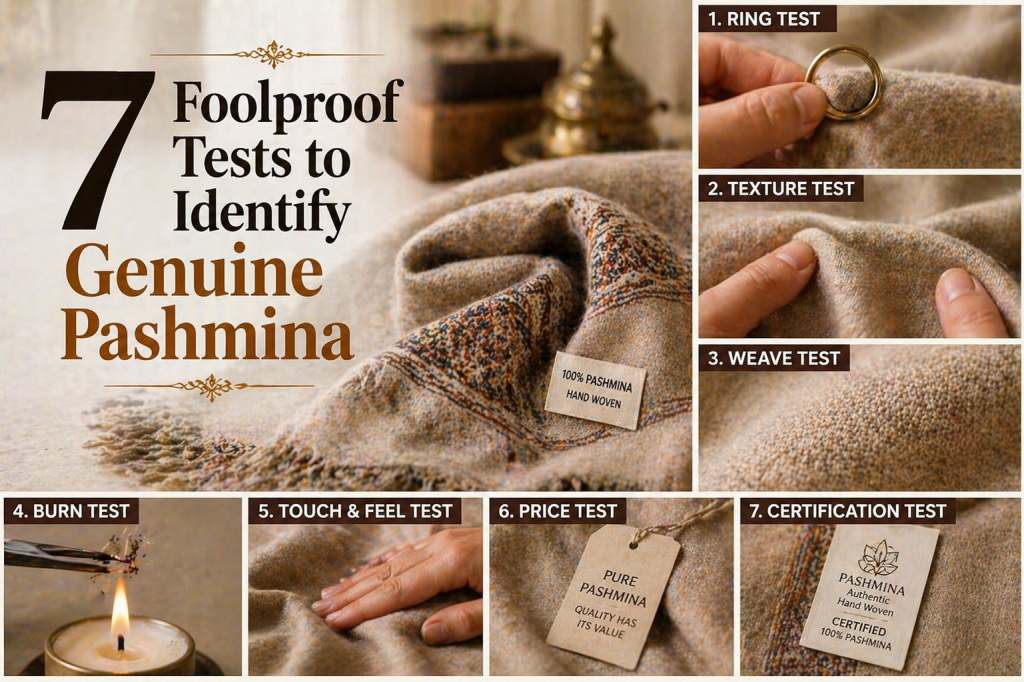
These tests have been used by artisans, buyers, and experts for generations. You don’t need a lab — just your hands, some basic observation, and five minutes.
The Touch Test
Hold the shawl and rub a small section between your fingers. Genuine Pashmina feels instantly warm, incredibly soft, and slightly textured — never slippery or synthetic. It warms your palm within seconds because fine natural fiber traps body heat. A synthetic or low-quality blend feels cool, smooth like silk, or plasticky.
The Ring Test
This is the most iconic Pashmina authentication test. Take a full-sized shawl and try to pass it through a finger ring. A genuine Pashmina is so finely woven and lightweight (typically 100–300g) that it glides through a standard ring without resistance. A synthetic shawl or a heavy wool blend will bunch, snag, or simply not fit through at all.
The Burn Test
Pull a single thread from the fringe. Hold it with tweezers over a non-flammable surface and light it. Genuine Pashmina burns like human hair — it burns slowly, smells like burnt hair or keratin, and leaves a soft, crushable ash. Synthetic fibers melt, curl away from the flame, drip, produce acrid plastic fumes, and leave hard, black, bead-like residue. If a seller refuses this test, that tells you everything.
The Pilling Test
Rub a small area of the shawl firmly with your palm for 30–60 seconds. Genuine Pashmina will form tiny, soft pills (fiber balls) on its surface — this is normal and expected with pure natural protein fibers, especially after the first few uses. It is actually a positive sign. Synthetic fabrics may pill too, but their pills are hard and don’t brush off; low-quality blends may show no pilling at all initially but deteriorate unevenly later.
The Stretch Test
Gently stretch a small section of the fabric and release it. Authentic Pashmina springs back to its original shape due to the natural elasticity of protein fibers. Synthetic fabrics tend to stay deformed or recover unevenly. If the fabric looks distorted after a simple stretch, it is almost certainly not genuine Pashmina.
The Weave Inspection
Hold the shawl up to a light source and examine the weave closely. Handwoven Pashmina shows subtle, beautiful irregularities — tiny variations in thread thickness, minor tension differences, and slight unevenness in spacing. These imperfections are marks of human artistry. A machine-made fake has robotic precision: perfectly uniform threads, identical spacing, and a weave that repeats like a printed pattern.
The Fringe Test
Examine the fringe carefully. On a genuine Pashmina, the fringe threads are extensions of the warp threads of the shawl itself — they emerge directly from the body of the fabric. Each fringe strand is hand-knotted, slightly uneven in length, and made of the same fiber. On a fake, fringes are often a different material, sewn or glued on as an afterthought. Look for stitching lines where the fringe attaches — that is an immediate red flag.
Important Note on the Burn Test
Only perform the burn test in a safe environment with proper ventilation. Ask the seller’s permission first. A legitimate seller selling genuine Pashmina will almost always agree — because they know it will pass. A seller who refuses without reason is raising a red flag about their product’s authenticity.
Real vs. Fake Pashmina: Full Comparison Table
Use this at-a-glance table when you’re in the store and need quick answers.
| Feature | Genuine Pashmina | Fake / Synthetic |
|---|---|---|
| Fiber Origin | Changthangi goat undercoat, Ladakh | Acrylic, viscose, wool, or synthetic blend |
| Fiber Diameter | 12–16 microns | 18 microns and above |
| Touch / Feel | Warm, soft, slightly textured | Slippery, cool, or rough |
| Ring Test | Passes easily through a finger ring | Bunches or cannot pass through |
| Burn Test | Smells like burnt hair; crushable ash | Melts, acrid smell, hard beads left |
| Pilling | Soft, brushable pills initially | Hard pills or no pilling, then rapid wear |
| Weave | Slight handwoven irregularities | Machine-perfect, robotic uniformity |
| Weight | Feather-light: 100–300g per shawl | Heavier or awkwardly light (very thin synthetics) |
| Warmth | Warms immediately, non-bulky | Stays cool, heavy, or too thin |
| Fringe | Extension of warp threads; hand-knotted | Stitched or glued on separately |
| Label | “100% Pure Pashmina” + GI certification | “Pashmina blend,” “art silk,” or vague terms |
| Price (USD) | $90 and above for a plain stole | Under $30 — always a red flag |
| Care Instructions | Dry clean only / hand wash cold, gentle | Machine washable — synthetic fibers only |
| Certification | GI Tag (GI No. 46), certificate of origin | No certification or vague documentation |
Types of Authentic Pashmina You Should Know
Not all genuine Pashmina shawls look the same. Authentic Pashmina comes in several distinct styles, each with its own craft tradition and price point. Knowing the difference also helps you verify authenticity — because a Kani weave, for example, cannot be faked cheaply.
Plain Pashmina
The purest form — no embroidery, no pattern. The beauty lies entirely in the softness and drape of the fiber. Available in solid colors or natural undyed shades.
Sozni Work
Intricate needle-point hand embroidery using silk thread on Pashmina. The back of the embroidery looks almost identical to the front — a hallmark of genuine Sozni work vs. machine embroidery.
Kani Pashmina
The rarest and most labor-intensive. Patterns are woven directly into the fabric using wooden twigs (kanis). No embroidery — the design is structural. A single Kani shawl can take 6–18 months to complete.
Ombré Pashmina
Features a color gradient effect achieved through hand-dyeing techniques. Authentic ombré Pashmina has soft, organic color transitions — not sharp digital-looking gradients found on synthetic prints.
Block-Printed Pashmina
Hand block-printed with natural or vegetable dyes. Each print has slight variations in ink pressure and placement — the beautiful signature of handmade production.
Jamawar Pashmina
A woven brocade pattern using multiple colors of yarn, inspired by Persian Jamawar tradition. Heavier than plain Pashmina but still distinctly warm and soft.
What Does Genuine Pashmina Actually Cost?
Price is one of the most reliable authenticity indicators — because authentic Pashmina simply cannot be made cheaply. The combination of rare fiber, hand-processing, and artisan labor means that no legitimate producer can offer genuine Pashmina at bargain prices without losing money.
- Plain Stole: $90 – $180
- Embroidered Shawl: $200 – $600
- Kani Woven: $800 – $2,500+
- Sozni Masterpiece: $1,200 – $4,000+
The “$25 Pashmina” Rule
If you see a “Pashmina shawl” priced under $40–$50 USD, it is not genuine Pashmina. Full stop. It is physically impossible to source Changthangi fiber, hand-spin it, hand-weave it, finish it, and sell it at that price with any margin. You are buying synthetic fiber with a luxury label.
Extremely high prices alone don’t guarantee authenticity either. Always combine price assessment with the physical tests described above and request proper certification.
How to Identify Genuine Pashmina When Buying Online
Buying Pashmina online is convenient, but it removes your ability to touch, burn, and physically test the shawl. Here is how to protect yourself as an online buyer — something most other guides completely ignore.
- Request a close-up video or macro photo of the weave. Ask the seller to send an unedited close-up. A genuine handwoven Pashmina will show slight irregularities in the weave under a macro shot. Machine-made fabrics look perfectly uniform even at extreme close-ups.
- Ask for the GI Tag photo. Request a clear photo of the Geographical Indication (GI No. 46) certificate or tag that accompanies the product. Genuine Indian Pashmina producers can provide this; fake sellers typically cannot.
- Check the fiber content declaration on the product page. Look for “100% Pure Pashmina” or “100% Cashmere Pashmina.” Any product listed as “Pashmina blend,” “Pashmina-style,” or “cashmere-like” is not genuine. The product description should include fiber origin and micron count if available.
- Review seller history and certifications. Look for sellers with verifiable Kashmir or Ladakh roots, years of history, and traceable artisan partnerships. Avoid anonymous marketplace sellers with no background information.
- Look at customer review photos critically. Brand photos are professionally styled. Real customer photos show how the shawl actually looks, drapes, and ages. Look for reviewers mentioning softness, pilling, and longevity — not just aesthetics.
- Ask about their return policy explicitly. A brand confident in their product’s authenticity will offer clear, fair returns. Vague or no-return policies on luxury goods are a warning sign.
- Test on arrival using the burn, ring, and pilling tests. Even after buying online, verify the product the moment it arrives. If it fails any test, exercise your return rights immediately.
“The hand never lies. A genuine Pashmina speaks to you the moment your skin meets the fiber — a warmth, a give, a softness that no machine can replicate. Learn to listen to that conversation.”
— Kashmiri master weaver, as shared with textile researchers documenting traditional craft
10 Red Flags That Scream “Fake!”
Memorize this list before you shop. These are universal warning signs regardless of where you’re buying.
- Price under $50 USD for a full-sized shawl — genuine Pashmina cannot exist at that price.
- Label says “Pashmina blend,” “art silk,” or “viscose” — these are direct confessions of inauthenticity.
- “Machine washable” care instructions — genuine Pashmina protein fibers require dry cleaning or very gentle hand washing, not machine washing.
- Shiny, silky surface — real Pashmina has a soft matte warmth; high sheen indicates synthetic fibers like viscose or polyester.
- Perfectly uniform weave with zero irregularities — mechanically woven and therefore not handwoven Pashmina.
- Fringe stitched on separately — look at the base of the fringe; if there’s a seam or different-colored thread, the fringe was attached, not woven.
- Seller refuses the burn test — a seller confident in genuine Pashmina welcomes verification.
- No fiber origin information whatsoever — genuine sellers know and will share exactly where their fiber comes from.
- Vague claims like “pure softness” or “Himalayan luxury” without specific fiber details, micron count, or GI certification.
- Synthetic smell or chemical odor — genuine Pashmina may have a very faint natural lanolin or wool-like scent, never a chemical or synthetic one.
How to Care for Your Genuine Pashmina
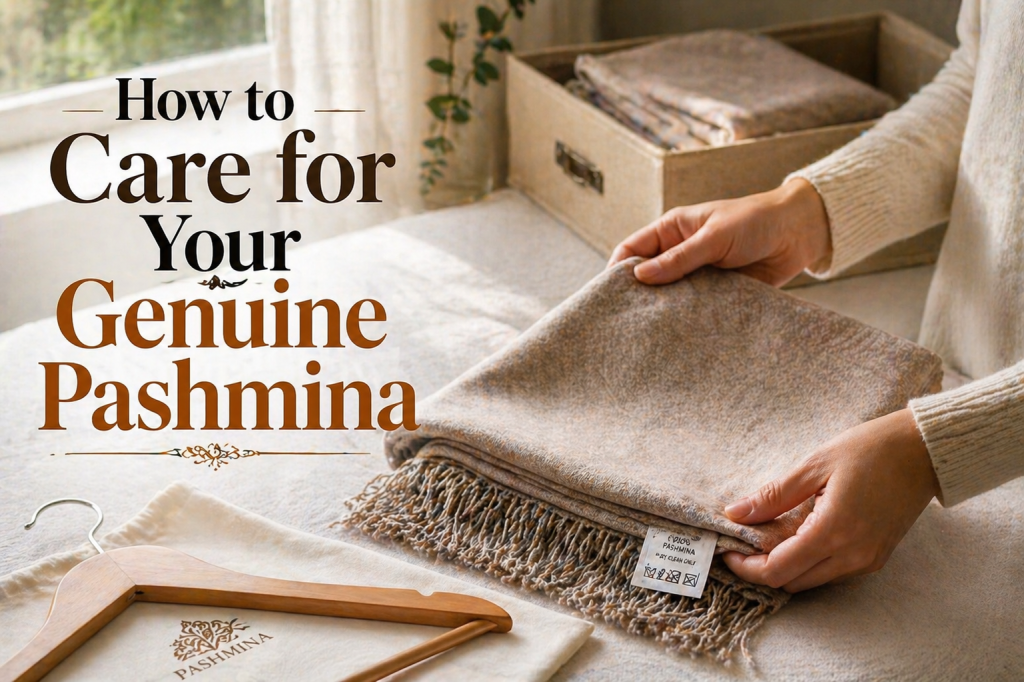
Once you have invested in a genuine Pashmina, protecting it properly ensures it lasts decades and becomes softer with age. Genuine Pashmina is surprisingly resilient when cared for correctly.
Washing
- Dry clean with a professional who understands delicate natural fibers
- Or hand wash in cold water with a tiny amount of baby shampoo or cashmere-specific detergent
- Gently press water out — never wring or twist
- Lay flat on a clean towel to dry, reshaping gently while damp
- Never machine wash — the agitation destroys the fine fibers permanently
- Never tumble dry — heat and friction felt the fibers irreversibly
- Never hang to dry — wet Pashmina is heavy and will stretch out of shape
- Avoid bleach, fabric softener, or harsh detergents
Storage
- Fold and store flat in a breathable cotton or muslin bag (not plastic)
- Use natural cedar blocks or lavender sachets to deter moths — they repel without damaging fibers
- Store in a cool, dry, dark place away from humidity and direct light
- Clean before storing for a season — food or perfume residue attracts moths
Pilling — Don’t Panic
Your new Pashmina will likely pill in the first few uses. This is normal and expected with genuine fiber — it is the shorter fibers working their way out. Gently remove pills with a cashmere comb or soft sweater stone. Over time, pilling naturally reduces, and the shawl becomes smoother and even softer with each wash.
Pashmina Gets Better With Age
Unlike synthetic fabrics that degrade and look cheap after a few seasons, a well-cared-for genuine Pashmina becomes noticeably softer and more lustrous over years. Many families pass authentic Pashmina shawls down through generations — they are genuine heirlooms, not fast fashion.
Frequently Asked Questions
Is all Pashmina from India?
Genuine Pashmina fiber comes from the Changthangi goats of Ladakh, India. However, the term “cashmere” is also applied to similar fiber from goats in China, Mongolia, and Iran. True Kashmiri Pashmina — hand-spun and hand-woven by artisans in the Kashmir Valley — carries India’s Geographical Indication (GI) tag and is considered the gold standard.
Can the ring test fail on a genuine Pashmina?
Yes — very thick or embroidered genuine Pashmina shawls may not pass through a standard ring, simply due to their construction (Kani or Jamawar weaves add significant bulk). The ring test works best for plain or lightly worked shawls. Always combine it with other tests rather than relying on it alone.
What is a GI Tag and do I need it?
A Geographical Indication (GI) Tag is a government-issued certification (GI No. 46 for Kashmir Pashmina) that confirms the product meets strict standards for fiber origin and production method. It includes a unique serial number and official documentation. While not every genuine artisan-made piece will have it — especially older or smaller workshop pieces — asking for it when buying from a commercial seller is a reasonable and important step.
My pashmina is pilling – is fake?
Pilling in the first few uses is actually a positive sign for genuine Pashmina, not a negative one. It is the short fibers working their way to the surface. Gently remove pills with a cashmere comb. After a few washes, pilling significantly reduces. Synthetic blends that pill have hard, permanent balls that don’t brush off — that is the version to worry about.
Can I wish my genuine Pashmina at home?
Yes, with extreme care. Use cold water, a capful of baby shampoo or cashmere wash, and gently submerge the shawl without rubbing. Rinse carefully, press (never wring) out the water, and lay flat on a clean towel to air dry. Never machine wash, tumble dry, or hang while wet. When in doubt, dry clean.
Is “Pashmina blend” ever acceptable?
It depends on what’s being blended. Pashmina/silk blends (typically 70% Pashmina, 30% silk) are a legitimate traditional combination that adds sheen and durability — but they should be clearly labeled as such and priced accordingly. However, “Pashmina blend” that includes wool, acrylic, viscose, or polyester is misleading marketing. A pure silk-blend with genuine Pashmina is different from a synthetic blend trying to pass off as pure Pashmina.
How long does a genuine Pashmina last?
A well-cared-for genuine Pashmina lasts decades. Many authentic pieces are passed down as family heirlooms and retain their softness and warmth for generations. The fiber actually becomes softer with proper use and washing over time — unlike synthetic fabrics that degrade and look worn within a few seasons.
Quick Summary
- It passes through a finger ring without bunching (Ring Test)
- It burns slowly, smells like hair, and leaves crushable ash (Burn Test)
- It feels warm, soft, and slightly textured — never slippery (Touch Test)
- It springs back after being gently stretched (Stretch Test)
- It shows slight, beautiful irregularities in the handwoven weave (Weave Test)
- It forms soft, brushable pills initially (Pilling Test)
- Its fringe threads are extensions of the body, not stitched on (Fringe Test)
- It is priced above $90 USD and comes with GI certification
- Its label clearly states “100% Pure Pashmina” with fiber origin details
You May Also Like It: