
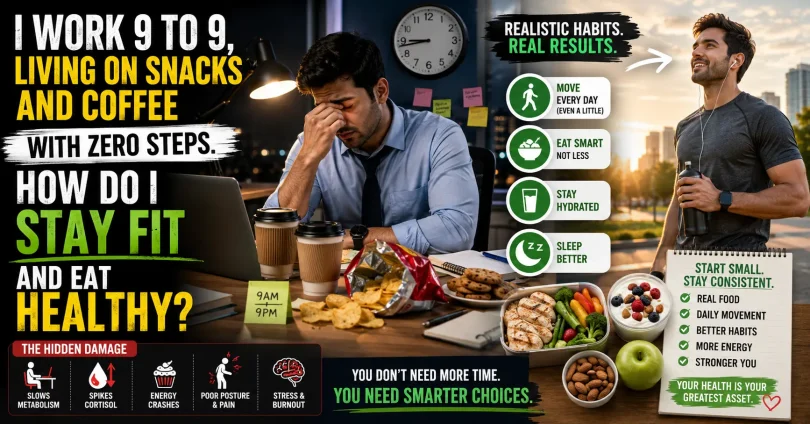
I Work 9 to 9 on Snacks and Coffee:
You wake up at 7 AM, rush to your desk by 9, and before you know it, the clock reads 9 PM. In between, you have consumed three cups of coffee, a packet of biscuits, some chips from a colleague’s desk, and maybe one rushed meal at your workstation. Sound familiar?
You are not lazy. You are not careless. You are simply overwhelmed by a schedule that leaves no room for anything else. And if you are wondering how to stay fit and eat healthy when you work 9 to 9 living on snacks and coffee with zero steps, you have landed on the right page.
This is not another article telling you to meal prep on Sundays or wake up at 5 AM. This is a realistic, honest, and practical guide built specifically for people who work extremely long hours and need health solutions that fit inside a packed day, not around it.
Why Your 9-to-9 Lifestyle Is Silently Wrecking Your Health
Before we fix the problem, you need to understand exactly what is going wrong inside your body during a 12-hour workday with no movement and poor food choices.
Your Metabolism Slows Down Without Movement
When you sit for hours without moving, your body significantly reduces a process called Non-Exercise Activity Thermogenesis, or NEAT. NEAT refers to all the calories your body burns through everyday movements like walking, standing, fidgeting, and climbing stairs. Research shows that NEAT can account for up to 350 calories or more in daily energy expenditure. When you eliminate all of that movement, your metabolic rate drops, fat storage increases, and weight gain follows even when you are not eating that much.
Coffee on an Empty Stomach Spikes Cortisol
Most 9-to-9 professionals start their morning with coffee before eating anything. The problem is that drinking caffeine on an empty stomach triggers a surge in cortisol, your body’s primary stress hormone. High cortisol over time leads to increased belly fat, blood sugar crashes, poor sleep, and heightened anxiety. Your morning coffee habit may feel like a lifeline, but without food underneath it, it is quietly damaging your hormonal health.
Snacking on Processed Foods Causes Energy Crashes
Biscuits, chips, packaged cookies, and vending machine snacks are high in refined carbohydrates and sugar. They give you a quick spike in blood sugar followed by a sharp crash, which is why you feel sleepy and unfocused after snacking. This cycle repeats throughout the day, leaving you perpetually tired and reaching for more caffeine to compensate.
Prolonged Sitting Damages Circulation and Posture
Sitting for eight or more hours daily causes blood to pool in the lower limbs, reduces arterial flow, and increases the risk of deep vein thrombosis over time. It also leads to tight hip flexors, weakened glutes, rounded shoulders, and chronic back and neck pain. These are not age-related problems. They are lifestyle-related problems, and they begin much earlier than most people expect.
Mental Health Takes a Hit Too
Lack of physical movement directly affects brain chemistry. Exercise naturally releases serotonin, dopamine, and endorphins, which regulate mood and reduce stress. Without any form of movement, these chemicals drop, making you more prone to anxiety, irritability, and burnout. If you have been feeling emotionally drained at the end of your workday, your sedentary routine is partly responsible.
The Mindset Shift You Need Before Anything Else
Most people try to fix their health using the same all-or-nothing thinking that has already failed them. They say they will start going to the gym, eat clean, and sleep eight hours. Then one busy week hits and the entire plan collapses.
The approach that actually works for 9-to-9 professionals is different. It is built on three principles:
- Small and consistent beats intense and occasional.
- You do not need to change everything. You just need to improve a few key things.
- The goal is not perfection. The goal is to stop the damage and build momentum.
Once you accept this, the following strategies become genuinely manageable.
How to Fix Your Eating Without Cooking or Meal Prepping
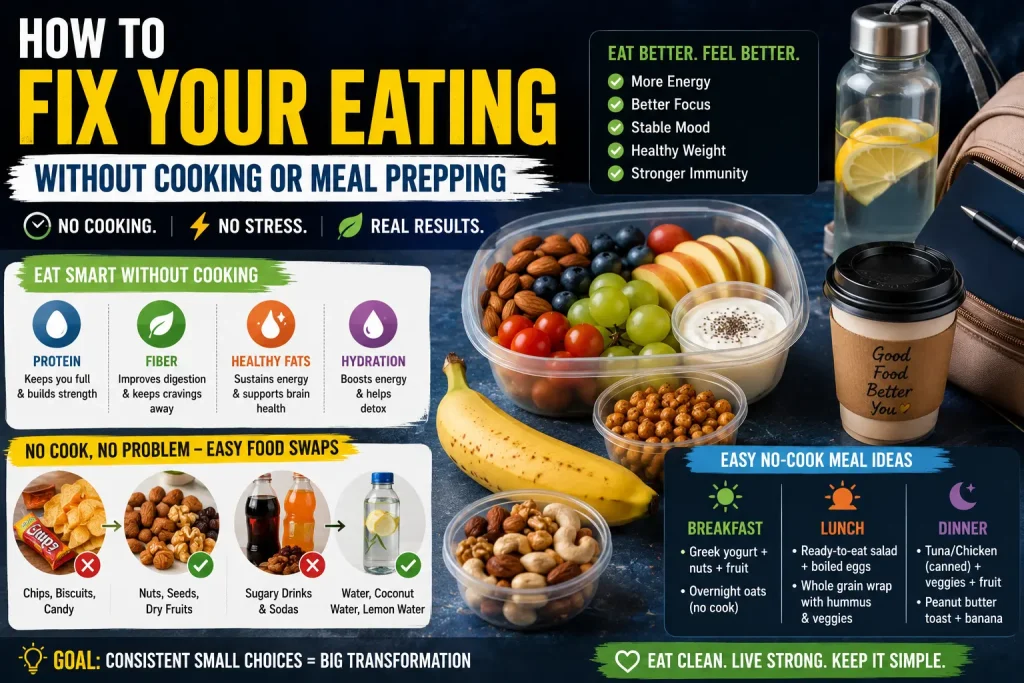
Food is the foundation. If your eating is chaotic, no amount of stretching or walking will fully compensate. Here is how to eat better within the reality of your current lifestyle.
Start with a Real Breakfast Before Coffee
This is the single highest-impact change you can make. Eating something with protein and healthy fat before your first coffee will stabilize your blood sugar, reduce cortisol, prevent mid-morning energy crashes, and dramatically reduce cravings throughout the day.
You do not need to cook. Here are no-cook, five-minute breakfasts that work:
- Greek yogurt with a handful of mixed nuts and a banana
- Two boiled eggs with whole grain toast, prepared the night before in eight minutes
- A peanut butter and banana sandwich on multigrain bread
- Overnight oats mixed the night before in a jar with milk, chia seeds, and honey
- A protein smoothie with milk, banana, peanut butter, and oats blended in two minutes
Understand the Three Nutrients That Keep You Full and Energized
You do not need to count calories or follow a rigid diet. You just need to make sure every meal contains at least two of these three pillars:
| Nutrient | Food Sources | Why It Matters |
| Protein | Chicken, eggs, lentils, paneer, Greek yogurt, tofu, fish | Keeps you full, preserves muscle, prevents cravings |
| Fiber | Vegetables, fruits, whole grains, legumes, nuts, seeds | Slows digestion, stabilizes blood sugar, supports gut health |
| Healthy Fat | Nuts, avocado, olive oil, seeds, fatty fish | Sustains energy, reduces inflammation, supports brain health |
A Realistic Daily Eating Plan for a 9-to-9 Professional
This plan does not require cooking skills. Every option can be ordered from a canteen, food app, or assembled in five minutes at home.
| Time | What to Eat |
| 7:00 AM – Breakfast | Greek yogurt with nuts OR boiled eggs with toast OR protein smoothie |
| 10:00 AM – Mid-Morning | A handful of almonds or walnuts, one fruit, or a small portion of roasted chana |
| 1:00 PM – Lunch | Dal rice or roti with sabzi and curd OR grilled chicken with salad and bread |
| 4:00 PM – Evening Snack | Roasted makhana, a boiled egg, peanut butter on a rice cake, or fruit with cheese |
| 7:30 PM – Dinner | Khichdi with vegetables OR a light sabzi with roti OR a protein-rich bowl with rice |
| Post-Dinner | A glass of warm milk with turmeric, or chamomile tea to support sleep |
How to Order Healthier on Food Delivery Apps
Competitors did not cover this, and it matters enormously because 9-to-9 professionals frequently rely on Zomato, Swiggy, or similar apps. Here is how to order smarter:
- Choose dal, sabzi, and roti over biryani or fried items for lunch.
- Add a salad or raita to your order whenever it is an option.
- Opt for grilled or tandoori protein over fried versions.
- When ordering fast food, go for a wrap or bowl with protein rather than a burger with fries.
- Avoid deep-fried starters. Order soups or salads if you want a starter.
- Replace sweet lassi with plain lassi or chaas.
How to Handle Coffee Without Destroying Your Health
You do not have to quit coffee. You just need to drink it smarter. Here is a framework that works:
- Never drink coffee on an empty stomach. Eat first, even if it is just a handful of nuts.
- Limit yourself to two cups per day, one in the morning after breakfast and one before 2 PM.
- Avoid coffee after 2 PM because caffeine has a half-life of five to six hours and will disrupt your sleep even if you fall asleep without trouble.
- Switch your third or fourth cup to green tea, which has lower caffeine and high antioxidants.
- If you use coffee for energy at 4 PM, replace it with a protein-rich snack and a ten-minute walk instead.
Hydration Is a Hidden Energy Booster
Dehydration is one of the most overlooked causes of fatigue, brain fog, and poor concentration at work. Most professionals are mildly dehydrated throughout the day and do not realize it. Here is how to fix this without thinking about it:
- Keep a large one-liter water bottle on your desk and refill it at least twice daily.
- Drink one glass of water before every meal and snack.
- Set a phone reminder every 90 minutes to take a few sips.
- Herbal teas, nimbu pani without sugar, and coconut water all count toward your hydration.
- If your urine is pale yellow, you are hydrated. If it is dark, drink more water immediately.
How to Move More When You Have Zero Time or Energy for the Gym
The good news is that you do not need a gym membership, workout clothes, or a single dedicated workout session to significantly improve your physical health. What you need is to understand the power of micromovement and incorporate it strategically throughout your day.
The Concept of Micromovement: Your Secret Weapon
Research consistently shows that breaking up sitting time with short bouts of movement, even as little as two to three minutes every hour, produces measurable improvements in blood sugar regulation, circulation, and energy levels. These small breaks compound over time into significant health benefits.
You do not need to sweat. You just need to move.
Desk Exercises You Can Do Without Anyone Noticing
These exercises require no equipment, no change of clothes, and no more than two to five minutes:
| Exercise | How to Do It | Recommended Reps |
| Seated Leg Raises | Lift one leg at a time under your desk | 2 sets of 15 reps each leg |
| Desk Push-Ups | Place hands on desk edge and do push-ups | 3 sets of 10 reps |
| Shoulder Rolls | Roll shoulders backward slowly | 10 repetitions twice a day |
| Neck Stretches | Tilt head side to side and hold for 5 seconds | 3 reps each side, twice daily |
| Calf Raises | Stand and rise onto your toes repeatedly | 3 sets of 20 reps |
| Seated Spinal Twist | Rotate your upper body left and right while seated | 5 reps each side |
| Glute Squeezes | Squeeze glute muscles while seated and hold for 5 seconds | 10 reps, 3 times a day |
The Every-Hour Rule
Set a timer on your phone or computer to alert you every 60 minutes. When it goes off, do one of the following:
- Stand up and walk to get water.
- Walk to a colleague’s desk instead of sending a message.
- Do ten desk push-ups or twenty calf raises.
- Walk to the bathroom that is farthest from your desk.
- Stand and stretch for two minutes.
That is five to ten minutes of movement per hour. Over a 12-hour day, that adds up to 60 to 120 minutes of activity without a single dedicated workout session.
The Power of Walking: Turning Dead Time Into Active Time
You probably have more walking opportunities than you realize. Here is how to find them:
- Walk during phone calls. Put your phone on speaker and walk around your office or home.
- Take the stairs instead of the elevator every single time.
- Get off your commute one stop early and walk the remaining distance.
- Walk to lunch instead of ordering delivery when possible.
- Take a ten-minute walk after dinner. This one habit alone has been shown to significantly reduce post-meal blood sugar spikes.
Aim for 4,000 steps as your initial target. This is achievable even for a desk-bound professional. Once you reach that consistently, push toward 6,000 and eventually 8,000.
The 10-Minute Morning Routine That Changes Everything
Competitors barely mentioned morning movement. This ten-minute routine, done before you sit at your desk, activates your metabolism, improves circulation, reduces cortisol, and genuinely changes how your entire day feels:
- Minute 1 to 2: Joint rotations starting from neck, shoulders, wrists, hips, knees, and ankles
- Minute 3 to 4: Twenty bodyweight squats
- Minute 5 to 6: Ten push-ups or modified push-ups on knees
- Minute 7 to 8: Plank hold for thirty seconds, rest, repeat
- Minute 9 to 10: Full body stretch focusing on chest, hip flexors, and hamstrings
That is it. No gym, no equipment, no shower required. Just ten minutes before you open your laptop.
Evening Wind-Down Movement
Even after a 12-hour day, your body benefits from gentle movement in the evening. This does not mean a workout. It means:
- A ten to fifteen-minute walk after dinner to improve digestion and reduce blood sugar.
- Five minutes of light yoga or stretching before bed to decompress the spine and calm the nervous system.
- Foam rolling your back and hips if you have a foam roller. This alone can eliminate most of the back pain caused by prolonged sitting.
Sleep, Stress, and Recovery – The Missing Piece Nobody Talks About
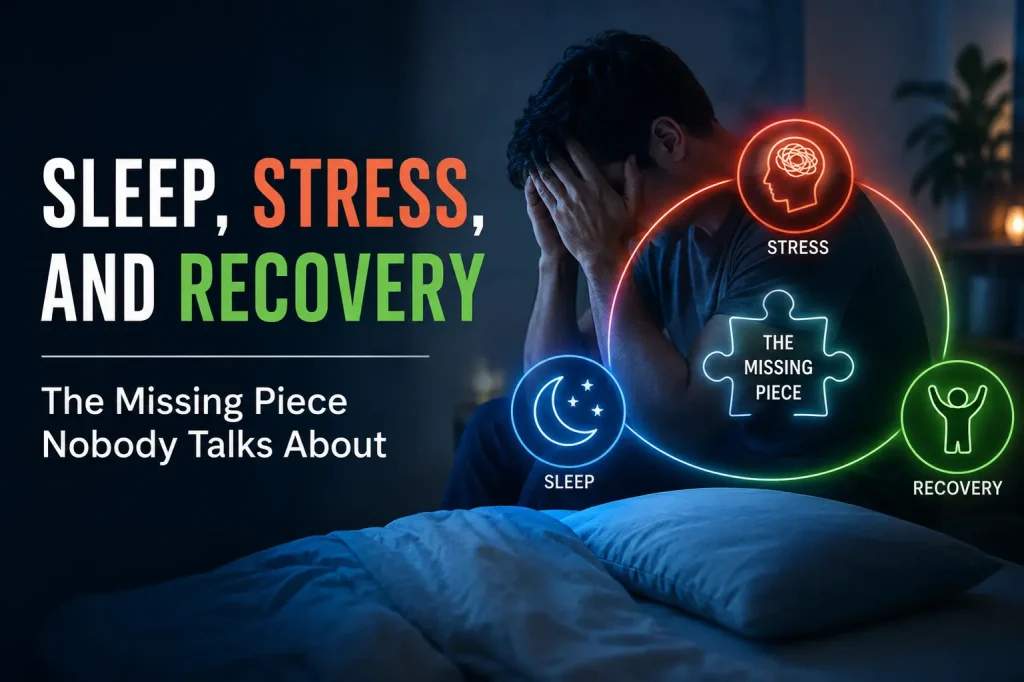
Every competitor article focused on food and movement. Almost none of them addressed what is arguably the most critical factor for a 9-to-9 professional: sleep and stress management. Without this, every other effort becomes significantly less effective.
Why Sleep Is Your Most Powerful Fat-Loss and Health Tool
When you sleep less than seven hours, your body produces more ghrelin, which is the hunger hormone, and less leptin, which is the satiety hormone. The practical result is that you feel hungrier the next day, crave more sugar and refined carbohydrates, and have far less willpower to make good food choices. Poor sleep also elevates cortisol, reduces muscle recovery, and impairs cognitive function.
If you are sleeping five or six hours and wondering why you cannot lose weight despite eating reasonably, inadequate sleep is likely a major contributing factor.
How to Improve Sleep Quality Even When You Work Late
- Avoid screens for at least 30 minutes before bed. The blue light from your phone and laptop suppresses melatonin production.
- Keep your bedroom cool and dark. Your body needs a slight temperature drop to initiate deep sleep.
- Avoid eating a heavy meal within two hours of your bedtime.
- Avoid caffeine after 2 PM. Even if you fall asleep, caffeine prevents deep, restorative sleep.
- Establish a consistent sleep and wake time, even on weekends. Your circadian rhythm thrives on consistency.
- Use a sleep tracking app or wearable to identify your actual sleep quality, not just duration.
Managing Stress to Prevent Cortisol-Driven Weight Gain
Chronic work stress directly causes fat storage, particularly around the abdomen. This is a hormonal response, not a character flaw. Here is how to manage it practically:
- Practice five deep breaths before any high-pressure meeting or stressful situation. This activates the parasympathetic nervous system and reduces cortisol within minutes.
- Take a genuine lunch break away from your screen, even if it is only 20 minutes. Eating while stressed impairs digestion significantly.
- Journaling for five minutes at the end of your workday creates a mental boundary between work stress and personal time.
- Progressive muscle relaxation before bed involves tensing and releasing each muscle group and is one of the most evidence-backed techniques for stress reduction.
- If work stress is chronic, consider speaking with a professional counselor or therapist. Your health is a legitimate reason to seek support.
The Weekend Reset Strategy
No other competitor article included this. The weekend is not a reward for surviving the week. It is a strategic recovery and preparation window that makes the next week significantly easier.
Saturday: Movement and Meal Preparation
- Get a longer walk of 30 to 45 minutes in the morning or evening.
- Cook or prepare two to three staple items in bulk: a pot of dal, a batch of boiled eggs, a container of mixed nuts and dried fruit, and a grain like quinoa or brown rice.
- Wash and store vegetables so they are ready to grab and eat through the week.
- Stock your pantry with healthy grab-and-go snacks: almonds, walnuts, roasted chickpeas, whole grain crackers, and dark chocolate above 70 percent cocoa.
Sunday: Rest, Recovery, and Mindset
- Sleep slightly longer to compensate for any sleep debt from the week.
- Do a gentle yoga session or a swim if accessible. Focus on recovery movement, not intensity.
- Review your upcoming week and identify where you can insert short walks, when to eat, and which meals you will order versus prepare.
- Spend 10 minutes writing down three health intentions for the week ahead. This simple practice dramatically improves follow-through.
Supplements Worth Considering for 9-to-9 Professionals
This section is not present in any of the competitor articles. While food should always come first, certain supplements are genuinely useful for professionals who cannot maintain a perfect diet. Always consult a physician before starting any supplement.
| Supplement | Why It Matters for 9-to-9 Professionals | Key Benefits |
| Vitamin D3 | Most desk workers are severely deficient due to minimal sun exposure | Supports immunity, mood, bone health, and hormonal balance |
| Magnesium Glycinate | Stress depletes magnesium rapidly | Improves sleep quality, reduces muscle tension, supports energy production |
| Omega-3 Fatty Acids | Rarely obtained through a typical snack-based diet | Reduces inflammation, supports heart and brain health |
| Whey or Plant Protein | Protein intake often falls short for busy professionals | Supports muscle retention and satiety between meals |
| Probiotic | Processed snacks damage gut microbiome over time | Improves digestion, immunity, and nutrient absorption |
| Ashwagandha | Clinically proven adaptogen | Reduces cortisol, improves stress resilience and sleep quality |
Habit Stacking – The Framework That Makes Everything Stick
This is a concept competitors did not address, yet it is one of the most powerful tools for building lasting health habits inside a packed schedule.
Habit stacking means attaching a new healthy behavior to an existing routine you already do without thinking. Because the existing habit is already automatic, it anchors the new behavior and makes it far easier to maintain.
| Existing Habit | Stack This New Habit Onto It | Why It Works |
| Making morning coffee | Eat a handful of nuts first, then make coffee | Prevents cortisol spike from coffee on empty stomach |
| Morning toilet visit | Follow it with a 10-minute movement routine | Builds exercise habit without extra planning |
| Opening your laptop to start work | Fill your water bottle first and place it on the desk | Guarantees morning hydration |
| Lunch break | Walk for 5 minutes before sitting down to eat | Adds steps and activates digestion |
| Joining a phone call | Stand up and walk slowly for the call duration | Turns idle time into active time |
| Finishing your last work task | Do 5 minutes of stretching before closing the laptop | Creates a healthy work-shutdown ritual |
| Getting into bed | Do 3 minutes of deep breathing or a brief body scan | Improves sleep onset and quality |
A Sample Full Day for a 9-to-9 Professional (Hour by Hour)
No competitor article provided an hour-by-hour breakdown. This is exactly what a busy professional needs.
| Time | Action |
| 6:45 AM | Wake up. Drink a glass of water immediately. |
| 6:50 AM | 10-minute morning movement routine (squats, push-ups, stretches). |
| 7:00 AM | Eat breakfast with protein. Then have your first coffee. |
| 7:30 AM | Leave for work or settle at your desk. |
| 9:00 AM | Start work. Bottle of water on your desk. |
| 10:00 AM | First hourly movement break. Stand, stretch, walk to water cooler. |
| 10:15 AM | Healthy mid-morning snack: nuts, fruit, or roasted chana. |
| 11:00 AM | Second hourly break. Ten desk push-ups or calf raises. |
| 12:00 PM | Third hourly break. Walk to a farther bathroom. |
| 1:00 PM | Lunch. Eat away from your screen. A proper meal with protein, fiber, and carbohydrate. |
| 1:20 PM | Short walk for 5 to 10 minutes after lunch. |
| 2:00 PM | Second coffee if needed. No more caffeine after this point. |
| 3:00 PM | Hourly movement break. Shoulder rolls, neck stretches, standing. |
| 4:00 PM | Evening snack: a boiled egg, makhana, peanut butter on a cracker, or a piece of fruit. |
| 5:00 PM | Stand during a call or walk while on a voice call. |
| 6:00 PM | Hourly break. Calf raises or a walk around the office. |
| 7:00 PM | Final hour. Drink your last glass of water for the day. |
| 9:00 PM | Work ends. Decompress with 5 minutes of breathing or light stretching. |
| 9:30 PM | Dinner: light, protein-rich, and not too heavy. |
| 9:50 PM | Short 10-minute post-dinner walk. |
| 10:30 PM | Begin wind-down. No screens. Dim lights. Warm tea. |
| 11:00 PM | Sleep. Aim for 7 hours minimum. |
Common Mistakes 9-to-9 Professionals Make and How to Avoid Them
- Skipping breakfast: This guarantees blood sugar instability, energy crashes, and overeating later.
- Using coffee as a meal replacement: Coffee is a stimulant, not a source of nutrition. It cannot substitute for food.
- Waiting until the weekend to exercise: Weekend-only workouts do not compensate for a sedentary week. Daily micro-movement matters more.
- Eating at your desk while working: Eating while distracted leads to overeating and poor digestion. Take a proper break.
- Relying on willpower alone: Willpower is depleted by work decisions throughout the day. Use systems and habit stacks instead.
- Treating health as an all-or-nothing project: If you cannot do everything, do something. A small habit done daily is worth more than a perfect plan followed once.
FAQs
Can you stay fit while working 9 to 9?
Yes, you can stay fit with small daily habits like healthy eating, short walks, hydration, and quick movement breaks during work hours.
What is the best diet for busy professionals?
A balanced diet with protein, fiber, and healthy fats works best for 9-to-9 professionals to maintain energy and avoid cravings.
Is coffee bad during long work hours?
Coffee is fine in moderation, but drinking it on an empty stomach can increase cortisol and energy crashes.
How can office workers stay active without the gym?
Desk exercises, hourly walking breaks, stairs, and short stretching sessions help office workers stay active without gym workouts.
How many steps should desk workers aim for daily?
Desk workers should first target 4,000 daily steps and gradually increase toward 8,000 for better health.
What are healthy snacks for long office hours?
Nuts, fruits, roasted chana, makhana, boiled eggs, and yogurt are healthier alternatives to chips and biscuits.
Does sitting all day slow metabolism?
Yes, prolonged sitting reduces calorie burn, slows metabolism, and increases fat storage over time.
How can professionals improve sleep after long workdays?
Limiting caffeine after 2 PM, reducing screen time, and maintaining a consistent sleep routine can improve sleep quality.
Final Thoughts
Working 12-hour days does not have to mean sacrificing your health. It does mean being strategic, realistic, and consistent. The professionals who successfully stay fit while working long hours are not doing dramatically different things from what you have read in this guide. They are simply doing them daily, without expecting perfection.
Start with one change this week. Eat before your morning coffee. Stand up every hour. Replace one packet of biscuits with a handful of nuts. These are not dramatic changes, but they are the foundation of a healthier body built inside a busy life.
Your 9-to-9 schedule is challenging, but it does not have to control your health. With the right habits, the right food choices, and a smarter relationship with movement and rest, you can feel significantly better without overhauling your entire life.
Begin today. Not Monday. Not next month. Today.
You May Also Like It:
How Do I Use Search Live to Identify the Signs Showing on My Car Dashboard?
How Can I Get a New Gas Pipeline Connection? What Should I Do to Make the Process Easier?
how to identify if the pashmina shawl i am buying is genuine?