
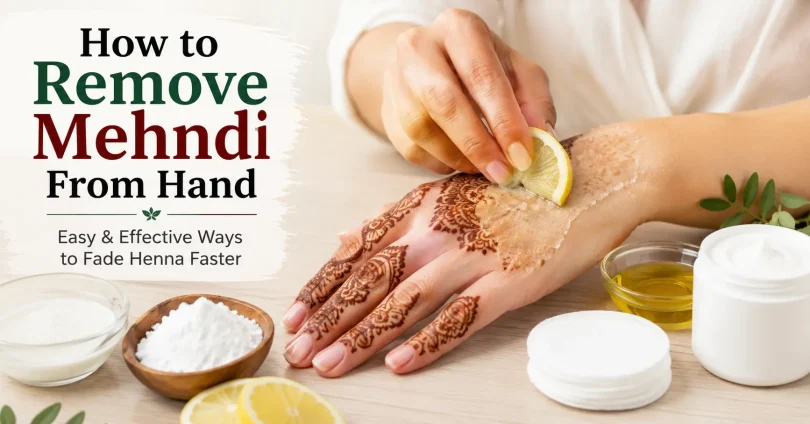
You stepped out of your mehndi appointment with a beautiful, dark design — and now you need it gone, fast. Maybe you have an office meeting tomorrow, a job interview, or you simply applied it on the wrong spot by accident. Whatever the reason, you are not alone. Searches for how to remove mehndi from hand spike every wedding season and every festival, and most of the advice floating around online is either incomplete, exaggerated, or unsafe.
This guide is different. It is built from real dermatological understanding of how henna actually binds to skin, combined with every safe removal method worth trying — including the ones most articles skip entirely, like how skin tone and skin type change your results, what a genuine allergic reaction looks like, and an honest answer to whether mehndi can really vanish in 5 minutes or 1 hour.
Read on for clear, step-by-step instructions you can start using right now.
Why Mehndi Stains Your Skin in the First Place
Mehndi (henna) paste contains a natural dye molecule called lawsone. When the paste sits on your skin, lawsone migrates into the outermost layer of skin, called the stratum corneum, and binds chemically with keratin, the protein your skin cells are made of.
This is the key fact almost every competing article glosses over: mehndi does not sit on top of your skin like paint. It bonds with the skin cells themselves. That is exactly why scrubbing it off in seconds is impossible, and why every safe method below works by speeding up the natural shedding of those dyed skin cells, not by dissolving the color instantly.
- Darker stain: more lawsone has bonded with keratin, usually because the paste was left on longer or the paste had a higher dye content.
- Longer-lasting stain: thicker-skinned areas such as palms, soles, and fingertips hold the dye much longer than the back of the hand.
- Faster fading: anything that increases skin cell turnover — warm water, gentle exfoliation, mild acids — naturally lifts the stain quicker.
Good to know: a fresh, dark stain typically peaks in color 24 to 48 hours after application due to oxidation, then begins fading naturally from day 3 onward.
Can You Really Remove Mehndi in 5 Minutes, 1 Minute, or 1 Hour?
This is the question most people are actually typing into Google, and it deserves an honest answer instead of a clickbait one.
The Honest Truth About Instant Removal
Because lawsone bonds with the protein layer of your skin, there is no safe method that erases a fully developed mehndi stain in 1 minute, 5 minutes, or even 1 hour. Any product or remedy that claims this is either talking about very light, freshly applied paste residue (not the actual stain) or is recommending something harsh enough to hurt your skin.
What you can realistically expect:
- In 1 minute to 5 minutes: you can remove leftover wet paste, glitter, or stickers — not the developed brown stain underneath.
- In 1 hour: a combination of warm water soak plus gentle exfoliation can visibly lighten a fresh stain, especially on thinner skin like the back of the hand.
- Overnight: leaving an oil-based treatment on while you sleep, followed by a morning scrub, gives noticeably better results than any single quick fix.
- In one day: realistic for noticeable lightening of a light or medium stain with repeated washing and exfoliation — not full disappearance.
If a remedy promises a fully dark mehndi stain gone in minutes, treat it with caution. It usually means a harsh chemical is doing the work, and your skin pays the price.
How to Remove Mehndi from Hand at Home: Step-by-Step Methods
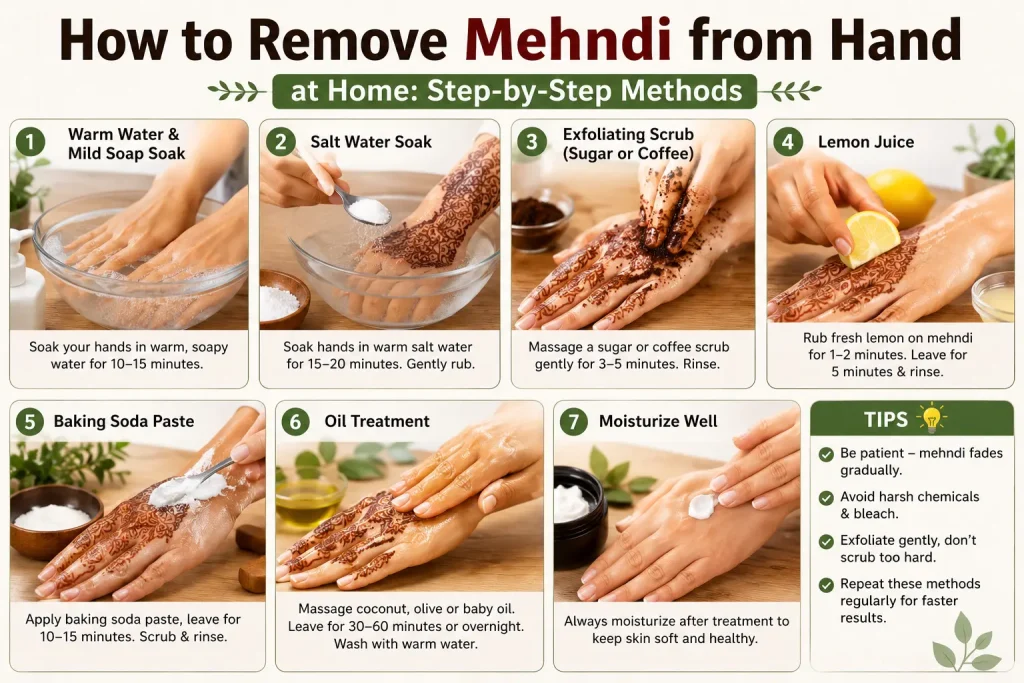
Below are the most effective, skin-safe techniques, organized from gentlest to strongest. Start from the top of the list if you have sensitive skin.
1. Warm Water and Mild Soap Soak
The simplest and safest place to start.
- Fill a bowl with comfortably warm (not hot) water.
- Add a few drops of a gentle, non-drying soap or hand wash.
- Soak your hands for 10 to 15 minutes.
- Pat dry and apply moisturizer immediately.
Repeat this 2 to 3 times a day. Warm water softens the outer skin layer, making it easier for dyed cells to shed naturally.
2. Salt Water Soak
Salt adds a mild exfoliating boost to the basic water soak.
- Dissolve half a cup of sea salt, Epsom salt, or regular table salt into warm water in a basin.
- Soak hands for 15 to 20 minutes.
- Gently rub your palms together or use a soft cloth.
- Rinse and moisturize well.
Avoid this method if you have any cuts, cracked skin, or eczema flare-ups, as salt can sting broken skin.
3. Exfoliating Scrub (Sugar, Coffee, or Store-Bought)
Physical exfoliation lifts dead, dyed skin cells faster than soap alone.
- Mix 1 tablespoon of sugar or used coffee grounds with 1 tablespoon of coconut or olive oil.
- Massage onto the stain in gentle circular motions for 3 to 5 minutes.
- Rinse with lukewarm water and moisturize.
You can also use a store-bought body scrub or a soft loofah. Always use light pressure — pressing hard does not speed up results, it only irritates your skin.
4. Lemon Juice
Lemon juice contains citric acid, a natural exfoliating acid with mild skin-lightening properties.
- Cut a fresh lemon in half.
- Rub the cut side directly over the stained area for 1 to 2 minutes.
- Leave the juice on for 8 to 10 minutes.
- Rinse thoroughly with cool water.
Citric acid increases photosensitivity. Avoid direct sun exposure on treated skin for a few hours, and never use lemon juice on broken or sunburned skin.
5. Lemon and Sugar Scrub
Combining lemon’s acid with sugar’s gentle abrasiveness speeds up results compared to using either alone.
- Mix 1 tablespoon of fresh lemon juice with 1 tablespoon of sugar.
- Apply to the stain and massage gently for 2 to 3 minutes.
- Leave for 10 minutes, then rinse.
- Moisturize immediately after, since both ingredients can be drying.
6. Baking Soda and Lemon Paste
One of the stronger natural combinations, best used no more than once a day.
- Mix 2 tablespoons of baking soda with 1 tablespoon of lemon juice to form a paste.
- Apply evenly over the stained skin.
- Let it sit for 8 to 10 minutes, no longer.
- Rinse with lukewarm water and follow with a rich moisturizer.
Never apply baking soda and lemon paste to the face. It is suitable only for hands, feet, and body skin, and should be skipped entirely if you have sensitive or eczema-prone skin.
7. Olive Oil or Coconut Oil Massage
The gentlest effective method, ideal for people who want to avoid drying their skin.
- Warm a tablespoon of olive oil or coconut oil between your palms.
- Massage into the stained area for 5 to 10 minutes.
- Leave the oil on for at least 20 minutes, or overnight for best results.
- Wipe off excess oil and wash normally.
Oils loosen the bond between lawsone and keratin over time. This method takes longer than acids or scrubs but is the safest choice for dry or sensitive skin, and it doubles as a moisturizing treatment.
8. Olive Oil and Salt Combination
- Mix 1 cup of olive oil with 3 to 4 tablespoons of sea salt.
- Apply generously over the stain using a cotton pad.
- Let it sit for 10 minutes.
- Gently rub off with a damp washcloth and rinse.
9. Hydrogen Peroxide (Cosmetic Grade, Diluted)
A mild bleaching method that works gradually.
- Use only a cosmetic-grade, diluted hydrogen peroxide solution (3 percent or lower).
- Apply a small amount to a cotton ball.
- Dab it onto the stain only, avoiding surrounding healthy skin.
- Rinse after 5 minutes.
Always patch-test on a small area first and never use undiluted or high-concentration hydrogen peroxide on skin.
10. Micellar Water or Makeup Remover
Useful mainly for lighter stains, glitter mehndi, or temporary white henna.
- Soak a cotton pad with micellar water.
- Press it onto the stain and let it sit for 30 seconds.
- Wipe gently, then repeat 2 to 3 times.
This will not remove a dark, fully set traditional henna stain on its own, but it works well combined with exfoliation.
11. Antibacterial Soap
- Wash hands with antibacterial soap 3 to 4 times daily.
- Use a soft brush or loofah while washing for added exfoliation.
- Moisturize after every wash to prevent dryness.
Results build up gradually over 24 to 48 hours of repeated washing rather than appearing instantly.
12. Toothpaste Method (Use With Caution)
This is one of the most searched remedies, so it deserves a clear, honest explanation rather than a flat yes or no.
- Apply a thin layer of plain white (non-gel, non-whitening-gel) toothpaste over the stain.
- Let it dry completely, about 10 minutes.
- Gently rub off with a soft, damp cloth and rinse well.
- Moisturize immediately afterward.
Toothpaste can mildly lighten a fresh stain because of its mild abrasive particles and menthol, which causes light surface irritation that encourages shedding. However, toothpaste is formulated for teeth, not skin, and frequent use can cause dryness, redness, or a burning sensation, especially with whitening or gel formulas. Use this method occasionally, never daily, and always patch-test first.
13. Chlorinated Pool Water
Swimming is genuinely one of the more effective accidental remedies, since pool chlorine acts as a mild bleaching agent.
- Swim for 30 to 40 minutes for noticeable fading.
- Apply a barrier moisturizer or oil before swimming to protect skin from chlorine dryness.
- Moisturize generously after toweling off.
14. Hair Conditioner
An unexpected but genuinely effective option for sensitive skin.
- Apply a generous amount of regular hair conditioner to the stain.
- Leave it on for 15 to 20 minutes so the skin fully absorbs it.
- Rinse with warm water.
Conditioner is formulated to soften and lift residue, which works similarly on skin as it does on hair, without any harsh exfoliation.
15. Steam and Scrub Combination
Best for darker, more stubborn stains.
- Hold your hands over a bowl of hot (not boiling) water for 5 to 10 minutes to let steam open and soften the skin.
- Immediately follow with a gentle exfoliating scrub.
- Rinse and moisturize.
Keep at least 12 inches between your skin and the steam source, and never use boiling water directly.
16. Overnight Oil Treatment
If you have time on your side, this is one of the most effective combinations for hands-off results.
- Massage warm coconut or olive oil into the stain before bed.
- Cover hands loosely with cotton gloves or socks to avoid staining your sheets.
- In the morning, wash off and follow with a gentle scrub.
This method softens the bonded dye all night long, so morning exfoliation removes far more stain than a daytime quick scrub would.
17. Repeated Gentle Hand Washing
Sometimes the simplest method is the most underrated one.
- Wash hands with a mild cleanser every 2 to 3 hours during the day.
- Pat dry rather than rubbing harshly.
- Apply moisturizer after every wash without exception.
Frequent washing accelerates the natural exfoliation cycle of skin cells, which is ultimately how every method on this list actually works.
Quick Reference: Best Method for Your Situation
Use this table to jump straight to the method that fits your timeline and skin type.
| Your Situation | Best Method | Realistic Result |
| Need it gone in under an hour | Warm water soak + gentle scrub | Visible lightening, not full removal |
| Have all night | Overnight oil treatment | Significant fading by morning |
| Sensitive or dry skin | Coconut or olive oil massage | Slow but gentle, no irritation |
| Want a fully natural approach | Lemon-sugar scrub + warm water | Gradual fading over 2 to 3 days |
| Going swimming anyway | Chlorinated pool water | Noticeable fade after one long swim |
| Stubborn bridal mehndi | Steam + scrub, repeated daily | Fades over 5 to 10 days |
Does Skin Tone or Skin Type Change How Mehndi Fades?
Yes, and this is rarely explained clearly. Two factors decide how your skin responds:
Skin Type
- Oily skin: natural sebum gradually breaks down the dye, so stains often fade a little faster.
- Dry skin: lacks the natural oils that help loosen the dye, so stains can sit longer unless you actively moisturize and exfoliate.
- Sensitive skin: reacts more easily to acids, baking soda, and scrubs, so gentler methods like oil massage and hair conditioner are safer choices.
Skin Tone
Skin tone does not change how long mehndi takes to fade chemically, but it does change how visible the stain appears. On deeper skin tones, the reddish-brown stain tends to blend in more and look less stark, while on lighter skin tones the same stain can appear more pronounced. Regardless of tone, the underlying biology and removal methods are exactly the same.
When Mehndi Removal Is Actually an Allergic Reaction
This is one of the most important sections in this guide, and most competing articles do not mention it at all. Pure, natural henna rarely causes reactions. But a lot of commercially sold “black henna” contains a chemical called PPD (para-phenylenediamine) to make the stain darker and develop faster.
If you notice any of the following, this is not a stain that needs removing with a home remedy. It is a reaction that needs medical attention.
- Intense itching, burning, or swelling at the design site
- Raised, red, or blistered skin in the exact shape of the mehndi pattern
- Symptoms appearing days after a very dark or jet-black design
- Oozing, crusting, or signs of infection
If you see any of these signs, stop all home remedies immediately, avoid further scrubbing or chemicals on the area, and consult a dermatologist. Scrubbing an allergic reaction will make it significantly worse.
What to Avoid When Removing Mehndi from Hand
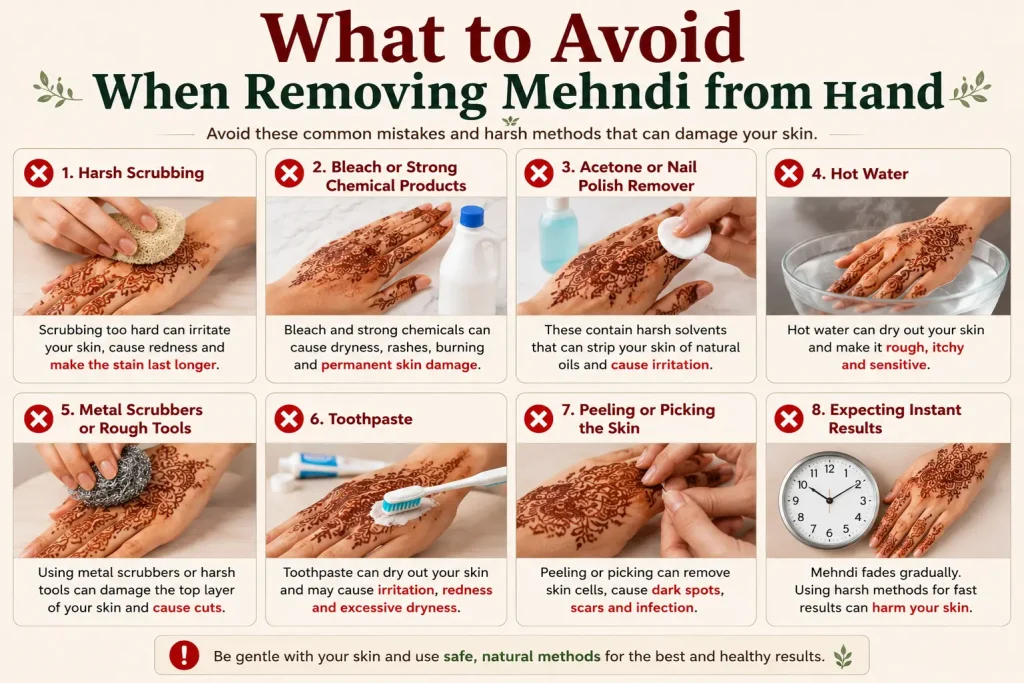
Speed should never come at the cost of your skin. Avoid the following, no matter how urgently you want the stain gone.
- Undiluted bleach or strong chemical skin lighteners — these can cause burns and long-term discoloration.
- Acetone or nail polish remover — never meant for skin and can severely dry or irritate it.
- Alcohol-based hand sanitizer as a removal trick — it dries skin without meaningfully lifting the stain.
- Pumice stones or hard scrubbing tools — these can tear delicate skin and cause scarring.
- Boiling or very hot water — softens skin briefly but causes burns and excessive dryness.
- Picking or peeling at the stain — henna dyes the skin itself, so picking means peeling your own skin, which can scar.
- Combining multiple strong methods at once (for example, baking soda, then lemon, then hydrogen peroxide back to back) — this compounds irritation instead of compounding results.
How to Remove Mehndi Stains from Nails
Henna often stains nails more stubbornly than skin because nail keratin is denser.
- Soak nails in warm, soapy water for 10 minutes.
- Gently buff the nail surface with a soft nail buffer, not a metal file.
- Apply a small amount of whitening toothpaste and scrub lightly with an old, soft toothbrush.
- Rinse and apply cuticle oil or hand cream.
Since nails grow out completely within a few weeks, even a stubborn nail stain will eventually disappear entirely on its own.
How Long Does Mehndi Take to Fade Naturally?
Even without any intervention, mehndi fades on its own as your skin renews itself. Here is a realistic timeline.
| Stain Type | Natural Fading Time | With Active Removal Methods |
| Light or accidental stain | 3 to 5 days | 1 to 2 days |
| Medium festive mehndi | 7 to 10 days | 3 to 5 days |
| Dark bridal mehndi | 2 to 3 weeks | 7 to 10 days |
| Palms and fingertips | Add 3 to 5 extra days | Add 2 to 3 extra days |
These are realistic ranges, not guarantees. Skin type, paste quality, and how long the mehndi was originally left on all affect your personal timeline.
How to Prevent Overly Dark Mehndi Stains Next Time
If easy removal matters to you, the smartest strategy is preventing a stubbornly dark stain in the first place.
- Remove the dried paste 2 to 4 hours after application instead of leaving it on overnight.
- Skip the traditional lemon-sugar sealing step, since it locks in a much darker, longer-lasting color.
- Avoid applying heat (like a heater or hot water) to speed up paste drying, as heat deepens the final stain.
- Wash your hands with plain water within the first hour after removing the paste, rather than waiting.
- Ask your mehndi artist for a lighter or more natural-grade henna paste if you know you need the stain gone quickly afterward.
When to See a Dermatologist
Most mehndi stains are simply a cosmetic, temporary inconvenience that home remedies can manage well. However, professional help is worth considering when:
- You suspect a PPD allergic reaction (see the warning section above).
- The stain has not faded at all after 3 to 4 weeks.
- Your skin has become unusually dry, cracked, or discolored after trying removal methods.
- You have an existing skin condition like eczema or psoriasis and are unsure which methods are safe for you.
A dermatologist can recommend a mild, medical-grade chemical exfoliation if truly necessary, but for the vast majority of people, this is never required.
Key Takeaways
- Mehndi stains bond with the protein in your skin, so there is no genuinely safe way to remove it in seconds.
- Gentle, repeated methods — warm water, mild exfoliation, and oils — outperform harsh one-time chemical attempts.
- Always moisturize after every removal method, since most of them are mildly drying.
- Stick to one method per session instead of layering multiple strong remedies together.
- Watch for signs of an allergic reaction, especially with very dark or black henna, and seek medical care if you notice them.
- If you are not in a hurry, simply letting mehndi fade naturally over one to three weeks is the healthiest option for your skin.
Frequently Asked Questions
Can mehndi be removed in 5 minutes?
No. You can remove wet paste residue in minutes, but a fully developed stain needs repeated gentle treatment over hours or days.
Does toothpaste really remove mehndi?
Toothpaste can mildly lighten a fresh stain due to its abrasive particles, but it can also dry out skin, so use it occasionally and always moisturize afterward.
How can I remove mehndi from hand overnight?
Massage warm coconut or olive oil into the stain before bed, cover your hands loosely, and exfoliate gently in the morning for noticeably better fading.
Is lemon juice safe for removing mehndi?
Yes, for most skin types, but avoid sun exposure right after use and skip it entirely if you have sensitive or broken skin.
Why does mehndi stay darker on palms and fingertips?
Skin is thicker in these areas, allowing the dye to bind more deeply and last longer than on the back of the hand.
How long does bridal mehndi usually last?
Dark bridal mehndi typically lasts two to three weeks, especially when sealed with the lemon-sugar method.
Is it safe to use bleach on mehndi stains?
No. Undiluted bleach can burn skin and cause long-term discoloration, so it should always be avoided.
Should I be worried if my mehndi stain itches or blisters?
Yes. This may indicate an allergic reaction to chemicals in black henna, and you should stop all home remedies and consult a dermatologist.
Conclusion
Removing mehndi does not have to be difficult when you use the right approach. While no method can completely erase a dark henna stain in just a few minutes, safe techniques such as warm water soaks, gentle exfoliation, lemon-based remedies, and oil treatments can significantly speed up the fading process. The key is to be patient and avoid harsh chemicals that may damage your skin. If you are looking for how to remove mehndi from hand safely, focus on gradual fading methods, moisturize regularly, and choose the technique that best matches your skin type. With consistent care, even the darkest mehndi stain will fade naturally and leave your skin healthy and irritation-free.
You May Also Like It: