
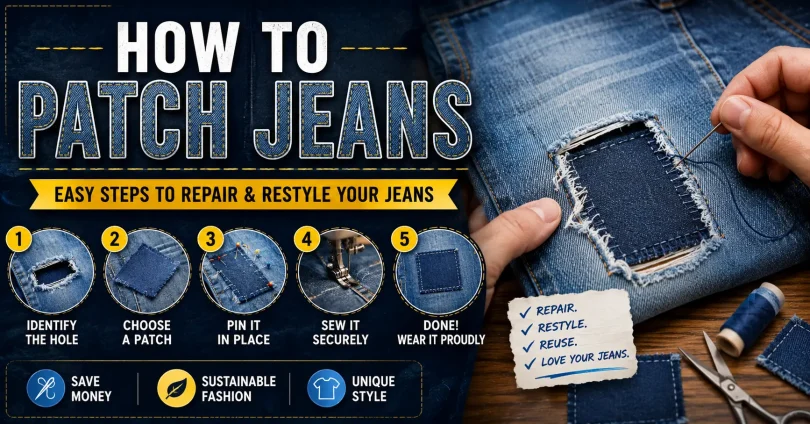
How to Patch Jeans The Complete Repair Guide.
Your favorite pair of jeans has a hole in the knee, a worn-out crotch, or a tear along the thigh. Your first instinct may be to replace them, but that is almost never the right move. A good pair of jeans can last decades with the right repairs, and patching jeans at home is easier than most people think.
This guide walks you through every method for patching jeans, from the fastest iron-on fix to the most durable hand-stitched repair. It covers every damage type, every location on the jeans, and every skill level from complete beginner to confident sewist. You will also find tips that most repair guides never mention, including how to choose the right patch fabric, how to prevent denim from fraying further before you start, and how to make your repair nearly invisible.
By the end of this guide, you will know exactly which method to use for your specific pair of jeans and how to execute it confidently.
Why Patching Jeans Is Worth Your Time
Before getting into the how-to, it helps to understand why mending matters beyond just saving money. Jeans are made from tightly woven cotton denim, one of the most durable fabrics in everyday clothing. A quality pair that fits well is genuinely hard to replace. Repairing them keeps a well-fitted garment in rotation and avoids the frustration of finding a new pair that fits just as well.
There is also an environmental case. The fashion industry produces enormous textile waste each year. Extending the life of your jeans by even two years through simple repairs significantly reduces that impact. Mending is one of the most direct and personal sustainability actions you can take.
Finally, a well-executed patch can actually look intentional. Visible mending, sashiko stitching, and contrast patches have all become legitimate style choices. Your repaired jeans do not have to look like a compromise.
Assess the Damage Before You Start
Not all jeans damage is the same, and the wrong repair method wastes time and produces weak results. Take one minute to assess what you are dealing with before picking up a needle or iron.
Types of Damage and What They Require
- Small clean hole (under 1 inch): Can be closed with hand stitching or a small iron-on patch applied from the inside.
- Large hole or tear (over 1 inch): Needs a fabric patch to bridge the gap. Iron-on alone is not enough for long-term durability.
- Fraying and thinning fabric: Requires a backing patch plus reinforcement stitching. The fabric is structurally weak, not just torn.
- Worn-through inner thigh or crotch: Needs a larger patch with strong edge stitching. This area experiences constant friction and flexing.
- Seam separation: Can be re-sewn by machine or hand without a patch in most cases.
Check the Surrounding Fabric First
Before patching, press the fabric around the damage gently between your fingers. If it feels thin, stiff with wear, or nearly transparent, the patch needs to extend well beyond the visible damage. Patching only the hole and leaving weakened fabric around it means a second tear will open within weeks.
Tools and Materials You Will Need
Your toolkit depends on the method you choose. Here is a complete list organized by repair type so you can gather only what you actually need.
For Iron-On Patch Repairs
- Iron-on denim patch (available at fabric and craft stores)
- Household iron
- Pressing cloth or thin cotton fabric
- Scissors
For Hand-Stitched Repairs
- Hand-sewing needle (size 7 or 8 for denim)
- Heavy-duty thread or embroidery floss (match denim color for invisible repairs, or contrast for decorative)
- Small scissors or seam ripper
- Patch fabric (denim, cotton twill, or canvas)
- Fabric glue or fusible web (optional, to hold patch in place while stitching)
- Thimble (highly recommended when pushing through multiple denim layers)
For Sewing Machine Repairs
- Sewing machine with a denim or jeans needle (size 90/14 or 100/16)
- Heavy-duty polyester or cotton thread
- Patch fabric
- Pins or sewing clips
- Seam ripper
- Free-motion quilting foot or darning foot (for darning repairs)
Choosing the Right Patch Fabric
This is the detail most guides skip entirely. The patch fabric you choose determines how durable and natural the repair looks. Here are the best options and when to use each:
- Matching denim: Cut from an old pair of jeans or denim scraps. Best for invisible repairs on the knee or thigh. The fabric weight and texture match the original.
- Lighter denim or chambray: Good for thinner jeans where heavy patching would create uncomfortable bulk.
- Canvas or cotton twill: Very durable, ideal for the crotch or inner thigh where friction is highest. Slightly stiffer than denim.
- Fusible interfacing: Not a standalone patch fabric. Use only as a stabilizer behind a real patch or to stop fraying before stitching.
- Decorative fabric: Corduroy, tweed, or patterned cotton for visible patches that are meant to stand out. Best for knee and back pocket repairs.
How to Patch Jeans: Step-by-Step Methods
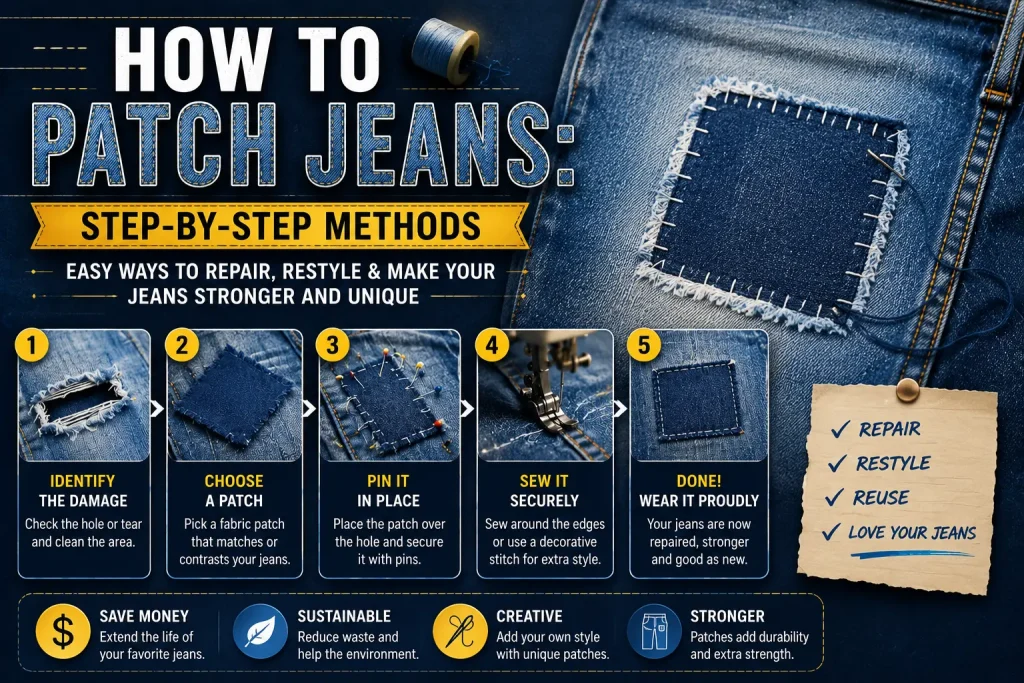
There are four main methods for patching jeans. Each one suits a different damage type and skill level. Read through all four before starting so you can choose the best approach for your specific repair.
Method 1: Iron-On Patch (Fastest and Easiest)
Iron-on patches use heat-activated adhesive to bond fabric to your jeans. This is the fastest method and requires no sewing skill. However, it is best used for small holes and as a temporary or supplementary fix rather than the sole repair on high-stress areas.
Best for: Small holes up to 1.5 inches, light tears on low-stress areas, and as a backing patch before hand or machine stitching.
Steps:
- Wash and dry your jeans. Ironing adhesive onto fabric that contains oils from skin contact creates a weaker bond.
- Trim any loose threads around the hole using small scissors. Do not cut the denim itself.
- Cut your iron-on patch so it extends at least 1 inch beyond the hole in every direction. Round the corners slightly; square corners lift and peel faster.
- Turn the jeans inside out. Position the patch adhesive-side down over the hole.
- Place a pressing cloth over the patch. This protects both the patch and the iron from adhesive residue.
- Press the iron firmly for 30 to 45 seconds without moving it. Use a cotton or high heat setting. Move the iron and press each section of the patch for the full time.
- Allow the patch to cool completely before handling. This sets the adhesive.
- Optional but recommended: Run a line of machine or hand stitching around the edge of the patch. This dramatically increases how long the patch stays in place through washing and wear.
Pro tip: If the patch is going on the outside of the jeans for a decorative look, use a pressing cloth on both the patch surface and the surrounding denim to prevent shine marks from the iron.
Method 2: Hand-Stitched Patch (Most Control, No Machine Needed)
Hand stitching gives you the most control over where and how thread is placed. It is quieter, more portable, and produces repairs that are often more flexible and comfortable than machine-stitched patches because there is no concentrated tension from machine sewing.
Best for: Medium holes, crotch and inner thigh repairs, areas where machine access is difficult, and decorative sashiko-style repairs.
Applying the Patch
- Cut the patch fabric at least 1 inch larger than the damaged area on all sides. For inner thigh or crotch repairs, go at least 1.5 inches beyond the visible damage because the surrounding fabric is usually weaker than it looks.
- Turn the jeans inside out. Place the patch over the damage with the right side of the patch facing outward (away from the inside of the jeans). The patch faces the inside of the garment and supports the outer fabric.
- Secure the patch with a few pins or a small amount of fabric glue. Make sure the patch lies completely flat with no puckering.
- Thread your needle with a doubled length of thread. Tie a small knot or use a loop anchor at the end.
- Sew a running stitch or backstitch around the entire perimeter of the patch, keeping stitches about 0.5 inches in from the edge. A backstitch is stronger and better for jeans.
- For holes larger than 1.5 inches, add rows of parallel running stitches across the patch to anchor it to the outer denim. These rows act like darning and prevent the outer fabric from sagging into the hole over time.
The Herringbone Stitch for Torn Edges
If you have a clean tear rather than a hole, the herringbone stitch closes the tear without distorting the fabric. Work from left to right. Make a small diagonal stitch from lower-right to upper-left across the tear, then bring the needle back down diagonally to the right side below the tear line. Repeat this cross pattern all the way along the tear. This stitch encases the raw edges and prevents further fraying.
Sashiko Stitching for Visible Repairs
Sashiko is a Japanese running stitch technique traditionally used to reinforce fabric. It creates geometric patterns using white or contrasting thread on a background fabric. On jeans, it produces striking visible repairs that look entirely intentional.
Apply a backing patch as described above. Then, using sashiko thread or embroidery floss and a blunt sashiko needle, stitch a grid, diagonal lines, or wave pattern across the patched area and into the surrounding denim. The stitching reinforces the repair and distributes stress across a larger fabric area, making it one of the most durable methods for high-wear areas.
Method 3: Sewing Machine Patch (Fastest Durable Repair)
A sewing machine produces the strongest and most consistent patch when you need a durable repair quickly. The key is using the right needle and foot for denim, and not rushing the process around seams and bulky areas.
Best for: Large holes, knee patches, thigh reinforcements, and any repair where long-term durability is the priority.
Steps:
- Install a denim needle in your machine. A size 90/14 needle works for most mid-weight jeans; use 100/16 for heavyweight denim.
- Thread the machine with heavy-duty polyester thread. Use a color that matches the jeans for invisible stitching, or a contrast color if the patch is meant to be visible.
- Cut the patch fabric and pin or clip it in place on the inside of the jeans.
- Set your machine to a straight stitch with a slightly longer stitch length (3.0 to 3.5mm). Denim is thick and short stitches can perforate the fabric or cause it to tear along the stitch line.
- Sew around the perimeter of the patch, then add rows of parallel stitching across the patched area. Keep rows about 0.25 to 0.5 inches apart.
- When you reach a seam, slow down and use the hand wheel to move the needle over the thick intersection manually. This prevents broken needles and skipped stitches.
- Backstitch at the start and end of every seam line to lock the stitching.
Pro tip: Place a small piece of tissue paper under the foot when beginning a seam at a thick edge. The paper stabilizes the foot and prevents skipped stitches. Tear it away after sewing.
Method 4: Machine Darning (No Patch Needed for Small Holes)
Machine darning uses free-motion stitching to weave new threads across a small hole, rebuilding the fabric structure without adding a separate patch. It produces the least visible repair of any method when done with matching thread.
Best for: Holes up to 1 inch in low-stress areas such as the thigh front or outer leg where a patch would be visible.
Steps:
- Attach a darning foot or drop the feed dogs on your machine. This allows you to move the fabric freely in any direction.
- Apply a small piece of fusible interfacing to the back of the hole to stabilize the edges before stitching.
- Set the machine to a straight stitch at medium length.
- Begin stitching across the hole in parallel rows, moving the fabric slowly and steadily. Work from one side to the other until the hole is covered with horizontal threads.
- Rotate the jeans 90 degrees and stitch another set of rows perpendicular to the first. This creates a woven grid that fills the hole.
- Keep stitching rows until the repaired area feels firm and the hole is no longer visible.
How to Patch Jeans by Damage Location
The location of the damage matters. Different areas of jeans experience different stresses, and the patch method and placement need to account for that.
How to Patch a Hole in the Knee
The knee is the most common location for jean damage. It flexes constantly and often takes the first impact when you kneel. Patches here need to be large enough to cover the area when the knee is bent, not just when standing straight.
- Cut a patch that is at least 2 inches wider and taller than the hole.
- Apply the patch to the inside of the jeans.
- To ensure coverage when the knee bends, hold the jeans so the knee area is flexed when you pin the patch. A flat patch on flat fabric will pull and gape when the knee bends.
- Stitch rows of parallel stitching across the patched area to anchor the outer denim to the patch.
- For a decorative exterior patch, cut your fabric to the desired size, pin it on the outside, and stitch around the entire edge. A zigzag stitch along the edge prevents fraying and adds visual texture.
How to Fix the Crotch and Inner Thigh
The crotch and inner thigh are the hardest areas to repair because they experience constant friction and movement. Patches here fail faster if undersized or poorly attached. This area also has multiple seams running together, which makes machine sewing challenging.
- Turn the jeans inside out and lay them flat.
- Cut a patch large enough to cover all visible wear, not just the actual hole. Worn fabric adjacent to the hole will tear next.
- Use canvas or heavyweight cotton twill for the patch material. This area needs the most durable fabric you have.
- Use a curved or teardrop shape if you are matching both sides of the inner thigh symmetrically.
- Attach with herringbone stitch or running stitch by hand. The herringbone stitch is especially good here because it is flexible and does not create a rigid edge that digs in when walking.
- If sewing by machine, work slowly around the crotch seams. You may need to turn the hand wheel manually over the thickest points.
- Add rows of reinforcement stitching across the patch interior, not just around the perimeter.
Important: If the damage extends right to the seams or through them, check whether the seams themselves need re-sewing before applying the patch. A patch over a broken seam will fail quickly.
How to Repair a Torn Pocket
Pocket tears are usually at the corners or along the top edge where the pocket fabric meets the jeans body. These areas take stress from hands and heavy items.
- If the tear is at the corner, place a small square of interfacing or denim behind the tear from the inside.
- Sew across the tear using a zigzag stitch or bar tack on the machine. A bar tack is a tight zigzag stitch over a very short distance, which is exactly how pocket corners were originally reinforced.
- For a torn pocket bag, the pocket may need to be removed at the top stitching, repaired, and re-attached, which is a more advanced repair but still achievable at home.
How to Fix a Fraying Hem
Fraying hems are easy to fix and easy to prevent from getting worse. Catch them early before the fraying travels up the leg seam.
- Fold the hem to the desired length and press with an iron.
- Stitch along the hem fold by machine using a straight stitch. Match the original hem stitch if you want the repair to be invisible.
- For a raw-edge hem that has become too frayed, apply a small amount of fray-stop adhesive or a bar of clear fabric glue along the raw edge before folding.
How to Patch Jeans Without Sewing
If you have no sewing tools at all, there are still effective options for patching jeans. These methods are best used as temporary fixes or for small, low-stress damage.
- Iron-on patches without stitching: As described in Method 1. Effective for small holes but will peel with repeated washing without added stitching.
- Fabric glue: Products such as Aleene’s Fabric Fusion or Dritz Liquid Stitch bond fabric without heat. Apply a thin layer to both surfaces, press together, and clamp or weight for the full cure time. These bonds are water-resistant once cured.
- Fusible webbing tape: Cut a piece of fusible webbing to size, place it between the patch and the jeans, and press with an iron following the package instructions. This is stronger than iron-on adhesive alone.
- Fray-stop adhesive: For fraying edges and small tears that have not opened into a full hole, fray-stop adhesive applied around the perimeter stops the damage from spreading. It dries clear and flexible.
Note: No-sew methods should not be the sole repair for the crotch, inner thigh, or any other high-friction area. The mechanical stress in these areas will defeat adhesive bonds within a few weeks of regular wear.
How to Make Patches Nearly Invisible
The biggest complaint about patched jeans is that the repair looks obvious. Here is how to minimize that.
- Match the denim weight and wash: A dark patch on light jeans is immediately visible. Use patch fabric from a similar pair of jeans or pre-wash new patch fabric to fade it before applying.
- Apply the patch from the inside: Internal patches are invisible from the outside unless the hole itself is very large. Focus your stitching on the interior.
- Use machine darning for small holes: As described in Method 4, thread darning with matching thread leaves almost no visible trace.
- Thread color matters more than stitch type: Matching your thread exactly to the denim makes almost any stitch invisible from a few feet away.
- Blend the patch edges: For exterior patches, fray the edges of the patch fabric slightly before applying. Frayed edges blend into the surrounding denim texture much better than clean-cut edges.
How to Make Patches Look Intentional and Stylish

If hiding the repair is not your goal, lean into it. Visible mending has become a significant style movement and a deliberate statement about sustainable clothing. Here are approaches that make patches look purposeful.
- Sashiko stitching: Use white thread on dark denim with geometric patterns such as grids, diamonds, or waves. Apply over a solid backing patch.
- Contrast patch fabric: A floral cotton patch on a knee, or a plaid flannel piece on a back pocket, stands out as a design choice rather than a repair.
- Embroidery over the patch: Simple embroidery such as flower outlines, leaves, or abstract geometric shapes drawn over a patch turns it into art.
- Iron-on embroidered patches: Brand patches, vintage-style badges, and band logos applied over a hole are one of the most widely recognized forms of visible mending and need no sewing skill.
- Color coordinated topstitching: Using bright orange thread on blue denim, for example, mimics the original topstitching color on most jeans and ties the repair back into the design of the garment.
Common Mistakes to Avoid When Patching Jeans
- Patching without trimming loose threads: Loose threads inside a patch create bumps and can eventually work their way through the patch and cause new holes.
- Using a patch that is too small: The most common reason patches fail early. Always extend at least 1 inch beyond visible damage in every direction.
- Skipping the stabilization step: Fraying edges must be secured before patching. Apply fusible interfacing or fray-stop adhesive around the hole before attaching the patch.
- Not washing after patching: Washing the jeans after patching reveals any puckering or tension issues while they are still easy to correct.
- Using the wrong needle for machine work: A standard needle will break or skip on denim. Use a denim needle and replace it if it shows any sign of dullness.
- Ignoring the surrounding weak fabric: Check the fabric around the hole. If it feels thin, extend the patch further or add reinforcement stitching to the adjacent area.
How to Care for Patched Jeans
Even a well-executed patch will not last as long as the original fabric. Here is how to extend the life of your repair:
- Wash jeans inside out. This reduces friction on the outer surface of the patch and prevents the edges from catching in the drum.
- Use a cold water wash. Hot water weakens both the denim fibers and any adhesive used in iron-on patches.
- Air dry when possible. The heat of a tumble dryer stresses fabric and adhesive bonds.
- Inspect the patch after each wash for any signs of peeling or thread loosening. Touch up early repairs before they fail completely.
- Re-iron an iron-on patch every few months if it starts to lift at the edges.
Quick Reference: Patch Method Comparison
Use this table to match your situation to the right repair method at a glance.
| Method | Skill Level | Best For | Durability |
| Iron-On | Beginner | Small holes, quick fix | Low to Medium |
| Hand Stitch | Beginner to Intermediate | Crotch, inner thigh, all areas | High |
| Machine Patch | Intermediate | Large holes, knee, thigh | Very High |
| Machine Darning | Intermediate | Small holes, invisible repair | Medium to High |
| Sashiko | Beginner | Visible mending, high-wear areas | Very High |
Frequently Asked Questions
How do I patch jeans without it being noticeable?
Apply the patch from the inside using matching denim fabric and thread that closely matches the original color. Machine darning with matched thread produces the least visible result for small holes. For larger damage, use an internal fabric patch with rows of parallel stitching that mimics the weave of the original denim.
Can I patch jeans by hand without a sewing machine?
Yes. The herringbone stitch, running stitch, and backstitch all work well on denim without a machine. Hand stitching is actually preferable for the crotch and inner thigh areas because it is more flexible and comfortable than machine stitching in areas that flex constantly.
How long do iron-on patches last on jeans?
Iron-on patches typically last between 5 and 20 washes depending on wash temperature, the quality of the adhesive, and whether they were reinforced with stitching. Adding a row of stitching around the perimeter of an iron-on patch dramatically extends its life.
What fabric should I use to how to patch jeans?
Denim from an old pair of jeans is the best match. Canvas or cotton twill is best for high-wear areas like the inner thigh. Avoid stretchy fabrics unless your jeans are stretch denim, as a non-stretch patch on stretch fabric will pucker and restrict movement.
How big should a patch be?
At minimum, the patch should extend 1 inch beyond the visible hole in every direction. For the inner thigh and crotch, extend at least 1.5 inches because the surrounding fabric is typically weakened even if it looks intact.
Should the patch go on the inside or outside of the jeans?
For invisible repairs, the patch goes on the inside. For decorative or visible mending, the patch goes on the outside. For the best structural result, apply a patch on both sides, using a firm backing patch inside and a decorative patch outside.
Can I patch stretch jeans?
Yes, but you need to use stretch denim or a fabric with comparable stretch for the patch. Applying a non-stretch patch to stretch denim will create tension and cause puckering or restrict the stretch of the jeans in that area.
Final Thoughts
Patching jeans is one of the most practical and rewarding skills you can develop as someone who values their clothing. It saves money, extends the life of garments that fit well and feel good, and gives you direct control over how your clothes age.
The method you choose — iron-on, hand stitch, machine patch, or darning — depends on the damage, its location, and the look you want. Start with the method that suits your current tools and skill level. Every repair you complete builds the confidence and technique for the next one.
Your jeans do not have to look repaired. With the right technique, matching materials, and a little patience, a patched pair of jeans can look, feel, and wear just as well as the day you bought them, and often better, because now they carry a story.
You May Also Like It: