
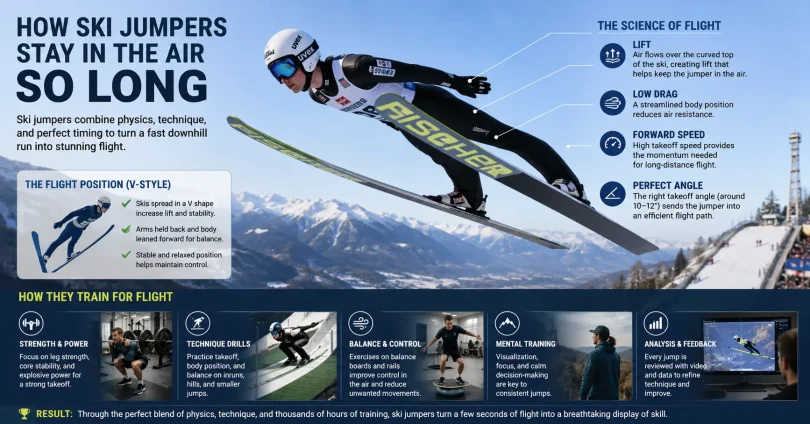
The complete guide to ski jumping aerodynamics, physics, technique, and elite training
Watch a ski jumper launch off the end of a ramp, and your first thought is probably: how are they still in the air? They do not simply fly in a straight arc like a ball thrown into the air. They glide, they float, and they cover distances that seem physically impossible for a human being.
- How Ski Jumpers Stay in the Air So Long and How They Train
The answer lies in aerodynamics, body positioning, elite equipment, and years of highly structured training. This article breaks down every aspect of ski jumping flight — from the physics that keep jumpers airborne to the exact training methods that elite athletes use to master it — including details you will not find in most other guides on this topic.
The Four Phases of a Ski Jump
Before diving into the physics, it helps to understand that a ski jump is not one action — it is four distinct phases, each of which affects how long a jumper stays in the air.
Phase 1: The In-Run (Approach)
The jumper sits in a tucked, aerodynamic crouch and accelerates down a steep ramp called the in-run. By the time they reach the takeoff table, they are traveling between 85 and 100 km/h (53 to 62 mph) depending on the hill size. This speed is the foundation of the entire jump — without it, there is no lift and no distance.
During this phase, the jumper keeps their body low and compact to minimize air resistance. The position must be consistent every single time, because even small deviations in speed translate directly into meters lost or gained at landing.
Phase 2: The Takeoff
The takeoff lasts approximately 0.25 to 0.35 seconds — a fraction of a second. The jumper explodes upward from a crouched position using a powerful leg drive, simultaneously shifting their body weight forward and extending their arms slightly for balance.
The timing of this movement is everything. Too early and the jumper loses speed before becoming airborne. Too late and they miss the optimal launch angle. Elite jumpers develop this timing through thousands of repetitions until it becomes fully automatic.
Phase 3: The Flight
This is the phase that defines the entire jump. The jumper spreads their skis into the V-shape, leans forward aggressively, and holds a rigid, aerodynamic body position for six to nine seconds while covering over 100 meters of horizontal distance.
Every micro-adjustment the jumper makes — a slight tilt of the arm, a change in hip angle, a shift in ski spread — directly affects how much lift they generate and how far they travel. This is where years of training become visible.
Phase 4: The Landing
Landing is not just about touching down safely. Judges award style points for the landing, which means the jumper must land in a specific Telemark position — one foot forward, knees bent, arms spread — to score well. The transition from flight mode to landing mode begins several meters before touchdown, requiring precise body awareness and split-second timing.
The Physics Behind Ski Jumping Flight
Ski jumping flight is governed by four aerodynamic and physical forces working simultaneously. Understanding these forces explains everything about how jumpers stay in the air so long.
1. Aerodynamic Lift
Lift is the upward force that prevents the jumper from falling straight down after leaving the ramp. It works on the same principle as an airplane wing — when air moves faster over the top surface of an object than the bottom, it creates a pressure difference that pushes the object upward.
A ski jumper in the V-style position creates a large, angled surface — their body leaning forward plus the spread skis — that deflects oncoming air downward. By Newton’s Third Law, the air pushes back upward on the jumper with equal force. This is lift.
In optimal flight position, lift nearly cancels out gravity, so the jumper descends only 2 to 3 meters per second vertically while traveling over 25 meters per second horizontally. The result is an exceptionally flat, gliding trajectory that covers enormous horizontal distance.
2. Drag
Drag is the air resistance that slows the jumper down. Since lift is directly related to speed — more speed equals more lift — managing drag is critical. Less drag means the jumper maintains higher speed throughout the flight, which sustains lift all the way to landing.
Jumpers minimize drag by keeping their body in the flattest, most streamlined position possible. Arms stay tight against the body, the chin is tucked down, and the suit is fitted precisely to FIS regulations to avoid any unnecessary fabric that would billow in the wind.
3. Gravity
Gravity pulls the jumper downward at 9.8 m/s squared throughout the entire flight. The jumper never escapes gravity — they simply counteract it with lift. When lift is sufficient, gravity’s effect is dramatically slowed. When the jumper starts to lose speed near the end of the flight, lift drops and gravity wins, pulling them down to the landing hill.
4. The Angle of Attack
The angle of attack is the angle between the jumper’s body surface and the oncoming airflow. It is one of the most important variables in ski jumping flight. Too small an angle produces little lift. Too large an angle causes aerodynamic stall — the airflow separates from the body surface, lift collapses, and the jumper falls.
Elite jumpers maintain an angle of attack of approximately 30 to 40 degrees throughout the flight, constantly making tiny adjustments as their speed changes during the glide.
The V-Style: The Revolution That Changed Ski Jumping
No single development in ski jumping history has had more impact on distance than the adoption of the V-style technique in the late 1980s.
Before the V-Style: The Parallel Technique
Before 1985, all ski jumpers held their skis parallel during flight — both tips together, both tails together, forming a narrow profile from ski tip to tail. This was considered the only correct technique. Coaches and judges actively penalized anything that deviated from it.
Jan Boklöv and the V-Style Breakthrough
Swedish jumper Jan Boklöv began experimenting with spreading his ski tips apart into a V-shape during the mid-1980s. The ski jumping establishment was skeptical and initially gave him lower style scores. But Boklöv kept winning distances — and his 1988-89 World Cup overall title forced the sport to take notice.
The physics behind his advantage were clear: the V-style creates a wider, more efficient airfoil. By the early 1990s, every competitive ski jumper had switched to the V-style.
Why the V-Style Generates More Lift
- Larger surface area: Spread skis create a wider wing that catches significantly more air, generating more upward pressure
- Body integration: The jumper’s body fits naturally in the center of the V, creating a continuous lifting surface from one ski tip across the body to the other
- Optimal angle of attack: The V-shape allows the jumper to present the most efficient angle to the oncoming airflow without sacrificing lateral stability
- Natural stability: Like a paper airplane’s wings, the V-shape provides inherent resistance to rolling and yawing, making the flight more stable and predictable
The V-style generates approximately 28% more lift than the parallel technique. Today, jumpers fine-tune their V-angle — typically 30 to 35 degrees per ski from the center line — based on wind conditions, hill profile, and personal aerodynamics.
Body Position and Aerodynamics in Detail
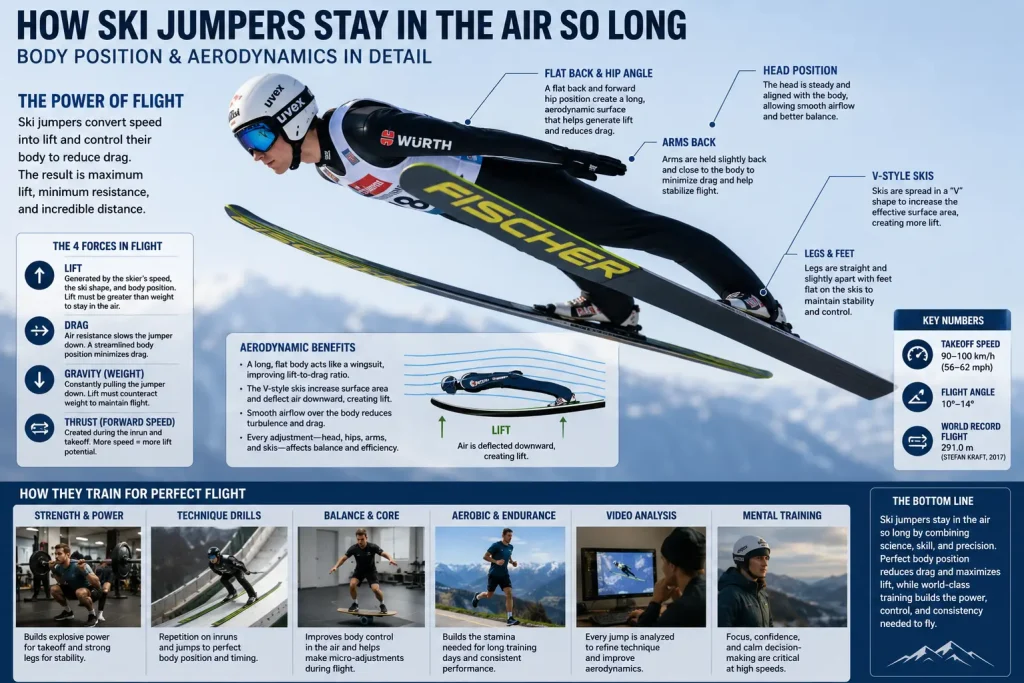
The V-style is just one component of optimal ski jumping aerodynamics. Every part of the body is positioned deliberately to maximize lift and minimize drag.
Forward Lean Angle
Jumpers lean their upper body forward at approximately 45 to 50 degrees from horizontal during flight. This is the single most important positional factor for generating lift. Think of holding your hand flat out of a car window at highway speed — the angle of your hand determines whether it lifts upward or gets pushed back. A ski jumper’s upper body works exactly the same way.
Too upright: not enough lift, short distance. Too flat: the jumper risks losing control or tumbling forward. The exact angle is maintained through core strength and years of proprioceptive training.
Arm and Hand Position
Arms are held tightly along the sides of the body or slightly behind, never extended outward or forward. Extended arms create turbulence and unnecessary drag. Elite jumpers keep their hands so close to their body that the fingertips nearly brush their thighs throughout the entire flight.
Head and Helmet
The chin is tucked down and the gaze is forward. Smooth, aerodynamic helmets are mandatory. The head generates a surprising amount of drag at 90+ km/h, so minimizing any turbulence around the helmet is part of the aerodynamic package.
Ski Length and Weight Rules
Skis can be a maximum of 145% of the jumper’s body height in length. This creates a significant aerodynamic advantage for taller, lighter athletes — they get longer skis and a larger lift surface relative to their body weight. Heavier jumpers must use shorter skis, which generate less lift.
The FIS introduced a Body Mass Index (BMI) rule in 2004 specifically to prevent athletes from dangerously starving themselves to become lighter (and thus gain an aerodynamic edge). If a jumper’s BMI falls below the minimum threshold, their maximum ski length is reduced. This rule has been refined several times to balance competitive fairness with athlete safety.
Suit Regulations
FIS regulates every aspect of the competition suit, including fabric thickness, air permeability (how much air passes through the material), and overall fit. Suits cannot be baggy enough to act as a parachute or sail, but they also cannot be so tight that they reduce lift. Suit measurements are checked at every competition before the jumper enters the in-run.
How the Hill Design Keeps Jumpers Safe
One of the most misunderstood aspects of ski jumping is how jumpers land from such enormous distances without serious injury. The answer lies entirely in the engineering of the landing hill.
The Landing Hill Profile
The landing hill is not a flat slope. It is carefully curved to match the parabolic flight trajectory of a jumper in optimal form. As the jumper glides through the air, the hill curves away beneath them at roughly the same rate they descend. At the moment of landing, the actual vertical drop is only 1 to 3 meters — similar to stepping off a table. Without this design, landing from 100+ meters would cause catastrophic injuries.
K-Point and Hill Size
Every ski jumping hill has a K-point (Konstruktionspunkt) — the engineering reference point that represents the design landing target. Landing at the K-point earns a baseline score. Landing beyond it earns bonus points. Landing short costs points.
Hills are classified by their Hill Size (HS), which is the maximum distance at which the hill profile remains safe for landing. For example, an HS120 hill has a safe landing zone to 120 meters. Ski flying hills — the largest in the world — have HS values above 185 meters.
The Knoll (Critical Point)
The critical point (P-point) marks the beginning of the flat runout at the bottom of the hill. Landing beyond this point is technically possible but increasingly dangerous because the slope flattens out, making the impact angle much harder. In competition, landing significantly past the critical point is extremely rare and triggers safety reviews of the hill setup.
How Ski Jumping Is Scored: What Judges Actually Look At
Most viewers focus only on distance, but ski jumping scoring is a combination of distance points and style points. Understanding both helps explain why body position and landing technique matter even when the jumper has already traveled far.
Distance Points
Each hill has a base score for landing at the K-point — typically 60 points. Every meter beyond the K-point earns an additional 1.8 to 2.4 points (depending on hill size). Every meter short of the K-point deducts the same amount. A jumper landing 20 meters past the K-point on an HS120 hill earns approximately 60 + (20 x 1.8) = 96 distance points.
Style Points
Five judges each award 0 to 20 points for the quality of the jump. The highest and lowest scores are dropped, and the remaining three are added together for a maximum of 60 style points. Judges assess:
- Body position during the flight — stability, forward lean, V-angle consistency
- Landing execution — quality of the Telemark landing (one foot forward, knees bent)
- Balance and control during the outrun after landing
Wind and Gate Compensation
Since wind conditions change between competitors, FIS uses a wind compensation system. A headwind (blowing toward the jumper) helps distance; a tailwind hurts it. Official wind sensors measure the wind during each jump and automatically add or subtract points based on the measured wind speed. Similarly, the gate compensation system adjusts scores when officials raise or lower the starting gate between competitors due to changing conditions.
How Ski Jumpers Train: A Complete Year-Round Program
Ski jumping training does not stop when the snow melts. Elite jumpers train 10 to 11 months per year across multiple disciplines, building the physical strength, aerodynamic skill, and mental discipline required to perform at the highest level.
Wind Tunnel Training
Wind tunnel sessions are one of the most direct ways to develop and refine flight position. Jumpers lie horizontally in a vertical wind tunnel and practice holding their optimal body position against a steady airstream. Coaches measure real-time lift and drag forces and can instantly see the effect of any positional change.
Wind tunnel sessions allow athletes to experiment with micro-adjustments — moving an arm a centimeter, changing hip tilt by a degree — and immediately quantify the aerodynamic impact. This feedback loop accelerates learning in ways that actual jumping cannot.
Summer Plastic Hill Jumping
Most major ski jumping facilities have landing hills coated in a special plastic material called Fairway matting or similar surfaces that function without snow. Jumpers train on these hills from May through October, taking thousands of actual jumps each season.
The in-run, takeoff, and flight phases on plastic hills are nearly identical to snow competition. The landing surface is slightly different, and foam padding is often placed at the bottom for beginners, but advanced athletes train on plastic hills at full competitive intensity throughout the summer.
Gym and Physical Training
Ski jumping demands a very specific physical profile: explosive leg power for the takeoff, exceptional core stability for flight position, and extreme flexibility in the hips and ankles. A typical gym training week includes:
- Plyometrics: Box jumps, depth jumps, bounding exercises, and single-leg explosive drills to develop the fast-twitch muscle power needed for the 0.3-second takeoff
- Core stability: Planks, hollow body holds, anti-rotation presses, and hanging leg raises to maintain the rigid forward-lean position during flight
- Hip flexibility: Extensive stretching and yoga-style mobility work to achieve and sustain the deep forward lean angle without straining the lower back
- Balance and proprioception: Single-leg balance drills on unstable surfaces, balance boards, and BOSU training to develop the fine motor control needed for in-flight adjustments
- Strength training: Squats, Romanian deadlifts, and Nordic hamstring exercises to support the explosive takeoff and absorb landing forces
Video and Biomechanical Analysis
Every training jump at the elite level is recorded from multiple camera angles simultaneously. Coaches use slow-motion footage to analyze the exact moment of takeoff (was it at 0.25 or 0.35 seconds?), the transition to flight position, V-angle consistency, and landing mechanics.
Advanced systems now overlay aerodynamic data directly onto video footage — coaches can see exactly where the lift-to-drag ratio peaks and falls during each jump. This level of analysis helps jumpers understand not just what they are doing wrong, but precisely why it costs them distance.
Ski Jump Simulator Training
Many training centers use ground-based jump simulators — devices that replicate the exact takeoff motion and allow jumpers to practice the explosive leg extension and forward body shift thousands of times without needing a hill at all. These simulators are especially useful for beginners developing takeoff timing, and for experienced jumpers returning from injury who need to rebuild the movement pattern before going back on the hill.
Mental Training and Visualization
Ski jumping is as much a mental sport as a physical one. A jumper stands at the top of a 90-meter or 120-meter hill, prepares to reach speeds over 90 km/h, executes a technically precise takeoff in under a third of a second, and then maintains a demanding flight position for six to nine seconds — all while being judged by five officials.
Elite athletes work with sports psychologists to develop:
- Visualization: Mental rehearsal of the entire jump sequence — from the starting gate through to the Telemark landing — before every training session and competition
- Pre-jump routines: Consistent breathing, physical, and mental routines performed before each jump to create a calm, focused mental state
- Distraction management: Techniques for blocking out crowd noise, weather changes, and competitive pressure at high-stakes events like the Olympic Games or World Championships
- Error response training: Developing the mental ability to reset after a bad jump and perform normally on the next attempt without carrying negative thoughts forward
Youth Development and How Beginners Start
Beginner ski jumpers do not start on full-size hills. Youth programs begin on very small practice hills — often just 5 to 10 meters in height — where the focus is entirely on the takeoff movement pattern, balance in flight, and safe landing technique.
As the athlete develops, they progress through increasingly larger hills: 10m, 20m, 40m, 60m, and eventually the standard 90m and 120m competition hills. This gradual progression means that by the time a jumper first attempts a 90m hill, they have already made thousands of jumps and have the technique thoroughly ingrained.
Nutrition, Weight Management, and Athlete Safety
Weight is one of the most important variables in ski jumping. Lighter jumpers generate more lift relative to gravity, which means every kilogram matters competitively. Historically, this created serious eating disorder problems in the sport.
The FIS BMI Rule
Since 2004, the FIS has enforced minimum BMI requirements for ski jumpers. If an athlete’s BMI falls below the minimum (currently set at 18.5 or higher depending on age and gender), their maximum allowed ski length is reduced. Shorter skis generate less lift, which directly reduces distance. This creates a powerful competitive incentive to maintain a healthy body weight.
The rule has been regularly updated and strengthened. Medical checks are conducted before every major competition. Athletes found below the minimum BMI face mandatory ski length reductions that effectively neutralize any competitive advantage their low weight might have provided.
Diet for Performance
Within the healthy weight range, ski jumping athletes eat carefully to optimize power-to-weight ratio. This typically means:
- High-carbohydrate fueling before training and competition for explosive energy
- Adequate protein intake to support muscle development from plyometric and strength training
- Careful calorie management to maintain a lean but healthy competition weight
- Working with registered dietitians who specialize in winter sports to avoid nutritional deficiencies
Notable Records and Elite Performers

The World Record
The official ski flying world record is held by Stefan Kraft of Austria, who jumped 253.5 meters at the Vikersund ski flying hill in Norway in 2017. To put that in perspective: he was airborne long enough to cover two and a half football fields.
Ski Flying vs. Standard Ski Jumping
Ski flying is a separate discipline using specially constructed hills larger than HS185. Jumpers reach speeds over 105 km/h on the in-run and stay airborne for up to 9 seconds, covering distances approaching 250 meters. The aerodynamic forces involved are significantly more intense, and even small positional errors at these speeds can be dangerous.
Legendary Athletes
- Matti Nykänen (Finland): Four-time Olympic champion who dominated the 1980s and early V-style era
- Gregor Schlierenzauer (Austria): Holds the record for World Cup individual victories with 53 wins
- Kamil Stoch (Poland): Three-time Olympic champion known for exceptional consistency and technical precision
- Sara Takanashi (Japan): The most successful women’s ski jumper in World Cup history, with record victories in the women’s circuit
Frequently Asked Questions
How do ski jumpers stay in the air?
They use aerodynamics and the V-style technique to create lift.
What is the V-style?
A technique where skis are spread into a V shape for better lift.
How fast do ski jumpers go?
Usually between 85–100 km/h.
How long do they stay airborne?
Around 6–9 seconds.
How far can ski jumpers travel?
More than 100 meters.
Is ski jumping dangerous?
Yes, but modern safety systems reduce the risk.
How do ski jumpers train?
Through wind tunnels, gym workouts, and hill practice.
Why are landings safe?
Because landing hills are specially curved for smooth impact.
What do judges score?
Distance, body control, and landing technique.
What is ski flying?
A larger version of ski jumping with much longer distances.
Conclusion
Ski jumping is one of the most physically and technically complex winter sports in the world. The ability to stay airborne for six to nine seconds and cover over 100 meters is not magic — it is the product of elite aerodynamics, perfected technique, and years of systematic training.
The V-style revolution transformed the sport by generating 28% more lift. The carefully engineered landing hills make enormous distances survivable. The combination of wind tunnel work, summer plastic hill jumping, explosive gym training, and rigorous mental preparation produces athletes capable of executing a technically perfect jump under intense competitive pressure.
The next time you watch a ski jumper glide silently through the air for what seems like an impossibly long time, you now know exactly what is making it happen — and how much work went into making it look effortless.
You May Also Like It:
How Do I Use Search Live to Identify the Signs Showing on My Car Dashboard?
How Can I Get a New Gas Pipeline Connection? What Should I Do to Make the Process Easier?
how to identify if the pashmina shawl i am buying is genuine?