
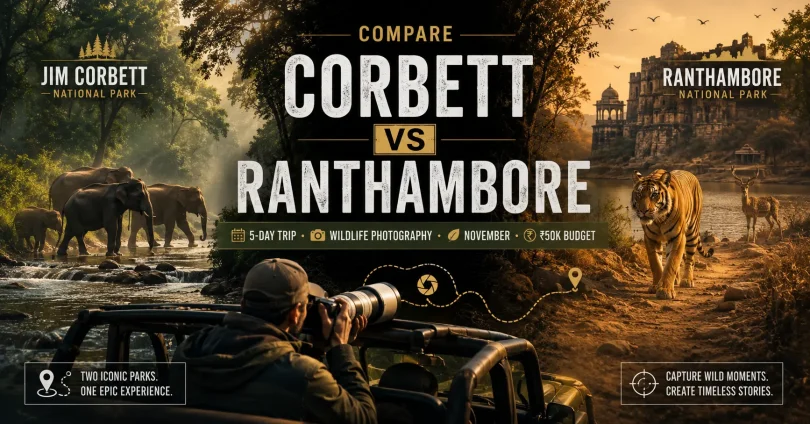
Corbett vs Ranthambore: 5-Day Wildlife Photography Trip:
You have five days, a budget of Rs. 50,000, and a camera ready for action. November is approaching, and you are torn between two of India’s most celebrated wildlife destinations: Jim Corbett National Park in Uttarakhand and Ranthambore National Park in Rajasthan. Both parks are legendary. Both host Bengal tigers. But they are very different experiences, and the wrong choice could cost you — not just money, but once-in-a-lifetime shots.
This guide compares both parks with complete honesty. You will find detailed breakdowns on tiger sighting probabilities, best photography zones, camera gear recommendations, safari booking strategies, day-by-day itineraries, accommodation options, and a full budget split — information that most articles on this topic simply skip.
Whether you are a hobbyist shooter or a serious wildlife photographer, this guide will help you make the right call for your November trip.
Why November is the Ideal Month for Wildlife Photography in India
November sits at the sweet spot for Indian wildlife photography. The monsoon season ends in October, leaving behind lush greenery, cleaner waterholes, and active wildlife. By November, the vegetation thins out slightly, improving visibility without the bone-dry harshness of summer.
Here is what November specifically offers at both parks:
- Temperature: Daytime highs of 18 to 28 degrees Celsius, dropping to 8 to 14 degrees at dawn. This produces the misty, golden-light mornings that make wildlife portraits extraordinary.
- Light Quality: November delivers soft diffused morning light for the first two hours after sunrise — the best window for wildlife photography anywhere in India.
- Animal Activity: Cool mornings push tigers, elephants, and deer out into open areas earlier, extending your productive shooting window.
- Crowd Levels: November is shoulder season. Peak tourist rush arrives in December and January. Booking in November means fewer vehicles competing for the same sighting.
- Safari Availability: Most zones at both parks are fully open by early November. Dhikala in Corbett opens in mid-November, giving you access to the premier photography zone.
Jim Corbett vs Ranthambore: At a Glance
The table below summarizes the key differences between the two parks across the most important factors for a wildlife photography trip.
| Factor | Jim Corbett | Ranthambore |
| Location | Ramnagar, Uttarakhand | Sawai Madhopur, Rajasthan |
| Distance from Delhi | 245 to 260 km (5 to 6 hrs) | 346 km (4 to 6 hrs by train) |
| Tiger Population | Around 260 inside reserve | 55 to 60 core area tigers |
| Tiger Visibility | Moderate (dense forest) | High (open terrain + water) |
| Landscape Type | Sal forest, grasslands, rivers | Dry deciduous forest, lakes, ruins |
| Best Safari Zones | Bijrani, Jhirna, Dhikala | Zones 2, 3, 4 (core area) |
| Other Wildlife | Elephants, gharials, 580+ birds | Crocodiles, sloth bears, peacocks |
| Photography Style | Environmental, atmospheric | Portrait, dramatic, high-contrast |
| November Light | Misty mornings, layered scenes | Clear open light, lake reflections |
| Budget Fit (50K) | Easier to stay within budget | Manageable with train + sharing |
| Safari Cost (Jeep) | Rs. 5,500 to 7,500 full jeep | Rs. 2,000 to 2,300 per seat |
| Accommodation | Rs. 1,800 to 4,000 per night | Rs. 2,000 to 5,000 per night |
| Booking Lead Time | 60 to 90 days in advance | 45 to 60 days in advance |
Tiger Sightings: Which Park Gives You Better Shots in November?
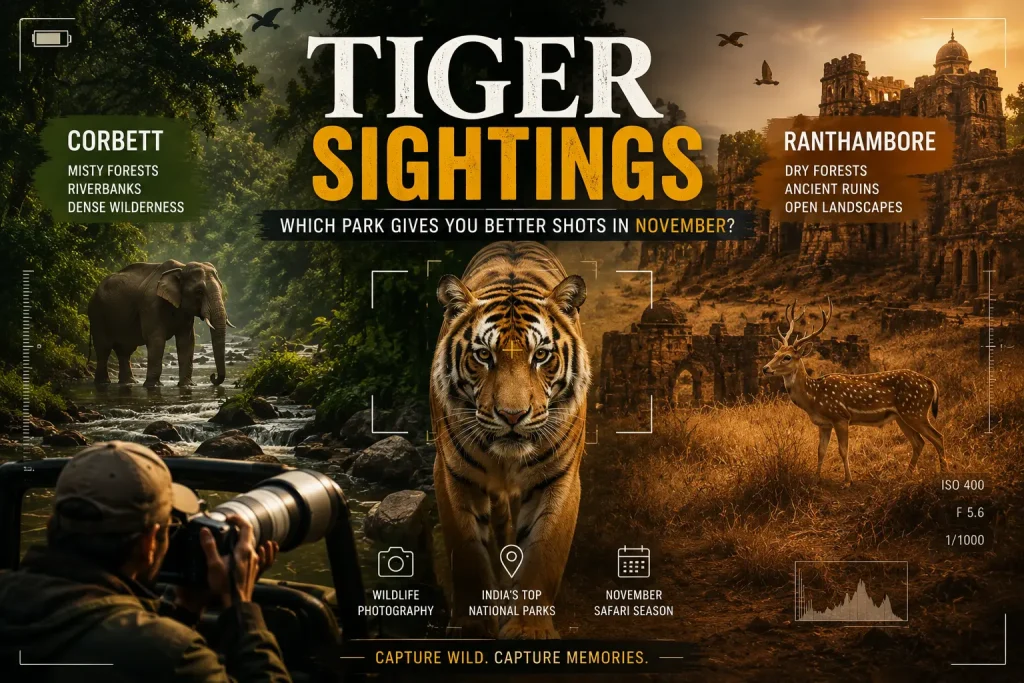
This is the question every wildlife photographer asks first. The honest answer requires understanding how each park’s habitat affects sighting frequency and shot quality — two very different things.
Jim Corbett Tiger Reserve
Corbett hosts one of the largest tiger populations in India, with approximately 260 tigers within the reserve. However, the park covers a vast area of dense sal forest, grasslands, and river valleys. Tigers are present, but locating them within thick cover is genuinely challenging.
What this means for your photography in November:
- Sighting Frequency: Moderate. You may sight tigers every 2 to 3 safaris on average, though it varies considerably by zone.
- Shot Quality: When sightings occur in Bijrani or along the Ramganga riverbed, the open grass and water backgrounds produce excellent environmental portraits.
- November Advantage: The dry grass of November opens up visibility in Bijrani and Dhikala considerably compared to peak monsoon. Dhikala, which opens mid-November, is the finest zone for wide landscape shots with tigers in frame.
- Bonus: Corbett offers Asia’s highest elephant density. Photographing wild elephant herds wading through the Ramganga is a world-class experience in itself.
Ranthambore National Park
Ranthambore covers a smaller core area with 55 to 60 tigers that are highly habituated to safari vehicles. The park’s open terrain — dry deciduous forest, three major lakes, and the ruins of Ranthambore Fort — forces tigers into visible spaces, especially near water sources.
What this means for your photography in November:
- Sighting Frequency: High. Many photographers report tiger sightings on 4 out of 6 safaris during November.
- Shot Quality: Exceptional for portraits. Tigers resting near Padam Talao or walking along the fort walls produce iconic, publication-ready images.
- November Advantage: The water levels at the three lakes are still high post-monsoon, attracting tigers consistently. Mornings bring tigers to the lake edges for drinking — a perfect 20-minute photography window.
- Bonus: The Ranthambore Fort backdrop is unique to this park. No other tiger reserve in India offers a UNESCO-heritage ruin as a natural photographic canvas.
Verdict on Tiger Sightings
If maximizing tiger photography is your primary goal, Ranthambore delivers a higher probability of close, photogenic sightings in November. Corbett rewards patience and offers more diverse subjects, but tiger encounters are less guaranteed.
Photography Landscape and Shooting Opportunities
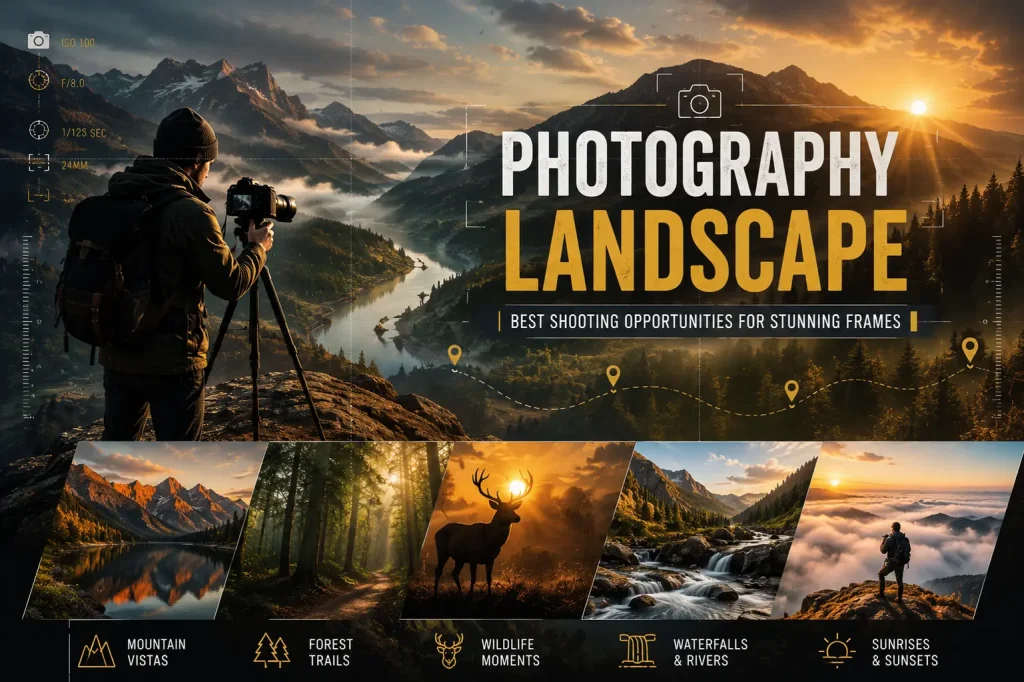
Understanding the visual language of each park is as important as knowing where tigers roam. The two parks demand different skills and gear setups.
Jim Corbett: The Atmospheric Forest Experience
Corbett is a cinematographer’s park. The layered forest, morning mist rising off the Ramganga, and herds of elephants moving through golden grass create scenes that feel alive and immersive.
Key photography subjects and opportunities at Corbett:
- Bengal tigers (often in grasslands or riverine areas)
- Asian elephants in herds along the Ramganga river
- Gharials and mugger crocodiles on river banks
- Sambar and chital deer in open meadows
- Over 580 bird species including pied kingfisher, crested serpent eagle, and great hornbill
- Misty forest sunrise scenes — unique to November
- Riverbed landscape photography at dawn
The challenge at Corbett is that dense vegetation can block sightlines. You need a telephoto lens of at least 500mm equivalent and patience. The reward is imagery that feels raw and authentic rather than posed.
Ranthambore: Dramatic and High-Contrast Wildlife
Ranthambore is a portrait photographer’s dream. The open scrub forest, three lakes, and the 10th-century fort create settings where animals appear against dramatic, uncluttered backgrounds.
Key photography subjects and opportunities at Ranthambore:
- Bengal tigers (frequently sighted near Padam Talao, Rajbagh Talao, and Malik Talao)
- Tigers framed against the Ranthambore Fort — an iconic composition
- Crocodiles basking in shallow lake edges
- Sloth bears (sightings are less frequent but remarkable)
- Sambar deer in large herds near water
- Peacocks in full display — particularly stunning in November
- Lake reflection photography at sunrise
Ranthambore’s terrain rewards any zoom range from 300mm to 600mm. The open landscape also means backlight and silhouette shooting near water are consistently achievable with some planning.
Camera Gear Recommendations: What to Bring for Each Park
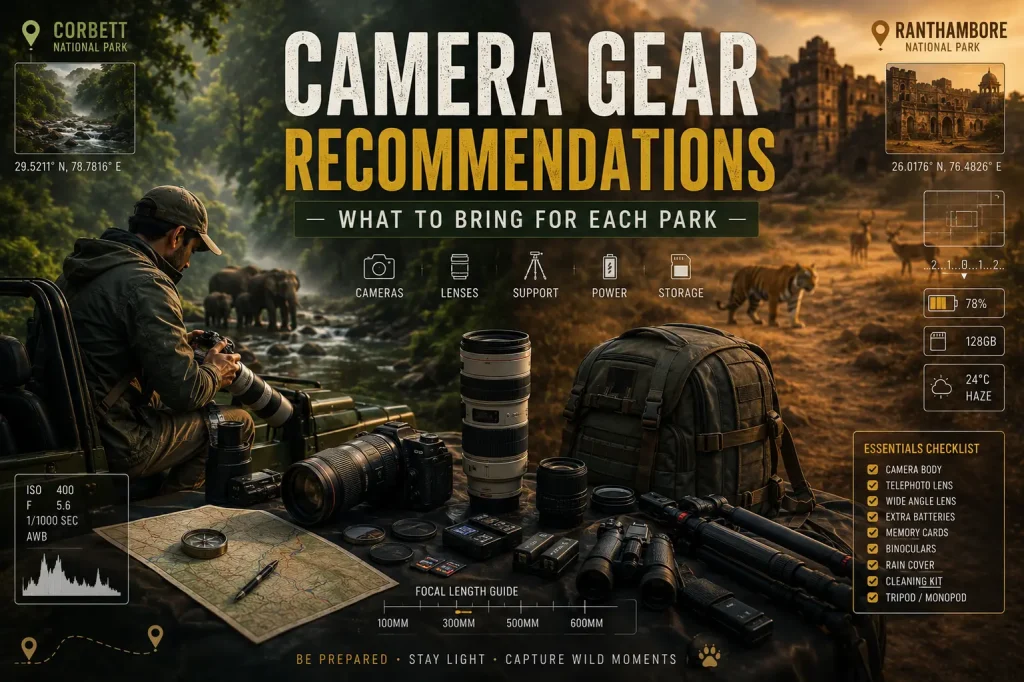
No competitor article on this topic covers gear recommendations in detail. This section fills that gap.
For Jim Corbett
- Primary Lens: 400mm to 600mm telephoto (or 100-500mm zoom). Dense forest requires reach to isolate animals from cluttered backgrounds.
- Secondary Lens: 24-105mm or 70-200mm for elephant herds, landscapes, and bird colonies at broader distances.
- Camera Body: Any modern DSLR or mirrorless with strong high-ISO performance. Corbett mornings are misty and darker than Ranthambore — you will often shoot at ISO 800 to 3200.
- Stabilization: In-body image stabilization (IBIS) or lens stabilization is essential for the low-light misty mornings.
- Tripod or Beanbag: A beanbag is preferred over a tripod in jeep safaris. It provides stability without taking up passenger space.
- Memory and Power: Bring at least 4 memory cards (64GB each) and two fully charged batteries per body. Cold mornings drain batteries faster.
For Ranthambore
- Primary Lens: 300mm to 500mm telephoto. The open terrain allows you to shoot from moderate distances with clean backgrounds.
- Secondary Lens: 70-200mm works well for lake scenes and fort silhouettes at dawn.
- Camera Body: Any camera with reliable autofocus tracking performs well. Ranthambore’s bright morning light means you can shoot at lower ISOs (400 to 800) for cleaner files.
- Polarizing Filter: Highly recommended for lake reflection shots and to manage bright open-sky glare.
- Cleaning Kit: Ranthambore’s dust is a real concern. Bring a blower, sensor swabs, and lens cleaning cloths on every safari.
- Teleconverter: A 1.4x teleconverter extends your reach without adding significant weight — useful for tiger portraits at the fort wall.
Safari Zone Guide: Where to Book for Best Photography Results
Corbett Safari Zones
Corbett is divided into several buffer and core zones. Not all zones offer equal photography value. Here is a practical breakdown for November:
- Bijrani Zone: The best zone for tiger photography in November. Open sal-grass meadows with good sightlines. Morning mist creates atmospheric, layered shots. Book this zone first.
- Dhikala Zone: Opens mid-November. Considered the crown jewel of Corbett by experienced photographers. Chaur grasslands and Ramganga reservoir views are unmatched. Requires canter vehicles (open bus), which limits camera positioning.
- Jhirna Zone: Open year-round, excellent for sloth bear and leopard sightings. A good fallback if Bijrani is fully booked.
- Dhela Zone: Buffer zone, open all year. Good for general wildlife but lower tiger density than core areas.
- Sitabani Buffer Zone: Not part of the core reserve. No photography permits needed but also lower wildlife density.
Booking tip for Corbett: Safari permits sell out 60 to 90 days in advance through the Uttarakhand Forest Department portal. Jeep safaris accommodate up to 6 passengers plus driver and guide. Hiring a full jeep gives you the flexibility to position yourself without asking other passengers to move.
Ranthambore Safari Zones
Ranthambore is divided into 10 zones, with zones 1 to 5 forming the core area and zones 6 to 10 covering the buffer zone.
- Zone 2 (Padam Talao): The single best zone for photographers. Padam Talao is the largest lake in Ranthambore. Tigers visit regularly, and the old Jogi Mahal rest house adds a historical dimension to your compositions.
- Zone 3 (Rajbagh Talao): Second priority for photographers. Rajbagh Talao hosts crocodiles, sambar, and tigers. November water levels make this a highly productive zone.
- Zone 4 (Malik Talao): Known for marsh crocodiles and consistent tiger activity. The smaller lake size means animals appear closer to the trail.
- Zone 1 (Fort Approach): Best for the classic Ranthambore Fort backdrop shot. Sightings near the fort walls are less frequent but unforgettable when they happen.
- Zone 5: Higher elevation with rocky terrain. Excellent for leopard photography.
- Zones 6 to 10 (Buffer): Lower permit costs but lower sighting frequency. Suitable if core zones are fully booked.
Booking tip for Ranthambore: The Rajasthan Forest Department portal releases permits 90 days in advance. Gypsy (jeep) seats cost approximately Rs. 2,000 to 2,300 per person for Indian nationals. Booking a full gypsy (4 to 6 seats) gives you full control of shooting positions and is worth the extra cost.
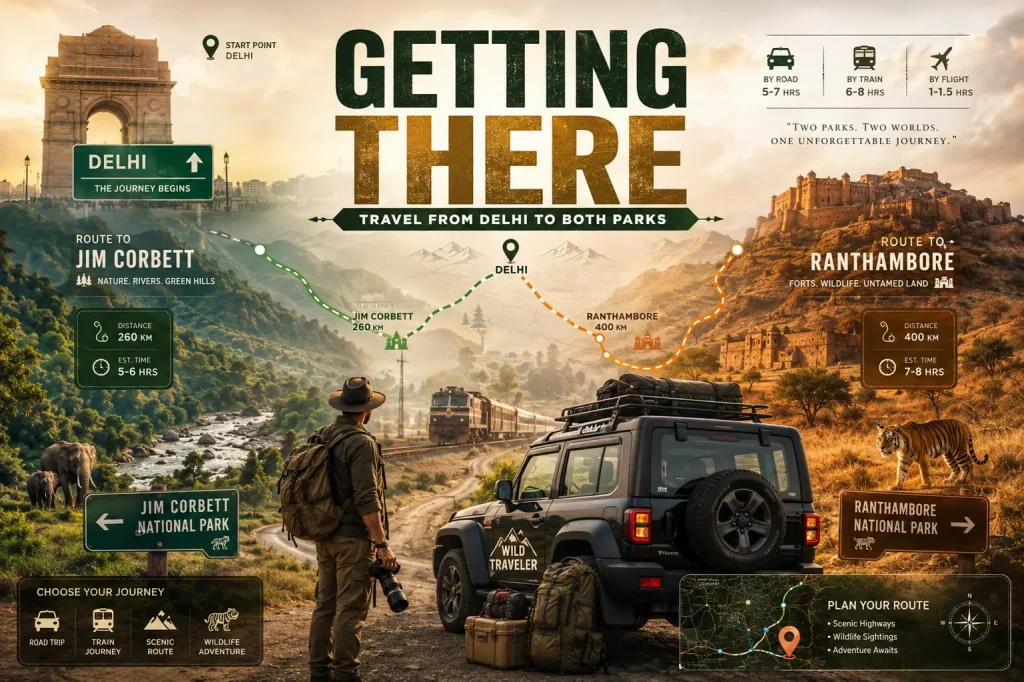
Getting There: Travel from Delhi to Both Parks
Delhi to Jim Corbett (Ramnagar)
Distance: Approximately 245 to 260 km. Total journey time: 5 to 6 hours by road or rail.
- By Train: The Ramnagar Express (train number 15013/15014) runs from Kashmere Gate ISBT area to Ramnagar. Journey time around 5 to 6 hours. Fare in Sleeper class: Rs. 200 to 350. In 3A AC: Rs. 600 to 900.
- By Road (Self-Drive or Taxi): NH 9 and NH 734 route via Moradabad to Ramnagar. Taxi (one way): Rs. 2,500 to 4,000. Self-drive fuel cost: Rs. 1,400 to 1,800 approximately.
- Time Recommendation: Take a night train from Delhi, arrive in Ramnagar by early morning, freshen up, and head directly for an afternoon safari on Day 1.
Delhi to Ranthambore (Sawai Madhopur)
Distance: Approximately 346 km. Total journey time: 4.5 to 6 hours by express train.
- By Train: Multiple express trains run from Hazrat Nizamuddin or New Delhi railway station to Sawai Madhopur. Recommended trains: Rajasthan Sampark Kranti Express or Kota Jan Shatabdi. Fare in Sleeper: Rs. 250 to 500. In AC 3A: Rs. 700 to 1,200.
- By Road (Taxi): Delhi to Sawai Madhopur via NH 48 and NH 52. Taxi (one way): Rs. 4,000 to 6,000.
- Time Recommendation: Take a morning express from Nizamuddin. Arrive by 1 PM, check in, and rest before an afternoon safari.
Local Transport Within the Park Area
- Corbett: Auto-rickshaws and local shared jeeps run between Ramnagar market and the gate zones. Budget Rs. 100 to 300 per local trip.
- Ranthambore: Sawai Madhopur is a compact town. Most hotels are within 2 to 5 km of the park gate. Auto-rickshaws charge Rs. 50 to 150 for town trips.
Accommodation Guide: Where to Stay Without Blowing Your Budget
Staying Near Jim Corbett
Ramnagar town and the areas near Dhikala, Bijrani, and Jhirna gates have a wide range of accommodation options.
- Budget (Rs. 800 to 1,500 per night): Basic guesthouses in Ramnagar market and Dhikuli area. Clean rooms, running hot water, local canteen meals available.
- Mid-Range (Rs. 1,800 to 3,500 per night): Jungle-facing resorts and cottages in Dhikuli, Corbett Nagar, and Marchula area. These are the sweet spot for wildlife photographers — comfortable but not luxury.
- Premium (Rs. 4,500 and above): Luxury jungle lodges inside or adjacent to the buffer zone. Excellent photography opportunities but beyond the 50K budget for a 5-day trip.
Recommended areas: Dhikuli (close to Bijrani and Jhirna gates) and Corbett Nagar (close to Dhela gate). Staying near the gate saves transfer time and lets you reach the park before sunrise.
Staying Near Ranthambore
Sawai Madhopur town and the road to the park gate (known as Ranthambore Road) have multiple hotel options.
- Budget (Rs. 1,000 to 1,800 per night): Clean guesthouses on Ranthambore Road within 3 km of the gate. Staff are usually knowledgeable about safari logistics.
- Mid-Range (Rs. 2,500 to 4,500 per night): Several well-regarded boutique hotels and wildlife camps on the main road. Many offer complimentary jeep booking assistance.
- Premium (Rs. 5,000 and above): Luxury tented camps and heritage properties near the park. Again, these exceed the budget for most photographers planning a 50K trip.
Recommended area: Ranthambore Road between Sawai Madhopur station and the park gate — maximum convenience, moderate pricing.
Complete Budget Breakdown for a 5-Day Trip (Rs. 50,000 Budget)
The following tables break down realistic costs for Indian nationals traveling solo or as a pair. Shared costs are calculated per person where applicable.
Budget Breakdown: Jim Corbett (5 Days, Per Person, Pair Sharing)
| Expense Category | Low Estimate (Rs.) | High Estimate (Rs.) | Notes |
| Round-trip train (Delhi-Ramnagar) | 400 | 900 | Sleeper to 3A AC |
| Local transfers | 500 | 1,000 | Auto/shared taxi |
| Accommodation (4 nights) | 7,200 | 14,000 | Rs. 1,800 to 3,500/night, pair sharing |
| Safaris (6 sessions, shared jeep) | 8,000 | 14,000 | Full jeep split between 2 |
| Meals (5 days) | 2,000 | 4,000 | Local dhabas and guesthouses |
| Entry permits and misc. | 1,500 | 2,500 | Gate fees, misc. expenses |
| TOTAL (Per Person) | 19,600 | 36,400 | Comfortably within Rs. 50K |
Budget Breakdown: Ranthambore (5 Days, Per Person, Pair Sharing)
| Expense Category | Low Estimate (Rs.) | High Estimate (Rs.) | Notes |
| Round-trip train (Delhi-Sawai Madhopur) | 500 | 1,200 | Sleeper to 3A AC |
| Local transfers | 400 | 800 | Compact town, low cost |
| Accommodation (4 nights) | 8,000 | 18,000 | Rs. 2,000 to 4,500/night, pair sharing |
| Safaris (6 sessions, gypsy sharing) | 6,000 | 12,000 | Per seat booking or shared full gypsy |
| Meals (5 days) | 2,000 | 4,500 | Local restaurants and hotels |
| Entry permits and misc. | 2,000 | 3,000 | Higher zone fees in core area |
| TOTAL (Per Person) | 18,900 | 39,500 | Manageable within Rs. 50K |
Budget Verdict: Both parks are achievable within Rs. 50,000 per person for a 5-day trip when you travel by train and share safari vehicles. Corbett is marginally easier to keep within budget because the train fare is lower and accommodation near Dhikuli is competitive. Ranthambore’s per-seat safari booking option is a strong budget tool that Corbett’s full-jeep model does not offer.
Full 5-Day Itinerary: Jim Corbett National Park
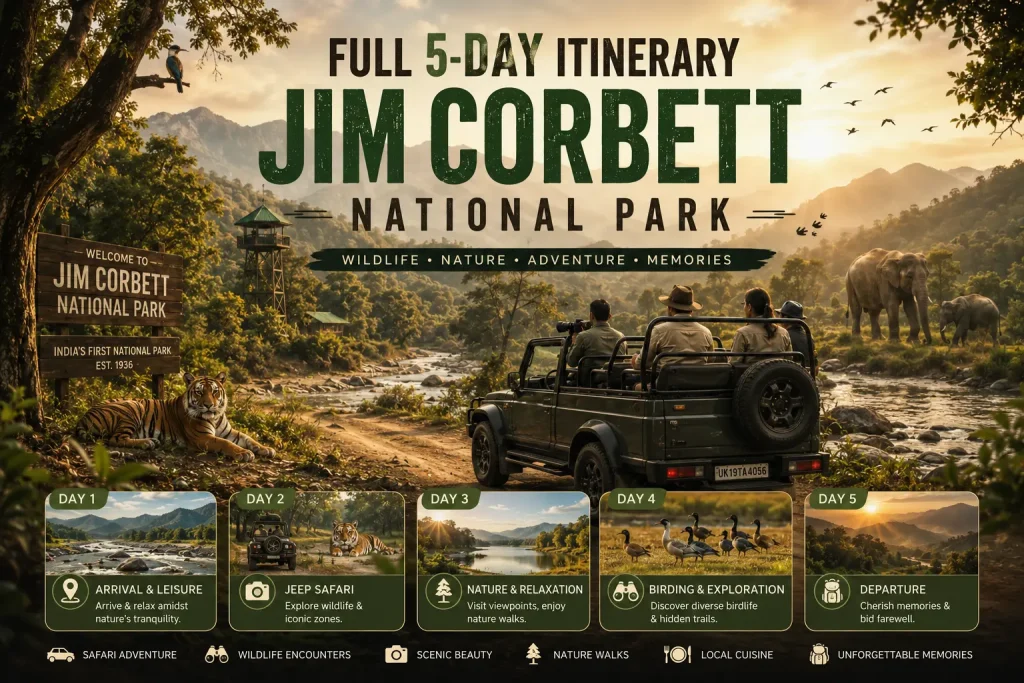
Day 1: Arrival in Ramnagar
- Arrive by morning train (overnight from Delhi recommended)
- Check in to your guesthouse in Dhikuli by 10 AM
- Afternoon safari in Bijrani Zone (2:30 PM to 6:00 PM) — first look at the park, grassland orientation
- Evening: Gear check, clean lenses, charge batteries
- Dinner at local dhaba or guesthouse kitchen
Day 2: Full Safari Day at Bijrani
- Morning safari: 6:00 AM to 9:30 AM in Bijrani Zone — the golden light window. Focus on tigers, elephants, and bird activity near the meadows
- Return for breakfast and rest (critical — fatigue ruins afternoon shooting)
- Afternoon safari: 2:30 PM to 6:00 PM in Bijrani or Jhirna Zone
- Evening: Review and cull images, prepare gear for the next day
Day 3: Jhirna Zone and Bird Photography
- Morning safari: 6:00 AM to 9:30 AM in Jhirna Zone — strong for sloth bear and leopard
- Afternoon: Birdwatching near the Kosi river (no permit required outside park gates)
- Afternoon safari: 2:30 PM to 6:00 PM — try Dhela Zone for a different landscape
Day 4: Dhikala Zone (Opens Mid-November)
- Full-day canter safari to Dhikala if open and permits available — this is the highlight of the trip
- Chaur grasslands offer the best wide-landscape wildlife photography in India
- Ramganga reservoir backdrops add drama to any shot
- If Dhikala is unavailable, repeat Bijrani morning and Jhirna afternoon
Day 5: Final Safari and Departure
- Early morning safari: 6:00 AM to 9:30 AM — final chance for tiger sighting at Bijrani
- Check out by 11:00 AM
- Transfer to Ramnagar station for Delhi train
- Review and back up all images during the journey
Full 5-Day Itinerary: Ranthambore National Park
Day 1: Arrival at Sawai Madhopur
- Arrive by train from Delhi (morning express recommended)
- Check in to hotel on Ranthambore Road
- Afternoon safari: Zone 3 or Zone 4 (2:00 PM to 5:30 PM) — orientation drive
- Evening: Walk to Sawai Madhopur market, local dinner
Day 2: Core Zone Photography — Padam Talao
- Morning safari: Zone 2 — Padam Talao (7:00 AM to 10:30 AM) — lake edge photography at prime tiger hour
- Focus on tigers near water, crocodile basking shots, and lake reflections
- Afternoon rest and image review
- Afternoon safari: Zone 3 — Rajbagh Talao (2:00 PM to 5:30 PM) — backlight and silhouette opportunities
Day 3: Fort Zone and Leopard Territory
- Morning safari: Zone 1 — Fort approach (7:00 AM to 10:30 AM) — aim for the iconic fort-backdrop tiger shot
- Rest, hotel lunch
- Afternoon safari: Zone 5 — rocky terrain, leopard territory, excellent panoramic landscape shots
Day 4: Malik Talao and Buffer Zone
- Morning safari: Zone 4 — Malik Talao (7:00 AM to 10:30 AM)
- Focus on crocodile and sambar herd photography — different visual style from the tiger zones
- Afternoon option: Zone 6 buffer zone — lower permit cost, good for peacock and bird photography
Day 5: Final Core Zone Safari and Departure
- Final morning safari in Zone 2 or Zone 3 — your highest probability tiger window
- Check out by noon
- Sawai Madhopur to Delhi train (midday or afternoon departure)
- Image backup and travel
Step-by-Step Safari Booking Guide
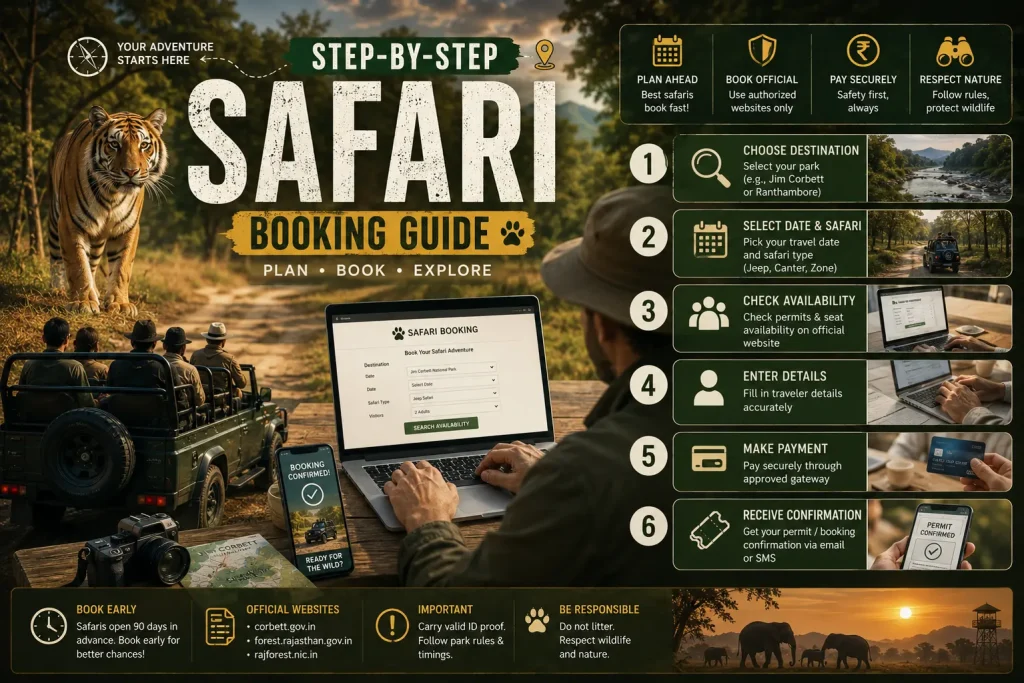
Competitors rarely explain how to actually book safaris. Here is a practical guide for both parks.
Booking Corbett Safaris
- Step 1: Visit the official Uttarakhand Forest Department portal at uttarakhandforest.gov.in
- Step 2: Register with your name, Aadhaar number (for Indian nationals), and contact details
- Step 3: Select your zone (Bijrani, Jhirna, Dhela, or Dhikala when open), shift (morning or afternoon), and number of seats or full jeep
- Step 4: Pay online. Keep the PDF confirmation for gate entry
- Step 5: Book at least 60 days in advance for November. Bijrani morning slots fill within hours of opening
- Important: Mobile phones are not permitted inside certain Corbett zones. Check zone-specific rules before your safari
Booking Ranthambore Safaris
- Step 1: Visit rajasthanwildlife.in or book through the Forest Department portal
- Step 2: Register and verify your mobile number for OTP-based booking
- Step 3: Select zone (1 through 10), vehicle type (gypsy or canter), and shift
- Step 4: Pay online. Save and print the booking confirmation
- Step 5: Book core zone (1 to 5) gypsies at least 45 to 60 days ahead for November
- Pro Tip: Ranthambore’s permit system refreshes cancelled seats regularly. Check the portal daily in the 10 days before your trip for last-minute availability
Expert Photography Tips Specific to Each Park
These practical tips come from on-ground experience that most travel guides leave out.
Tips for Jim Corbett
- Arrive Before Gate Opening: Reach the safari gate 30 minutes early. Vehicles that enter first get first position at any sighting that develops at dawn.
- Use the Mist: November mornings produce 15 to 45 minutes of mist near the Ramganga. Shoot wide, include the mist layers, and embrace the atmosphere — this is what separates Corbett shots from every other park.
- Watch the Grass: Chital deer bunching together and staring in one direction almost always means a predator nearby. This behaviour gives you 60 to 90 seconds of preparation time.
- Shoot the Elephants: Do not tunnel-vision on tigers at Corbett. Elephant herds crossing the Ramganga in morning light are portfolio-worthy images that very few photographers prioritize.
- Noise Discipline: Jeep drivers take noise seriously. Keep conversation minimal and avoid sudden movements that spook animals.
Tips for Ranthambore
- Zone 2 First Hour: The first 40 minutes in Zone 2 after gate opening are the highest-probability period. Stay near Padam Talao and do not rush to move zones.
- Position Your Vehicle: Ask your driver to park with the sun behind you (east-facing in the morning). Front-lit animals make for cleaner, sharper portraits.
- Use the Fort Backdrop Deliberately: The fort is visible from multiple points in Zones 1 and 2. If you spot a tiger walking in that direction, anticipate and position for the fort backdrop before the animal arrives.
- Watch the Water Edge: Tigers approach water slowly, often stopping to scan for threats. Set your focus point at the lake edge and wait. The approach walk is often better than the actual drinking moment.
- Dust Management: Ranthambore’s dry terrain kicks up dust during afternoon safaris. Use a UV filter to protect your front element and check for dust on your sensor before every safari.
Frequently Asked Questions
Which park is better for first-time wildlife photographers?
Ranthambore is the better choice for first-timers. The open terrain and high tiger visibility mean you will come home with images regardless of experience level. Corbett rewards photographers who understand forest behaviour and camera settings, making it more suitable for intermediate and advanced shooters.
Can I visit both parks in one 5-day trip?
It is not advisable. Corbett and Ranthambore are approximately 600 km apart by road. Splitting 5 days means you lose at least 2 full days to travel, leaving only 3 safari sessions at each park — not enough for a productive photography trip.
Is a private jeep necessary, or can I share with strangers?
Sharing is possible and budget-friendly, especially at Ranthambore where per-seat booking is standard. However, for serious photography, a private jeep gives you freedom to position, stop, and wait without other passengers becoming impatient. If budget allows, always book a full jeep at Corbett.
What is the best time of day for wildlife photography at both parks?
The first 90 minutes after gate opening (approximately 6:00 AM to 7:30 AM at Corbett and 7:00 AM to 8:30 AM at Ranthambore) delivers the best combination of animal activity and soft directional light. This is non-negotiable for serious photographers.
Do I need a government-approved guide?
Yes, at both parks a certified naturalist guide is mandatory and is included in the safari permit cost. A good guide improves sighting frequency dramatically. At Ranthambore, experienced guides in Zones 2 and 3 often know individual tigers by name and can predict their movement patterns.
Are there any restrictions on camera equipment?
Neither park restricts camera body or lens size. However, Corbett prohibits mobile phones in certain core zones during safaris. Drones are strictly prohibited at both parks and carry heavy penalties. Flash photography is not allowed as it disturbs wildlife.
How should I handle a tiger sighting without panicking?
Switch to burst mode before you enter the park, not when the tiger appears. Pre-set your shutter speed to at least 1/500s to freeze motion. When the sighting occurs, breathe, trust your autofocus, and shoot in short bursts of 5 to 8 frames rather than holding the shutter continuously. Review your settings in the first pause rather than during the sighting.
The Final Verdict
| Your Priority | Best Choice | Reason |
|---|---|---|
| Maximum tiger sightings | Ranthambore | Open terrain, habituated tigers, lake waterholes |
| Diverse wildlife subjects | Jim Corbett | Elephants, gharials, birds, forest deer |
| Dramatic portrait photography | Ranthambore | Fort backdrop, lake reflections, high-contrast light |
| Atmospheric landscape photography | Jim Corbett | November mist, riverine scenery, layered forests |
| Tight budget management | Jim Corbett | Shorter distance from Delhi, lower train fare |
| Easy travel logistics | Ranthambore | Excellent express train connectivity |
| First-time wildlife photographer | Ranthambore | Higher sighting probability, open terrain |
| Experienced photographer seeking challenge | Jim Corbett | Complex habitats, behavioral photography |
Both Jim Corbett and Ranthambore National Parks are extraordinary in November. Your choice comes down to what kind of images you want on your memory card at the end of Day 5.
Choose Ranthambore if tiger portraits and dramatic, publication-ready shots are your goal. Choose Corbett if you want environmental storytelling, diverse wildlife, and a deep immersive forest experience.
Either way, book your safaris at least 60 days in advance, travel by train to save budget, stay near the park gate, and spend every spare minute of daylight studying the jungle. The best wildlife photograph is not the one you plan — it is the one you are ready for.
You May Also Like It:
How Do I Use Search Live to Identify the Signs Showing on My Car Dashboard?
How Can I Get a New Gas Pipeline Connection? What Should I Do to Make the Process Easier?
how to identify if the pashmina shawl i am buying is genuine?