

How to Negotiate Car Price. Buying a car is one of the biggest financial decisions most people make. Yet the majority of buyers walk into a dealership without a clear strategy — and end up paying far more than they should. The good news is that the car price is almost always negotiable, and knowing how to negotiate a car price can save you thousands of dollars.
This guide covers everything — from pre-visit research to closing the deal — including tactics, scripts, timing secrets, and mistakes that most buyers make. Whether you are buying a new car, a used car, or negotiating with a private seller, this guide has you covered.
Why Car Prices Are Negotiable
Car dealerships set sticker prices — also called MSRP (Manufacturer’s Suggested Retail Price) — with the expectation that buyers will negotiate. The sticker price is a starting point, not a fixed number. Dealers build in profit margins to give themselves room to come down while still making money.
Several factors make car prices flexible:
- Dealer incentives: Manufacturers regularly offer dealers cash bonuses for selling a certain number of units per month. These incentives give dealers flexibility to reduce prices.
- Inventory pressure: A car sitting on the lot for 60 days or more costs the dealer money in floor plan financing. The longer it sits, the more motivated they are to move it.
- End-of-month or end-of-quarter targets: Salespeople and dealerships have sales quotas. Near the end of a reporting period, they are more willing to cut a deal.
- Competition: With dozens of dealers selling the same brand, a buyer can use competing offers as leverage.
What to Do Before You Go to the Dealership
Most buyers lose negotiating power before they even arrive at the dealership because they skip preparation. Thorough preparation is the single most important thing you can do.
Set Your Maximum Budget First
Know the maximum total amount you are willing to pay — not just the monthly payment. Dealers often focus on monthly payments to distract you from the total cost. A lower monthly payment stretched over 84 months can cost you far more than a higher payment over 48 months.
Calculate your total budget like this:
- Maximum vehicle price (before taxes and fees)
- Expected taxes and registration fees in your state
- Trade-in value (if applicable)
- Down payment amount
- Maximum acceptable loan interest rate
Get Pre-Approved for Financing
Before visiting a dealer, get pre-approved for an auto loan from your bank or credit union. This gives you two major advantages:
- You know exactly what interest rate you qualify for, so the dealer cannot inflate it.
- You come in as a cash buyer from the dealer’s perspective, which gives you stronger negotiating power on the purchase price.
Even if the dealer offers you a lower rate, having pre-approval as a benchmark protects you.
Test Drive Before You Negotiate
Do your test drive on a separate visit from your negotiation visit if possible. Once a salesperson knows you love the car, your leverage weakens. Keep your emotions neutral during the test drive and avoid making enthusiastic comments in front of the salesperson.
How to Research the Right Price
Walking in without price research is the single biggest mistake car buyers make. Here is how to build a solid price foundation before you negotiate.
Know the Invoice Price
The invoice price is what the dealer paid the manufacturer for the vehicle. It is typically 2 to 8 percent below MSRP depending on the model. Websites like Edmunds, TrueCar, and Kelley Blue Book publish invoice prices for most vehicles. Aim to negotiate as close to invoice as possible, or even below it if dealer incentives are active.
Check Market Value and Local Listings
Look at what similar vehicles are selling for in your area. Check:
- Edmunds: Provides True Market Value (TMV) — the average price buyers actually pay in your region.
- Kelley Blue Book (KBB): Shows fair market range for both new and used vehicles.
- TrueCar: Shows actual transaction prices paid by buyers nearby.
- Cars.com and AutoTrader: Show active listings to compare inventory and prices.
Find Out About Manufacturer Incentives
Manufacturers offer rebates, cashback offers, and low-interest financing deals that change monthly. Check the manufacturer’s official website and sites like Edmunds for the current month’s incentives on your target vehicle. These incentives come off the price in addition to any negotiation you do.
How Long Has the Car Been on the Lot?
Use tools like Autocheck or ask the dealer directly how long a specific vehicle has been in inventory. Cars sitting for 60 to 90 days are prime negotiation targets. Dealers pay interest on floored inventory, meaning every day a car sits costs them money.
Understanding Dealer Pricing Terms
Knowing these terms prevents dealers from confusing you during negotiation.
| Term | What It Means |
| MSRP | Manufacturer’s Suggested Retail Price — the sticker price on the window |
| Invoice Price | What the dealer paid the manufacturer for the car |
| Dealer Holdback | A percentage (usually 2-3% of MSRP) the manufacturer pays back to the dealer after the sale |
| Dealer Incentives | Cash bonuses from the manufacturer paid to the dealer for hitting sales targets |
| Market Adjustment | An above-MSRP markup dealers add on high-demand vehicles |
| Out-the-Door Price | The total price including all taxes, fees, and charges — the number that actually matters |
| Destination Charge | Fee charged by the manufacturer to ship the car to the dealer — not negotiable |
| Documentation Fee | A dealer administrative fee — often negotiable or waivable |
| Dealer Add-Ons | Extras installed by the dealer (window tint, protection packages) — almost always negotiable |
The Best Time to Negotiate a Car Price
Timing is a genuine, underused advantage. Here is when dealers are most likely to negotiate:
- End of the month: Salespeople work toward monthly quotas. In the last 3 to 4 days of any month, they are much more willing to cut a deal to hit their numbers.
- End of the quarter: March, June, September, and December are the most powerful months because both dealer and manufacturer bonuses often reset quarterly.
- End of model year: When the new model year arrives (usually late summer), dealers need to clear current-year inventory. Discounts on current-year models can be substantial.
- Weekdays: Dealerships are less busy on Tuesday, Wednesday, and Thursday mornings. Salespeople have more time and less foot traffic pressure, which can work in your favor.
- Bad weather days: Rainy or cold days bring in fewer shoppers. Dealers are more motivated to move metal when the showroom is quiet.
- Holiday sales events: Presidents Day, Memorial Day, Labor Day, and Black Friday are legitimate sale periods with real manufacturer incentives behind them.
How to Negotiate a Car Price Step by Step
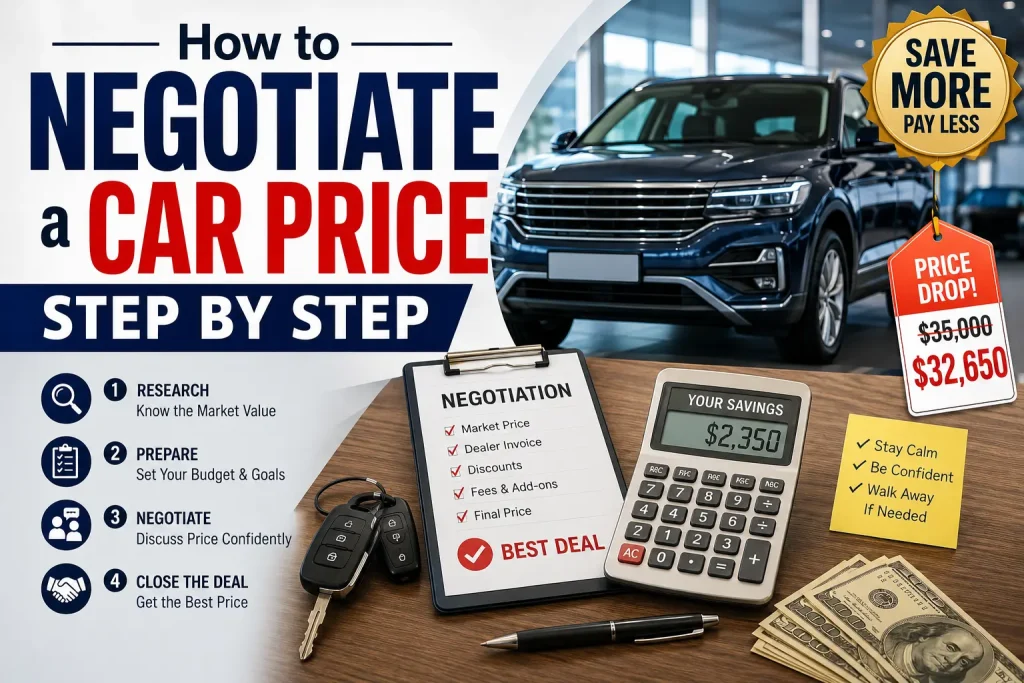
Step 1: Decide on Your Target Price Before You Walk In
Based on your research, set three price points:
- Your ideal price: Invoice price or below, after any rebates.
- Your acceptable price: A price that represents solid value.
- Your walk-away price: The maximum you will pay under any circumstances.
Step 2: Start With the Out-the-Door Price
Always negotiate the total out-the-door price, not the monthly payment. When you focus on monthly payments, dealers can manipulate the loan term and interest rate to make a bad deal look affordable. Ask the salesperson to provide a complete breakdown of the out-the-door price before any negotiation begins.
Step 3: Make Your Opening Offer Below Target
Open below your target price, but do not be insulting. A reasonable opening offer is 5 to 10 percent below invoice price. This gives you room to negotiate up while still landing at or near your target.
Example: If invoice is $30,000 and your target is $29,000, open at $27,500.
Step 4: Let the Dealer Counter — Then Pause
After you make your offer, stop talking. Silence is a powerful negotiating tool. Let the salesperson respond. When they counter, do not immediately respond with a number. Take a pause, review the figures, and ask questions. The next person to speak often gives ground.
Step 5: Use Competing Offers as Leverage
If you have quotes from other dealers — or even printed listings from competing dealerships — bring them. A real competing offer is one of the most effective negotiating tools available. You are not threatening the dealer; you are showing them you have done your homework.
Step 6: Separate Trade-In and Financing
Keep the trade-in negotiation completely separate from the purchase negotiation. Dealers blend these together to confuse buyers. Agree on the purchase price first. Then introduce the trade-in. Then discuss financing. Never let the salesperson combine them into one monthly payment figure.
Step 7: Get Everything in Writing
Before you sign anything, get a complete itemized worksheet with every number spelled out. Review it line by line. Check for dealer add-ons that you did not agree to. Confirm the interest rate, loan term, and total amount financed. Never rely on verbal promises.
Specific Negotiation Scripts You Can Use
Most guides tell you what to do but not what to say. Here are real scripts for common situations.
Opening Offer Script
“I have done my research on this vehicle. Based on the invoice price and current market conditions, I am prepared to offer $[your number] out the door today if we can agree. I have financing arranged, so I am ready to close quickly. Does that work for you?”
Handling the Counter Offer
“I appreciate the offer, but I am not quite there yet. My ceiling on this vehicle is $[your acceptable price] out the door. If you can meet that number, I will sign today. If not, I have another appointment at [competing dealer name] this afternoon.”
When They Focus on Monthly Payments
“I understand you want to find a payment that works for me, but I prefer to negotiate the total vehicle price first. Can you give me your best out-the-door price on this car?”
When They Refuse to Move
“I respect that you have a position on price. Let me think it over and compare with the other options I am looking at. I will call you by end of day if I want to move forward.” Then stand up slowly. This prompts many salespeople to offer additional discounts before you leave.
How to Negotiate a Used Car Price
Used car negotiation follows similar principles but has additional variables.
Get a Pre-Purchase Inspection
Before negotiating seriously, pay $100 to $150 to have an independent mechanic inspect the vehicle. Any mechanical issues found become negotiating points. A worn transmission, upcoming brake job, or tire replacement are legitimate grounds to request a price reduction.
Check the Vehicle History Report
Pull a Carfax or AutoCheck report. Accidents, title issues, and odometer discrepancies all reduce the vehicle’s value. Use any red flags to justify a lower offer.
Use Depreciation Data
Used car values depreciate based on mileage, condition, and age. Know the private party value and the trade-in value from KBB or Edmunds. A used car at a dealership should be priced between private party and certified pre-owned pricing, not above the new car’s MSRP.
Specific Used Car Opening Tactic
“I have reviewed the KBB fair market value for this vehicle in this condition with these miles. The fair private party value is $[number]. I understand you have overhead costs, so I am offering $[slightly below your target] which is fair given the market. Would you accept that?”
How to Negotiate at a Private Sale
Private sellers are often more emotionally attached to their vehicles, which creates both challenges and opportunities.
- Always meet in a safe, public location for the test drive and inspection.
- Bring cash or a bank check — private sellers often accept a lower price for immediate payment.
- Point out specific, verifiable issues (high mileage, cosmetic damage, upcoming service needs) rather than general complaints.
- Ask when they need to sell. A motivated seller with a time deadline is more flexible on price.
- Do not reveal your maximum budget. Instead, anchor with a specific, researched offer.
- Offer a slightly awkward number like $7,750 instead of $8,000. Specific numbers signal that you have done the math.
Negotiating Add-Ons, Fees, and Extras
Many buyers negotiate a great vehicle price and then lose hundreds or thousands on fees and add-ons at the finance office. This is where dealerships recover margin lost during negotiation.
Dealer Add-Ons to Decline or Negotiate
- Paint protection / ceramic coating: Often installed cheaply and marked up significantly. You can buy quality products yourself for far less.
- Fabric protection: Essentially a spray application with a massive markup.
- VIN etching: A small theft deterrent with a large price tag. You can buy a DIY kit for under $25.
- Nitrogen-filled tires: Regular air is 78% nitrogen. This is not worth the markup.
- Extended warranty: Sometimes worth it, but often overpriced at the dealership. You can purchase third-party warranties after the sale for less.
- GAP insurance: May be worth it if you are financing a large amount, but check your own auto insurer’s rate first — it is almost always lower.
Fees That Are Often Negotiable
- Documentation fee: Required in some states, negotiable in others. Ask for it to be reduced or waived.
- Dealer prep fee: A catchall charge that can often be removed.
- Advertising fee: Sometimes added to the price — push back on this.
Government taxes, registration fees, and destination charges are generally not negotiable and should not be confused with dealer fees.
Trade-In Negotiation: Keep It Separate
Your trade-in is a separate transaction from your purchase. Mixing them together is one of the most common ways buyers lose money without realizing it.
How to Handle Your Trade-In
- Get your car appraised at CarMax, Carvana, or a competing dealership before going to negotiate your new purchase.
- Know your trade-in’s KBB trade-in value and private party value.
- Do not mention your trade-in until you have agreed on the purchase price.
- Use your CarMax or Carvana offer as a baseline. The dealer must beat it to earn your trade-in business.
- If the dealer lowballs the trade-in after agreeing on a purchase price, you can sell your car to CarMax separately and still get your negotiated new car price.
The key phrase to remember: “I want to separate the purchase and the trade-in. Let’s agree on the price of this car first, and then we can discuss my current vehicle.”
How Financing Affects Your Negotiation
Dealerships make significant profit from financing. The dealer marks up the interest rate above what the lender offers (called the dealer reserve), keeping the difference as profit. Here is how to protect yourself.
Know Your Credit Score First
Your credit score determines your baseline interest rate. Check your credit score before shopping. A score above 720 typically qualifies you for the best available rates.
Compare at Least Three Financing Sources
- Your primary bank
- A local credit union (often the best rates)
- The manufacturer’s financing arm (sometimes offers 0% promotional rates)
Dealer Financing Can Work for You Too
Do not automatically reject dealer financing. Manufacturers sometimes offer subvented rates (0.9%, 1.9%) that beat the market. If you take dealer financing to get a promotional rate, check whether you can refinance at a lower rate after the first few months without penalty.
Important: If taking a manufacturer’s special financing rate (like 0% APR), you often forfeit the cash rebate. Calculate which option saves you more money over the life of the loan.
Mistakes to Avoid When Negotiating a Car Price
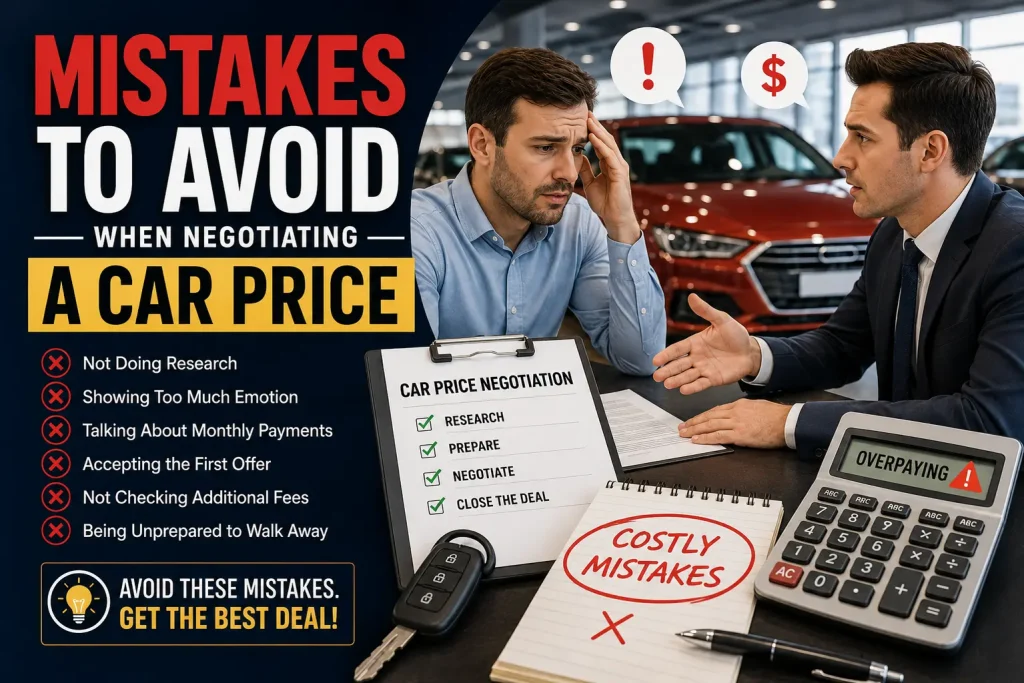
Focusing on Monthly Payment Instead of Total Price
This is the number-one mistake. A salesperson can make any car seem affordable by extending the loan term. A $40,000 car at 84 months at 7% still costs $40,000 plus $12,000 in interest. Always negotiate the total out-the-door price first.
Revealing Your Budget
Never tell a salesperson your maximum budget. If you say “I can spend up to $35,000,” that immediately becomes the target price. Instead, anchor with a specific, researched offer.
Falling in Love with One Specific Car
If you must have that exact car in that exact color with those exact features, you have no walk-away power. Research two or three acceptable vehicles and stay genuinely open to alternatives. The willingness to walk away is your most powerful tool.
Negotiating Without Competing Quotes
Contacting only one dealer removes all competitive leverage. Before negotiating in person, email the internet sales departments of three to five competing dealerships and ask for their best out-the-door price on a specific vehicle.
Skipping the Finance Office Review
Many buyers negotiate hard on the car price and then simply sign what the finance manager puts in front of them. Review every line of the finance contract. Check the interest rate against your pre-approval. Look for add-ons you did not agree to. Confirm the loan term.
Letting Urgency Pressure You
“This deal is only good today” and “Someone else is looking at this car right now” are classic high-pressure sales tactics. In reality, most deals can be recreated. If a dealer will not give you time to think, walk away.
When to Walk Away — and Why It Works
Walking away is not a bluff — it is a legitimate negotiating strategy. It signals that you are a serious, informed buyer who will not be pressured. Here is when to walk:
- The dealer will not negotiate near your researched fair price.
- They keep shifting focus to monthly payments despite your requests to discuss total price.
- They refuse to provide an itemized out-the-door price breakdown.
- They are using high-pressure tactics like artificial urgency or a fictional competing buyer.
- The finance office adds charges you did not agree to during negotiation.
When you walk, do it calmly and leave your contact information. In many cases, a dealer will call within 24 to 48 hours with a better offer. Even if they do not, another dealer will have similar inventory.
Online and Email Negotiation Tactics
Negotiating by email before visiting in person is one of the most underused strategies available to car buyers. It works especially well because:
- You eliminate the in-person psychological pressure of the dealership environment.
- You can compare multiple dealer responses side by side.
- You create a written record of every offer.
- You can negotiate at your own pace without a salesperson watching your expressions.
The Email Negotiation Method
- Identify 3 to 5 dealers within reasonable driving distance who stock your target vehicle.
- Email the internet sales department — not the general sales line — of each dealer.
- Be specific: include the exact year, make, model, trim, and color you want.
- Ask for their best out-the-door price, including all fees and taxes.
- Use the lowest competing quote to negotiate lower with each dealer.
- Do not visit until you have a written offer you are willing to accept.
Sample email: “I am actively shopping for a [Year Make Model Trim] in [color]. I am ready to purchase within the next few days. Please send me your best out-the-door price including all fees and taxes. I am contacting multiple dealers and will choose based on total price and availability.”
Negotiating for First-Time Car Buyers
If you are buying a car for the first time, the process can feel overwhelming. Here are the most important things to focus on:
- Do not rush: Take as much time as you need. A good deal will still be there tomorrow in most cases.
- Bring a trusted person: Having a second person with you changes the dynamic. You can confer privately, which slows the process and gives you breathing room.
- Stick to your script: Prepare two or three key phrases and repeat them if needed. “I need to think about it” is always acceptable.
- Remember the dealer needs you too: The salesperson wants to sell a car just as much as you want to buy one. You have power in this transaction.
- Start with a less competitive model: If possible, avoid negotiating on the most popular trim level, which has the least discount flexibility. Models with older inventory or outgoing trims are better starting points.
Quick Reference: Car Negotiation Checklist
Use this checklist before, during, and after your negotiation.
Before the Dealership
- Research MSRP, invoice price, and true market value
- Check current manufacturer incentives and rebates
- Get pre-approved for financing from bank or credit union
- Get your trade-in appraised at CarMax or Carvana
- Email 3 to 5 dealers for competing out-the-door quotes
- Set your target price, acceptable price, and walk-away price
- Plan to visit on a weekday near end of month
At the Dealership
- Request an itemized out-the-door price before negotiating
- Negotiate purchase price before mentioning trade-in or financing
- Use competing quotes as leverage
- Do not reveal your maximum budget
- Stay calm and take time to think between counter-offers
- Be prepared to walk away
At the Finance Office
- Compare dealer financing rate to your pre-approval rate
- Review every line item on the contract
- Decline or negotiate unnecessary add-ons
- Confirm loan term, interest rate, and total amount financed
- Never sign anything you have not fully read
Frequently Asked Questions
How much can you negotiate off a new car price?
On most new cars, buyers can reasonably negotiate 3 to 8 percent below MSRP, depending on the model and current market conditions. High-demand vehicles with limited inventory may have little to no discount. Cars with slow sales or approaching model-year changeover can yield discounts of 10 percent or more.
Is it rude to negotiate the price of a car?
No. Negotiation is a standard, expected part of the car buying process. Dealers set MSRP with the assumption that buyers will negotiate. Being respectful, direct, and informed is not rude — it is smart.
What should you not say when negotiating a car price?
Avoid saying your maximum budget, how much you love the car, that you need the car urgently, or that you have not shopped anywhere else. These statements remove your leverage.
Should you negotiate car price or monthly payment?
Always negotiate the total out-the-door price, never the monthly payment. Monthly payments can be manipulated by adjusting loan terms and interest rates to hide the true cost of the vehicle.
Can you negotiate a car price after agreeing?
If you signed the contract, the deal is done. However, if you have not yet signed, you can and should continue negotiating. If you discover errors or undisclosed charges in the finance office, point them out and ask for corrections before signing.
Does paying cash help negotiate a car price?
Contrary to popular belief, dealers prefer financing because they earn profit on the loan. Paying cash removes that profit source. In practice, it rarely helps and sometimes hurts. Negotiate the purchase price first, then reveal your payment method.
What is a fair profit for a car dealer?
A dealer making $500 to $1,500 over invoice on a new car sale is considered a fair transaction. Dealers also earn income from manufacturer holdback and incentives, financing, service, and accessories, so they do not need to make their entire profit on the purchase price.
Final Thoughts
Negotiating a car price is a learnable skill, not a talent you either have or do not have. Every dollar you do not negotiate away is a dollar that stays in your pocket. The buyers who get the best deals are not the most aggressive — they are the most prepared.
Do your research. Know your numbers. Set your walk-away price before you walk in. Keep trade-in and financing separate. Review every document before you sign. And remember: there is always another car and always another dealer.
Approach the process with patience, information, and a calm willingness to walk away — and you will almost always come out ahead.
You May Also Like It:
I Have Sensitive Skin. How Gentle Are Nivea’s Creams Compared to Aveeno?
My Son Can’t See How Do I Explain Colours to Him?
Compare Corbett and Ranthambore for a 5-Day Wildlife Photography Trip in November on a 50K Budget