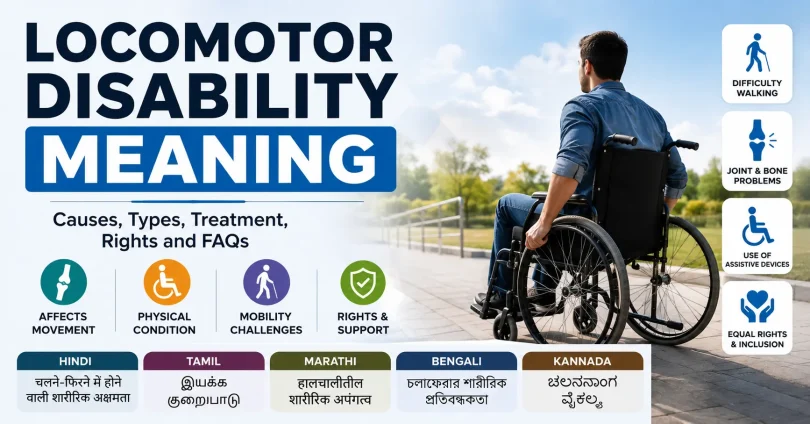
Locomotor disability is a physical condition that affects a person’s ability to move freely. It may impact walking, standing, sitting, lifting objects, or performing everyday activities. The condition can be present from birth or develop later because of an injury, illness, or age-related changes.
Millions of people around the world live with locomotor disabilities. With proper treatment, rehabilitation, assistive devices, and social support, many individuals lead independent and successful lives.
In this comprehensive guide, you’ll learn the Locomotor Disability Meaning, its causes, symptoms, types, diagnosis, treatment, legal rights, and answers to the most common questions.
What is the Meaning of Locomotor Disability?
Locomotor disability refers to a condition where a person’s movement is restricted due to impairment of bones, joints, muscles, limbs, or nerves.
According to the Rights of Persons with Disabilities (RPwD) Act, 2016 in India, locomotor disability includes disabilities affecting movement caused by conditions involving the musculoskeletal or nervous system.
Simply put, it means difficulty in moving one or more body parts.
Examples include:
- Difficulty walking
- Paralysis
- Missing limbs
- Joint deformities
- Muscle weakness
- Limited movement of arms or legs
Simple Definition
A locomotor disability is a physical impairment that limits a person’s ability to move or perform daily physical activities.
Locomotor Disability Meaning in Hindi
Locomotor disability meaning in Hindi:
चलने-फिरने में होने वाली शारीरिक अक्षमता
या
गतिशीलता संबंधी विकलांगता
यह ऐसी शारीरिक स्थिति है जिसमें व्यक्ति को चलने, खड़े होने, हाथ-पैरों का उपयोग करने या सामान्य गतिविधियाँ करने में कठिनाई होती है।
Locomotor Disability Meaning in Tamil
Locomotor disability meaning in Tamil:
இயக்க குறைபாடு
It refers to a condition where a person experiences difficulty in body movement due to problems affecting muscles, bones, joints, or nerves.
Locomotor Disability Meaning in Marathi
Locomotor disability meaning in Marathi:
हालचालीतील शारीरिक अपंगत्व
It means a physical disability that affects movement and mobility.
Locomotor Disability Meaning in Bengali
Locomotor disability meaning in Bengali:
চলাফেরার শারীরিক প্রতিবন্ধকতা
It refers to difficulty in moving because of impairment in the limbs, muscles, bones, or nervous system.
Locomotor Disability Meaning in Kannada
Locomotor disability meaning in Kannada:
ಚಲನಾಂಗ ವೈಕಲ್ಯ
It means a physical disability affecting movement due to problems in muscles, bones, joints, or nerves.
How Does Locomotor Disability Affect Daily Life?
Depending on its severity, a person may have difficulty with:
- Walking
- Standing
- Climbing stairs
- Running
- Sitting for long periods
- Carrying heavy objects
- Writing
- Dressing
- Cooking
- Driving
- Using public transport
Some people require mobility aids while others can perform most activities independently.
Causes of Locomotor Disability
Several medical conditions can lead to locomotor disability.
Congenital Conditions
These are present at birth.
Examples:
- Cerebral palsy
- Clubfoot
- Congenital limb defects
- Spina bifida
Accidents and Injuries
Trauma can permanently affect movement.
Examples include:
- Road accidents
- Sports injuries
- Spinal cord injuries
- Fractures
- Burns
Neurological Disorders
Diseases affecting the brain or nerves can reduce mobility.
Examples:
- Stroke
- Parkinson’s disease
- Multiple sclerosis
- Muscular dystrophy
Bone and Joint Diseases
These conditions affect the skeletal system.
Examples:
- Arthritis
- Osteoporosis
- Bone deformities
- Joint disorders
Infections
Certain infections may damage muscles or nerves.
Examples:
- Polio
- Tuberculosis affecting bones
- Bone infections
Amputation
Loss of one or more limbs due to:
- Accidents
- Diabetes complications
- Cancer
- Severe infections
Symptoms of Locomotor Disability
Symptoms vary from person to person.
Common signs include:
- Difficulty walking
- Muscle weakness
- Joint stiffness
- Poor balance
- Limited movement
- Limb deformity
- Chronic pain
- Paralysis
- Difficulty gripping objects
- Reduced coordination
Types of Locomotor Disability
Monoplegia
Only one limb is affected.
Hemiplegia
One side of the body becomes weak or paralyzed.
Paraplegia
Both legs are affected.
Quadriplegia
All four limbs are affected.
Amputation
Loss of an arm, leg, hand, or foot.
Cerebral Palsy
A neurological disorder affecting movement, muscle tone, and posture.
Muscular Dystrophy
A group of inherited diseases causing progressive muscle weakness.
Severity Levels
Doctors often classify locomotor disability based on movement limitations.
- Mild
- Moderate
- Severe
- Complete impairment
Disability percentage is determined using medical guidelines for certification.
How is Locomotor Disability Diagnosed?
Doctors may recommend:
Physical Examination
Assessment of movement, strength, and balance.
Medical History
Review of injuries, illnesses, and family history.
Imaging Tests
Examples:
- X-ray
- MRI
- CT scan
Neurological Tests
These evaluate nerve and muscle function.
Treatment for Locomotor Disability
Treatment depends on the underlying cause.
Physical Therapy
Helps improve:
- Muscle strength
- Flexibility
- Balance
- Walking ability
Occupational Therapy
Teaches techniques to perform daily tasks independently.
Medicines
Doctors may prescribe medications for:
- Pain relief
- Muscle relaxation
- Inflammation
Surgery
Some conditions require surgical correction.
Examples:
- Joint replacement
- Bone correction
- Tendon repair
- Spinal surgery
Assistive Devices
Common mobility aids include:
- Wheelchairs
- Walkers
- Crutches
- Prosthetic limbs
- Orthotic braces
- Walking sticks
Can Locomotor Disability Be Cured?
Some conditions improve significantly with treatment.
Others may be permanent but manageable.
Early diagnosis and rehabilitation often improve mobility and quality of life.
Prevention Tips
Not every case can be prevented, but risk can be reduced by:
- Wearing safety gear
- Following road safety rules
- Exercising regularly
- Maintaining bone health
- Managing diabetes
- Getting recommended vaccinations
- Seeking prompt treatment for injuries
Rights of People with Locomotor Disability
Many countries have laws protecting people with disabilities.
Common rights include:
- Equal employment opportunities
- Inclusive education
- Accessible public buildings
- Accessible transportation
- Protection against discrimination
- Government welfare schemes
- Disability certificates and benefits where applicable
In India, these rights are supported under the Rights of Persons with Disabilities Act, 2016.
Tips for Living Independently
People with locomotor disabilities can improve independence by:
- Following prescribed therapy
- Staying physically active within medical advice
- Using assistive devices correctly
- Modifying the home for accessibility
- Learning adaptive skills
- Seeking emotional support when needed
Common Myths About Locomotor Disability
Myth: People with locomotor disability cannot work.
Fact: Many people work successfully across a wide range of professions with reasonable accommodations.
Myth: All locomotor disabilities require a wheelchair.
Fact: Some people use canes, walkers, braces, prosthetic limbs, or no mobility aid at all.
Myth: It affects intelligence.
Fact: Locomotor disability affects physical movement, not intelligence.
Myth: Every case is permanent.
Fact: Some conditions improve with surgery, therapy, or rehabilitation.
Frequently Asked Questions
What is the meaning of locomotor disability?
It is a physical disability that limits a person’s ability to move due to problems affecting muscles, bones, joints, limbs, or nerves.
Is locomotor disability permanent?
Not always. Some conditions improve with treatment, while others may be lifelong.
What causes locomotor disability?
Common causes include birth defects, accidents, spinal injuries, stroke, arthritis, cerebral palsy, muscular disorders, infections, and amputations.
Is locomotor disability considered a physical disability?
Yes. It is classified as a physical disability because it primarily affects body movement and mobility.
Can a person with locomotor disability work?
Yes. Many individuals work successfully with suitable workplace accommodations and assistive technology.
What is locomotor disability meaning in Hindi?
It means चलने-फिरने में होने वाली शारीरिक अक्षमता or गतिशीलता संबंधी विकलांगता.
What is locomotor disability meaning in Tamil?
It is இயக்க குறைபாடு, referring to a physical condition that affects movement.
What is locomotor disability meaning in Marathi?
It is हालचालीतील शारीरिक अपंगत्व, meaning a physical disability affecting movement.
What is locomotor disability meaning in Bengali?
It is চলাফেরার শারীরিক প্রতিবন্ধকতা, referring to difficulty in movement due to physical impairment.
What is locomotor disability meaning in Kannada?
It is ಚಲನಾಂಗ ವೈಕಲ್ಯ, which means a disability affecting body movement.
Is physiotherapy useful for locomotor disability?
Yes. Physiotherapy is often a key part of treatment and can improve strength, flexibility, balance, and mobility.
Can children have locomotor disability?
Yes. Some children are born with locomotor disabilities, while others develop them due to illness or injury.
Conclusion
Understanding the locomotor disability meaning is essential for creating a more inclusive and supportive society. This condition affects movement but does not define a person’s abilities or potential. With early diagnosis, medical care, rehabilitation, assistive technology, and accessible environments, people with locomotor disabilities can lead productive, independent, and fulfilling lives.
Whether you were searching for the meaning in English or translations such as locomotor disability meaning in Hindi, Tamil, Marathi, Bengali, or Kannada, the core concept remains the same: a physical impairment that affects movement and mobility. Greater awareness helps reduce misconceptions and promotes equal opportunities for everyone.