
Eid al-Adha 2026 is one of the most significant celebrations in the Islamic calendar. It brings together faith, family, generosity, and sacrifice in a way that no other occasion does. Whether you are a Muslim preparing for the holiday, a non-Muslim curious about its meaning, or simply someone trying to understand when and how Eid al-Adha is celebrated in 2026, this guide covers everything you need to know in a clear, accurate, and easy-to-read format.
In this article, you will find the exact date of Eid al-Adha 2026, its spiritual significance, how long it lasts, what happens on each day, how Muslims celebrate it, Qurbani rules, prayers, gift-giving customs, greetings, and much more. Nothing is left out.
Quick Answer
- Date: Wednesday, May 27, 2026 (begins at sunset on Tuesday, May 26)
- Duration: 4 days (May 27 to May 30, 2026)
- Islamic Date: 10th Dhul Hijjah 1447 AH
- Also Known As: Feast of the Sacrifice, Bakra Eid, Eid al-Kabir, Greater Eid
- Observed By: 1.8 billion Muslims worldwide
- Key Ritual: Qurbani (animal sacrifice), Eid prayer, charity, family gatherings
What is Eid al-Adha?
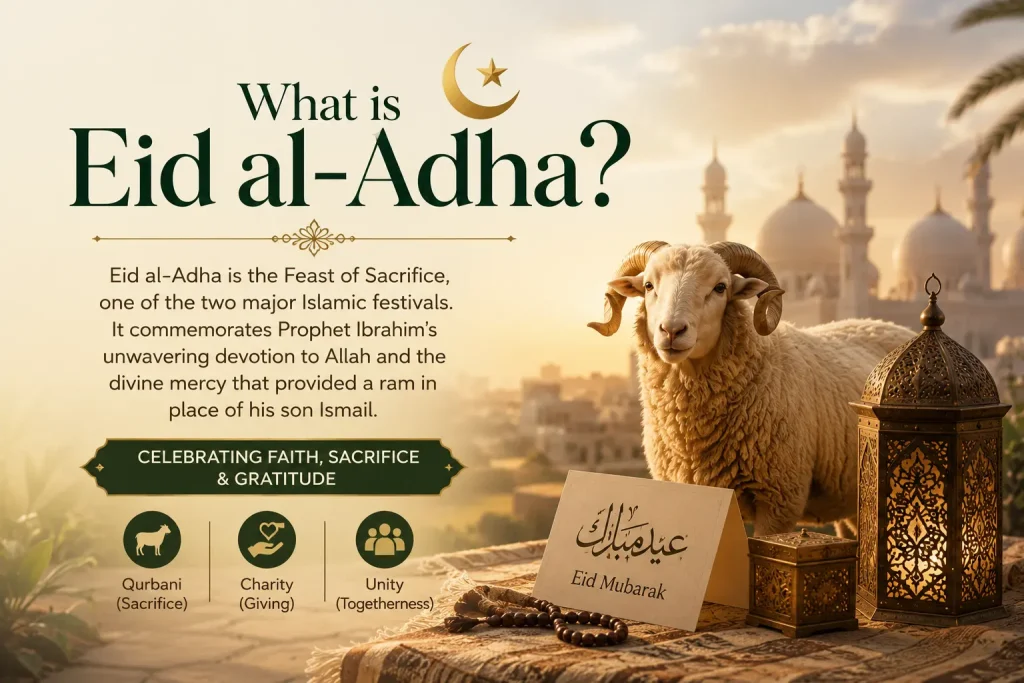
Eid al-Adha, which translates from Arabic as the ‘Festival of the Sacrifice,’ is the second and greater of the two major Islamic festivals, the first being Eid al-Fitr. It is celebrated by Muslims around the world to honor the willingness of Prophet Ibrahim (Abraham) to sacrifice his son Ismail (Ishmael) as an act of obedience to Allah (God).
According to Islamic belief, just as Ibrahim was about to carry out the sacrifice, Allah intervened and replaced Ismail with a ram. This act of divine mercy is commemorated every year through the ritual of Qurbani, in which Muslims who can afford to do so slaughter an animal and distribute the meat to family, neighbors, and those in need.
Eid al-Adha also coincides with the Hajj pilgrimage to Mecca, one of the Five Pillars of Islam. The day of Eid al-Adha falls on the 10th of Dhul Hijjah, the final month of the Islamic lunar calendar, immediately after the Day of Arafah, which is considered the holiest day of the Islamic year.
Other Names for Eid al-Adha
- Feast of the Sacrifice (English translation)
- Bakra Eid or Bakrid (South Asia, referring to the goat sacrificed)
- Eid al-Kabir, meaning ‘Greater Eid’ (North Africa and the Middle East)
- Tabaski (West Africa)
- Kurban Bayrami (Turkey, meaning ‘Sacrifice Holiday’)
Eid al-Adha Dates by Country in 2026
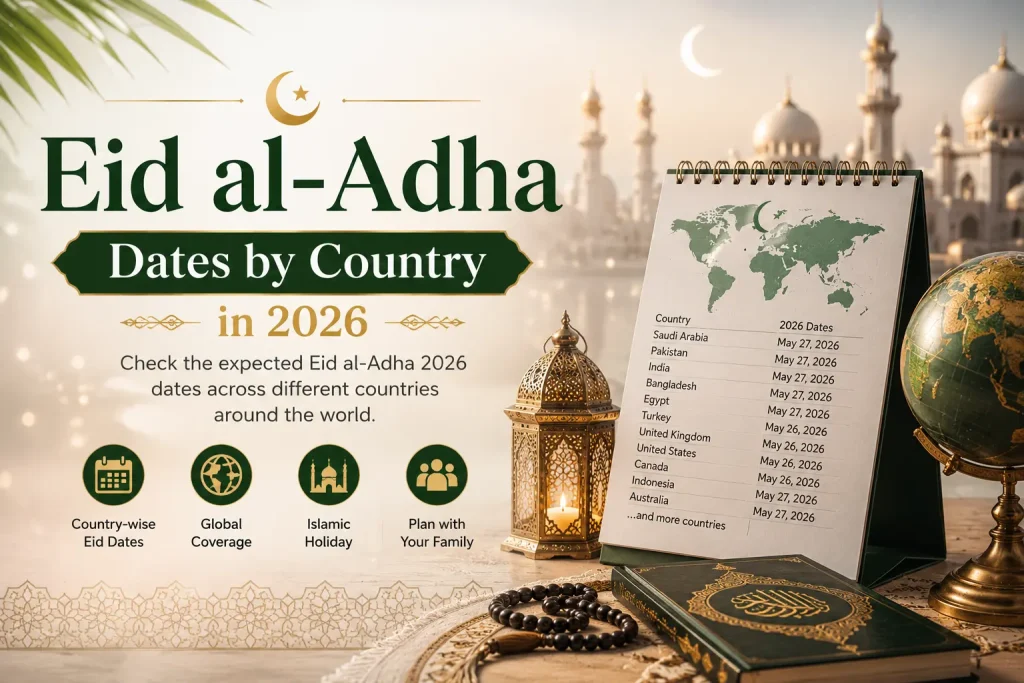
Due to moon sighting differences, dates may vary as follows:
- Saudi Arabia: May 27, 2026 (based on astronomical calculation)
- Pakistan, India, Bangladesh: May 27 or May 28, 2026 (pending local moon sighting)
- United Kingdom: May 27, 2026
- United States & Canada: May 27, 2026
- Turkey: May 27, 2026
- Indonesia & Malaysia: May 27, 2026
- Egypt & North Africa: May 27, 2026
What are Eid Days in 2026?
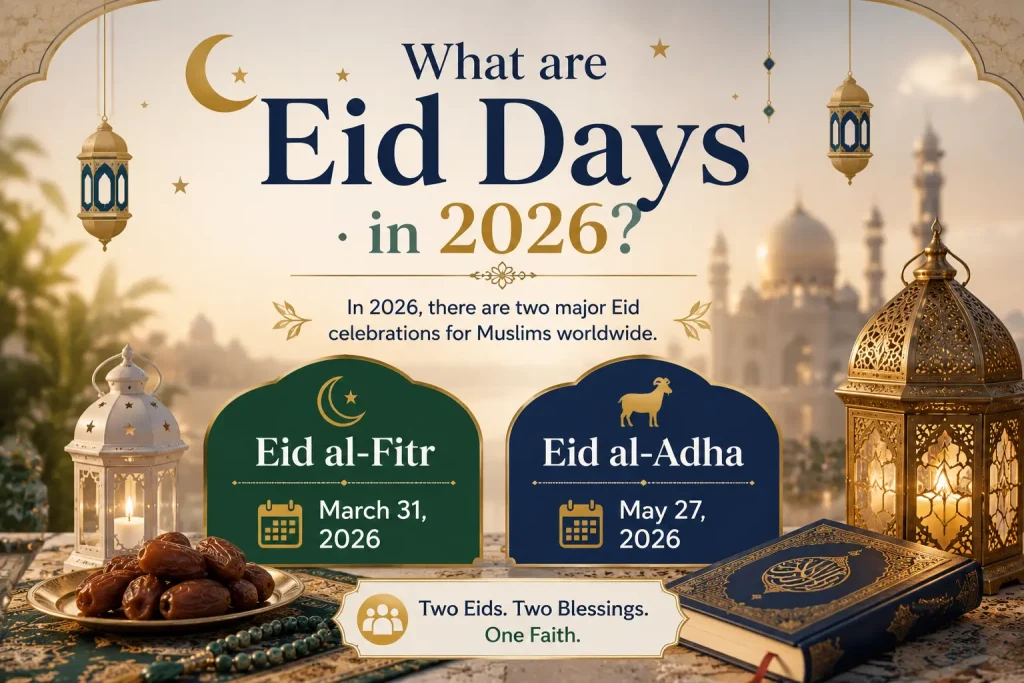
In 2026, there are two main Eid celebrations:
- Eid al-Fitr 2026: March 31, 2026 (marks the end of Ramadan)
- Eid al-Adha 2026: May 27, 2026 (marks the Feast of the Sacrifice)
Both are public holidays in many Muslim-majority countries, with Eid al-Adha typically carrying a longer holiday period due to the rituals that span multiple days.
How Long is Eid al-Adha in 2026?
Eid al-Adha officially lasts four days. In 2026, this means the celebration runs from Wednesday, May 27 to Saturday, May 30. Each day holds its own spiritual significance.
Day-by-Day Breakdown of Eid al-Adha 2026
Day 1 – Wednesday, May 27, 2026 (The Main Day)
- Eid prayer (Salat al-Eid) is performed in congregation after sunrise
- Qurbani (animal sacrifice) begins after the Eid prayer and continues for three days
- Families gather for breakfast and festive meals
- New clothes are worn, and greetings of ‘Eid Mubarak’ are exchanged
- Charity and Zakat al-Adha are given to the poor
Day 2 – Thursday, May 28, 2026 (Ayyam al-Tashreeq)
- Qurbani continues for those who could not perform it on Day 1
- Meat is distributed: one-third kept, one-third given to friends, one-third donated to the needy
- Dhikr (remembrance of Allah) is performed throughout the day
- Family visits and community gatherings continue
Day 3 – Friday, May 29, 2026 (Ayyam al-Tashreeq)
- Final day for Qurbani according to the majority of Islamic scholars
- Pilgrims performing Hajj complete the Stoning of the Devil ritual in Mina
- Continued acts of worship, prayer, and charity
Day 4 – Saturday, May 30, 2026 (Last day of Tashreeq)
- The final day of the Eid period
- Pilgrims begin leaving Mina after completing Hajj rites
- Communities hold final feasts and social visits
In many Muslim-majority countries, the government declares a public holiday for the entire four-day period. In non-Muslim countries, Muslims typically take a day off on the first day for Eid prayer and celebrations.
Eid al-Adha and the Hajj Pilgrimage
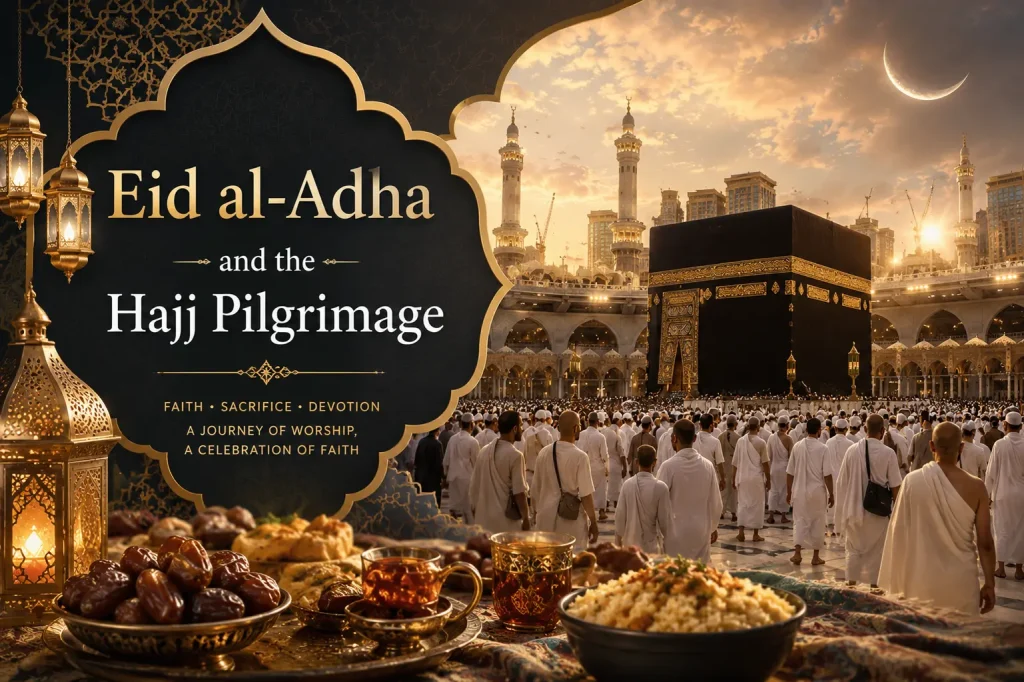
Eid al-Adha is deeply connected to the Hajj pilgrimage. Hajj is the fifth pillar of Islam and takes place in the Islamic month of Dhul Hijjah. In 2026, Hajj begins around May 22 and culminates on the Day of Arafah on May 26, 2026, the day before Eid al-Adha.
The Day of Arafah – May 26, 2026
The Day of Arafah is considered the holiest day of the Islamic year. On this day, pilgrims performing Hajj stand on the plain of Arafah and pray for forgiveness. For Muslims not performing Hajj, fasting on the Day of Arafah is highly recommended. The Prophet Muhammad (peace be upon him) said that fasting on this day expiates the sins of two years: the previous year and the coming year.
Key Hajj Dates Linked to Eid al-Adha 2026
- 8 Dhul Hijjah – May 25, 2026: Pilgrims arrive in Mina (Day of Tarwiyah)
- 9 Dhul Hijjah – May 26, 2026: Day of Arafah (fasting recommended for non-pilgrims)
- 10 Dhul Hijjah – May 27, 2026: Eid al-Adha begins; Qurbani and Hajj rituals start
- 11-13 Dhul Hijjah – May 28-30, 2026: Days of Tashreeq in Mina
Qurbani: The Sacrifice of Eid al-Adha
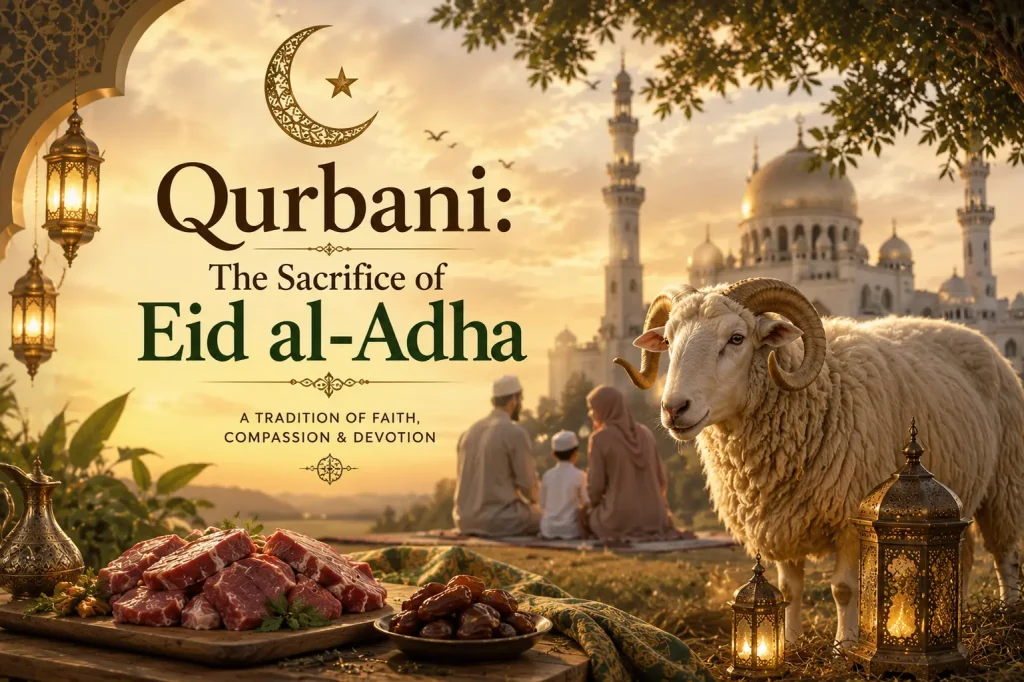
Qurbani refers to the ritual animal sacrifice performed during Eid al-Adha. The word comes from the Arabic root ‘qurb,’ meaning closeness or nearness to Allah. Performing Qurbani is an act of worship that brings a Muslim closer to God by following the example of Prophet Ibrahim.
Who Must Perform Qurbani?
Qurbani is obligatory (Wajib) for every adult Muslim who is sane, free, not a traveler, and who possesses wealth equal to or above the Nisab threshold (the minimum amount of wealth that requires a Muslim to pay Zakat). For those below this threshold, Qurbani is highly recommended but not compulsory.
Which Animals are Allowed for Qurbani?
- Goat or sheep: One animal is sufficient for one person or one household
- Cow or buffalo: One animal can be shared among up to seven people
- Camel: One camel can be shared among up to seven people
All animals must be healthy, free from obvious defects, and have reached the minimum age.
Minimum Age Requirements for Qurbani Animals
- Goat or sheep: At least one year old (six months for a sheep if it appears mature)
- Cow or buffalo: At least two years old
- Camel: At least five years old
How is the Qurbani Meat Distributed?
Islamic tradition recommends dividing the Qurbani meat into three equal parts:
- One-third kept for yourself and your immediate family
- One-third given to relatives, friends, and neighbors
- One-third donated to the poor and those in need
Performing Qurbani Abroad or via Charity
Muslims who cannot perform Qurbani locally can authorize a trusted Islamic charity or organization to carry it out on their behalf in a country where meat is needed most. This is a widely accepted practice and allows Muslims in Western countries to fulfill their religious obligation while also supporting communities facing food insecurity in developing countries.
Timing of Qurbani
Qurbani must be performed after the Eid prayer on May 27, 2026, and can be done until sunset on May 30, 2026 (the 13th of Dhul Hijjah). It is not valid to perform Qurbani before the Eid prayer.
Eid al-Adha Prayer (Salat al-Eid)
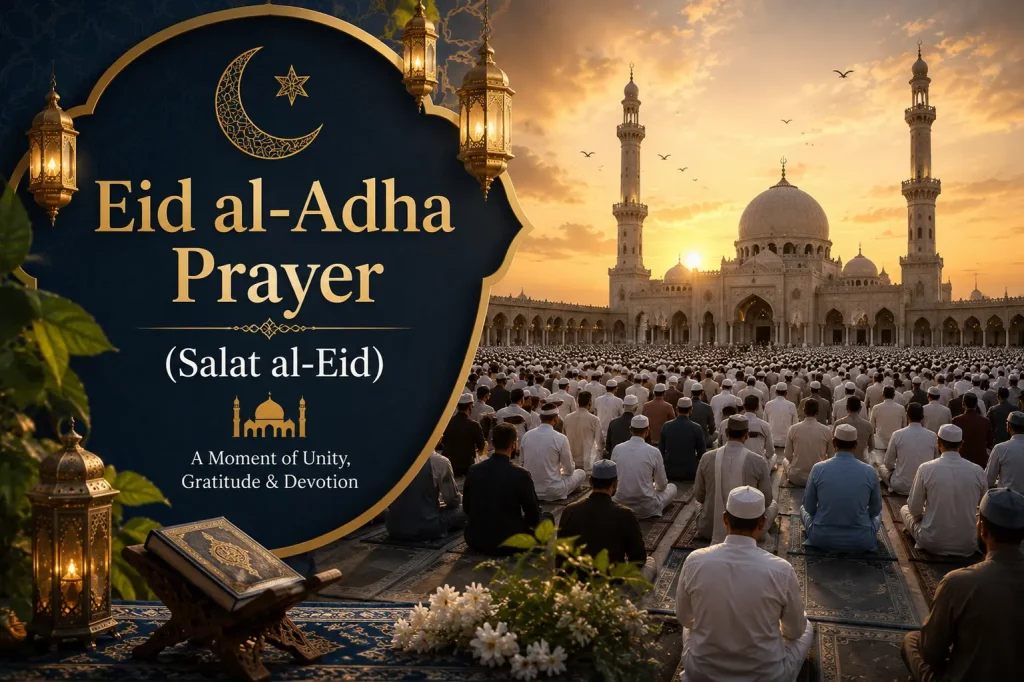
The Eid prayer is one of the most important acts of worship on Eid al-Adha. It is performed in congregation at the mosque, an open field, or a community center. The prayer consists of two units (Rakats) with additional Takbeers (saying ‘Allahu Akbar’).
How to Perform the Eid Prayer
- The Eid prayer is performed after sunrise and before midday
- There is no Adhan (call to prayer) or Iqamah for Eid prayer
- The Imam leads the congregation in two Rakats
- In the first Rakat, seven additional Takbeers are made before the recitation
- In the second Rakat, five additional Takbeers are made before the recitation
- After the prayer, the Imam delivers a Khutbah (sermon)
- Listening to the Khutbah is Sunnah (recommended)
Eid Prayer Etiquette
- Perform Ghusl (full body ritual bath) before the prayer
- Wear your best or new clothes
- Apply perfume (for men)
- Eat something sweet (such as dates) before going to the prayer
- Walk or drive to the mosque reciting Takbeer aloud
- Take a different route back home if possible, as this is Sunnah
How to Celebrate Eid al-Adha 2026

Eid al-Adha is a time of joy, reflection, worship, and community. Here is a complete guide to how Muslims celebrate this blessed occasion around the world.
Before Eid: Preparation
- Fast on the Day of Arafah (May 26, 2026) if you are not performing Hajj
- Make arrangements for Qurbani in advance by booking with a local butcher or charity
- Buy new or clean clothes for yourself and your children
- Give Sadaqah (voluntary charity) and help those less fortunate
- Prepare or plan festive meals and sweets
- Decorate your home with lights and Eid decorations
On the Day of Eid
- Wake up early, perform Ghusl, and wear your best clothes
- Have a small breakfast before heading to the Eid prayer
- Attend the Eid prayer at your local mosque or prayer ground
- Perform Takbeerat aloud on the way to and from prayer
- Greet fellow Muslims with ‘Eid Mubarak’ or ‘Eid Said’
- Visit family members, starting with parents and elders
- Distribute Eidi (gifts or money) to children in the family
- Perform or ensure your Qurbani is carried out after the prayer
- Share festive meals with family, friends, and neighbors
Community and Social Activities
- Attend community Eid fairs and bazaars
- Organize or participate in charity drives and food distribution events
- Visit neighbors, including non-Muslim ones, and share Eid sweets and food
- Support local charities and donate to those in need
- Take family photos and share Eid wishes with loved ones
Eid al-Adha for Children
Eid al-Adha is a wonderful opportunity to teach children about Islamic values such as sacrifice, gratitude, and generosity. Parents can:
- Explain the story of Prophet Ibrahim and Ismail in an age-appropriate way
- Involve children in preparing Eid meals and decorating the home
- Give Eidi (cash gifts) and special presents to children
- Take children to visit grandparents and relatives
- Let older children participate in the Eid prayer
Eid al-Adha Greetings in 2026
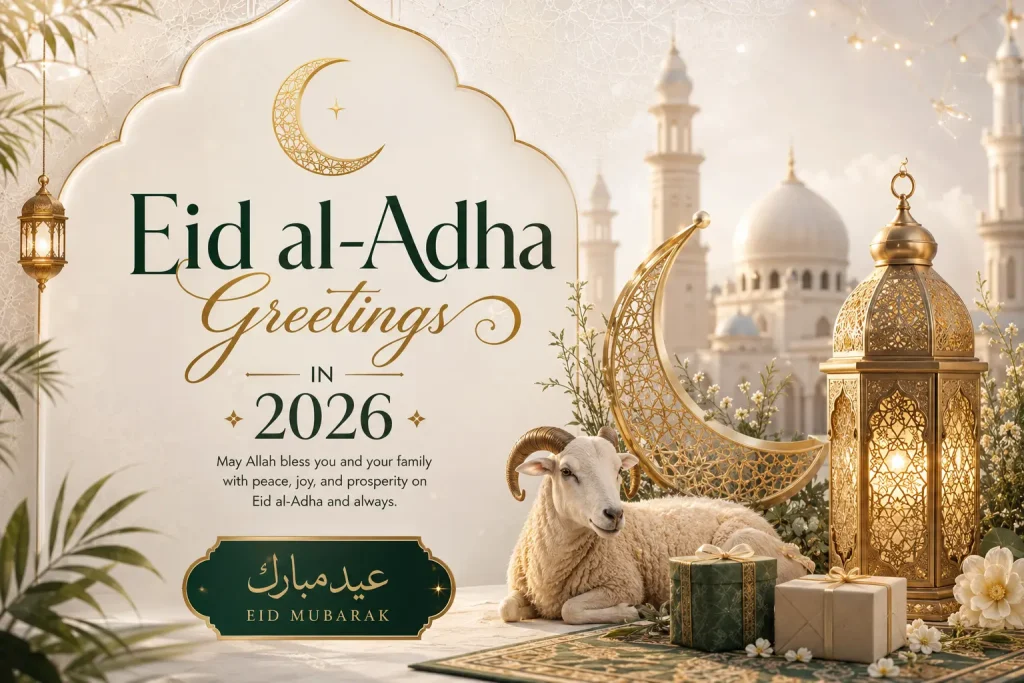
Exchanging warm greetings is an important part of Eid al-Adha. Here are the most common phrases:
- Eid Mubarak (Arabic) – Blessed Eid
- Eid Said (Arabic) – Happy Eid
- Taqabbalallahu Minna wa Minkum – May Allah accept from us and from you
- Khair Mubarak (Urdu/Hindi) – Blessed goodness
- Bayraминiz Kutlu Olsun (Turkish) – May your holiday be blessed
- Bonne Fete de l’Aid (French) – Happy Eid celebration
The Takbeer of Eid is also recited aloud from the night before Eid until the end of the days of Tashreeq: ‘Allahu Akbar, Allahu Akbar, La ilaha illallah, Allahu Akbar, Allahu Akbar, Wa lillahil Hamd.‘ (Allah is the Greatest, Allah is the Greatest, there is no god but Allah, Allah is the Greatest, Allah is the Greatest, and all praise belongs to Allah.)
Traditional Eid al-Adha Foods
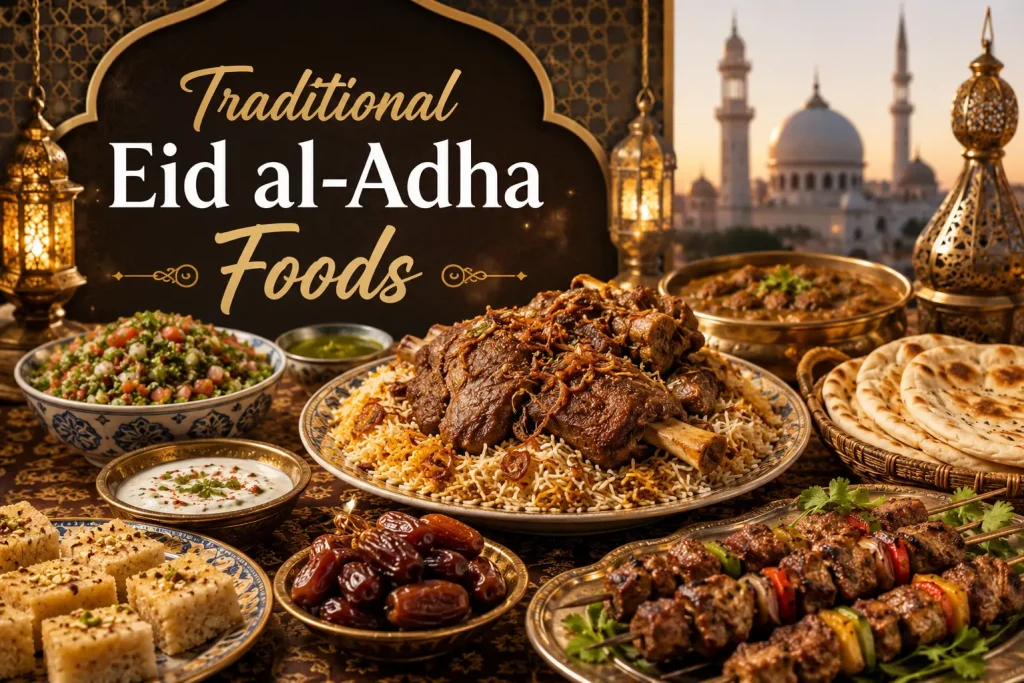
Because Eid al-Adha centers on the sacrifice of an animal, meat dishes take center stage in the Eid feast. Dishes vary widely by region and culture.
Popular Eid al-Adha Dishes Around the World
- South Asia (Pakistan, India, Bangladesh): Biryani, Karahi, Nihari, Haleem, Seekh Kebabs, Sheer Khurma
- Middle East (Saudi Arabia, Egypt, Jordan): Kabsa, Mansaf, Fatteh, Ouzi, Maamoul sweets
- Turkey: Kuzu tandır (slow-roasted lamb), Baklava, Simit
- West Africa: Thieboudienne, Yassa, grilled mutton
- Southeast Asia (Indonesia, Malaysia): Rendang, Satay, Ketupat
- North Africa (Morocco, Algeria, Tunisia): Mrouzia (lamb tagine with honey and raisins), Chorba
It is also highly recommended to share food with neighbors, the poor, and anyone who may not have enough to eat during the celebrations.
Where is Eid Today in 2026? Global Celebrations
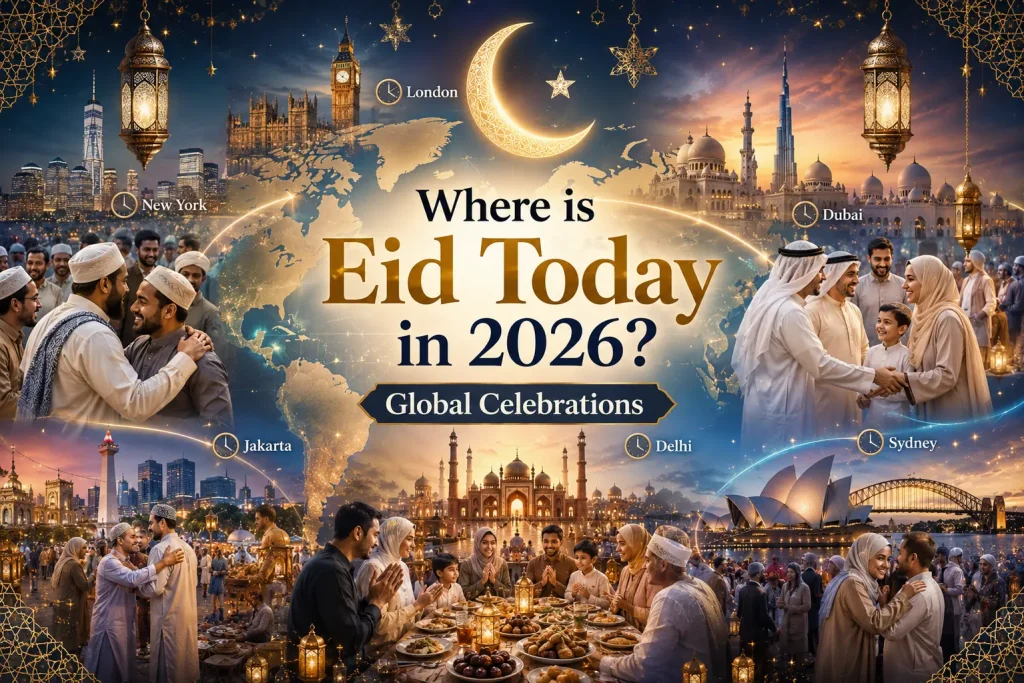
Eid al-Adha is celebrated by approximately 1.8 billion Muslims across the globe. Here is a look at how different regions mark this important occasion:
Saudi Arabia
As the center of the Islamic world, Saudi Arabia sees the largest Eid al-Adha gatherings. The Grand Mosque in Mecca and the Prophet’s Mosque in Medina are filled with pilgrims completing Hajj. Government offices and businesses close for the full four-day holiday. Streets are adorned with lights, and charitable organizations distribute massive quantities of Qurbani meat.
Pakistan and South Asia
In Pakistan, India, and Bangladesh, Eid al-Adha (called Bakra Eid or Eid ul-Adha) is one of the most eagerly awaited events of the year. Families purchase sacrificial animals such as goats, cows, and camels weeks in advance. Meat is cooked in large quantities and shared with extended family and the less fortunate. Bazaars, family reunions, and traditional meals are central to the celebration.
United Kingdom and Western Countries
Muslim communities in the UK, USA, Canada, Australia, and Europe gather at local mosques and Islamic centers for Eid prayer. Many arrange Qurbani through charities that perform the sacrifice in countries such as Somalia, Bangladesh, or Syria. Community Eid fairs, food festivals, and charity fundraisers are organized across major cities.
Turkey
In Turkey, Kurban Bayrami (Sacrifice Holiday) is a four-day national public holiday. Families perform animal sacrifices and distribute meat to neighbors and the needy. It is also common to visit elderly relatives and give children candy and small gifts.
West Africa
In countries such as Senegal, Nigeria, Mali, and Ghana, Eid al-Adha (known as Tabaski in many West African nations) is the most celebrated Muslim holiday of the year. Communities dress in elaborate traditional attire, and festive meals are shared across neighborhoods.
The Spiritual Significance of Eid al-Adha
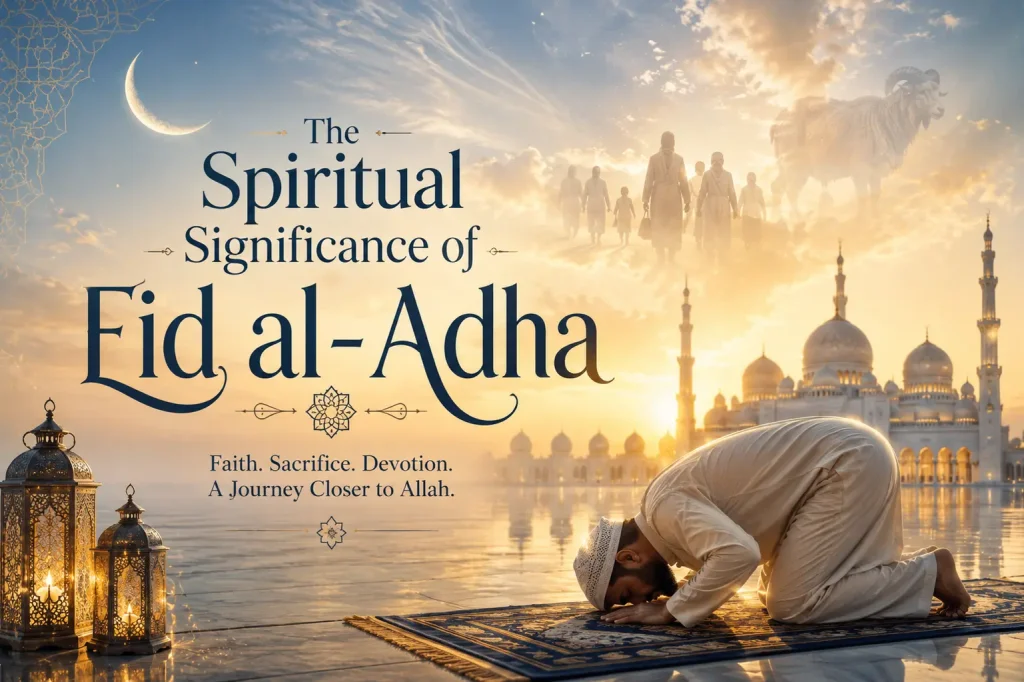
Beyond the celebrations and feasts, Eid al-Adha carries profound spiritual lessons that every Muslim is encouraged to reflect on.
Lessons from the Story of Ibrahim and Ismail
- Complete trust and submission to Allah: Ibrahim’s willingness to sacrifice what he loved most teaches Muslims about absolute faith.
- Obedience over personal desire: Ibrahim chose obedience to Allah over his natural love for his son.
- Gratitude for Allah’s mercy: The divine replacement of Ismail with a ram reminds believers that Allah’s mercy always prevails.
- The reward of patience: Ibrahim’s steadfast patience over decades was rewarded with the greatest of blessings.
Why Qurbani Matters Beyond the Ritual
Qurbani is not simply about slaughtering an animal. It is a reminder that everything we own belongs to Allah, and that we must be willing to give generously in His cause. The meat shared with the poor ensures that even the most vulnerable members of society can enjoy a festive meal during Eid. This emphasis on community welfare and social justice is at the heart of the holiday.
Eid al-Adha vs. Eid al-Fitr: Key Differences
| Feature | Eid al-Adha | Eid al-Fitr |
|---|---|---|
| Islamic Month | Dhul Hijjah (12th month) | Shawwal (10th month) |
| Islamic Date | 10th Dhul Hijjah | 1st Shawwal |
| 2026 Gregorian Date | May 27, 2026 | March 31, 2026 |
| Main Ritual | Qurbani (animal sacrifice) | Zakat al-Fitr (charity) |
| Preceded by | Day of Arafah & Hajj | Month of Ramadan (fasting) |
| Duration | 4 days | 3 days |
| Also Called | Greater Eid, Bakra Eid | Sweet Eid, Choti Eid |
| Fasting Before | Fasting on Day of Arafah (recommended) | No fasting; Ramadan ends |
Frequently Asked Questions
Q: What is Eid al-Adha?
Eid al-Adha is the Feast of Sacrifice celebrating Prophet Ibrahim’s obedience to Allah. It is observed on 10th Dhul Hijjah.
Q: When is Eid al-Adha 2026?
Eid al-Adha 2026 is expected on Wednesday, May 27, 2026, depending on moon sighting.
Q: How long does Eid al-Adha last?
It lasts 4 days, from May 27 to May 30, 2026.
Q: What are the Eid dates in 2026?
Eid al-Fitr: March 31, 2026
Eid al-Adha: May 27, 2026
Q: Where is Eid celebrated?
Eid is celebrated worldwide in Muslim communities.
Q: Is fasting on Day of Arafah necessary?
No, but it is highly recommended for non-Hajj pilgrims.
Q: Can Qurbani be done for a deceased person?
Yes, many scholars allow Qurbani on behalf of deceased family members.
Q: What if I cannot afford Qurbani?
Qurbani is not obligatory if you cannot afford it. You can still pray, give charity, and celebrate Eid.
Conclusion
Eid al-Adha 2026 falls on Wednesday, May 27, and is a four-day celebration observed by 1.8 billion Muslims around the world. It is a time for deep reflection, worship, generosity, and togetherness. From the Eid prayer and Qurbani ritual to family feasts and charitable giving, every aspect of this holiday carries meaning that goes far beyond tradition.
Whether you are observing it for the first time or have celebrated it your whole life, Eid al-Adha is an opportunity to renew your faith, strengthen family bonds, support those in need, and draw closer to Allah.
Eid Mubarak to all Muslims around the world!
You May Also Like It:
I Have Sensitive Skin. How Gentle Are Nivea’s Creams Compared to Aveeno?
My Son Can’t See How Do I Explain Colours to Him?
Compare Corbett and Ranthambore for a 5-Day Wildlife Photography Trip in November on a 50K Budget