
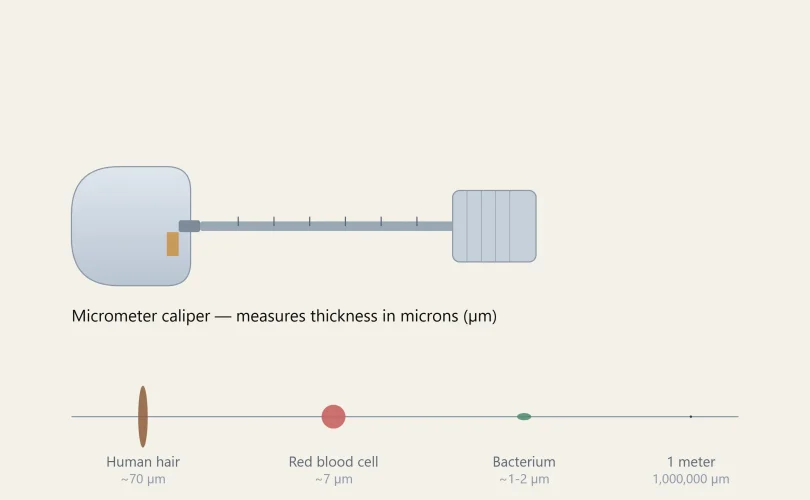
When it comes to measuring extremely small distances the thickness of a human hair, the width of a bacterium, or tolerances in precision machining regular units like centimeters or millimeters simply aren’t small enough. This is where the micrometer comes in, a unit built specifically for the world of microscopic precision.
What Is a Micrometer?
A micrometer (also called a “micron”) is a unit of length in the metric system, represented by the symbol µm. It’s one-millionth of a meter, making it far smaller than anything we typically deal with in everyday measurements. Because of its scale, the micrometer is essential in fields like:
- Manufacturing and engineering, for measuring tolerances in machined parts
- Electronics, where circuit components and semiconductor layers are measured in microns
- Biology and medicine, for describing the size of cells, bacteria, and tissue samples
- Textiles, where fiber diameters are often expressed in micrometers
Micrometer to Meter: The Core Relationship
The conversion between micrometers and meters is straightforward once you know the base relationship:
1 micrometer = 0.000001 meter (10⁻⁶ meters)
In other words, it takes 1,000,000 micrometers to make up a single meter. To convert a value from micrometers to meters, you divide by 1,000,000; to go from meters to micrometers, you multiply by the same number.
Because the numbers involved are often either very large or written in scientific notation, doing this conversion by hand can easily lead to decimal-point errors. This is exactly why many students, engineers, and lab technicians prefer using a dedicated tool such as this micrometer to meter converter, which instantly gives accurate results along with the formula and reference examples, removing any guesswork from the process.
Why Precision at This Scale Matters
At the micrometer level, even the smallest miscalculation can have real consequences. In precision manufacturing, a tolerance error of just a few microns can cause parts to fail to fit together. In medical diagnostics, accurately measuring cell size at the micron level can be critical for identifying abnormalities. This is why understanding and correctly applying micrometer conversions isn’t just an academic exercise it has real, practical stakes.
Final Thoughts
The micrometer might represent an almost imperceptibly small unit of measurement, but its role in science, engineering, and manufacturing is significant. Whether you’re calculating tolerances on a production line or studying microscopic organisms, knowing how to convert between micrometers and meters quickly and accurately is a skill worth having in your toolkit.