
Deciding to end a marriage is never easy, and the legal process around it can feel even harder if you do not know where to start. This guide breaks down exactly how to apply divorce in India, covering both mutual consent and contested divorce, so you know what to expect at every stage, what documents you need, how long it takes, and what it costs.
Two Ways to Apply for Divorce in India
Indian law recognises two broad routes to end a marriage. Choosing the right one from the start saves you years of avoidable litigation.
| Aspect | Mutual Consent Divorce | Contested Divorce |
| Who files | Both spouses jointly | One spouse, against the other’s wishes |
| Grounds needed | None, only mutual agreement | Cruelty, adultery, desertion, and other legal grounds |
| Typical timeline | 6 to 18 months | 2 to 10 years |
| Cost | Lower, fewer hearings | Higher, multiple hearings and evidence |
| Emotional strain | Lower, cooperative process | Higher, adversarial process |
Which Law Applies to Your Marriage

The law governing your divorce depends on how your marriage was solemnised, not on where you currently live.
- Hindu Marriage Act, 1955: applies to Hindus, Buddhists, Sikhs, and Jains, under Section 13B for mutual consent and Section 13 for contested grounds
- Special Marriage Act, 1954: applies to inter-religious or civil marriages registered under this Act, under Sections 27 and 28
- Indian Divorce Act, 1869: applies to Christian couples, under Section 10A for mutual consent
- Parsi Marriage and Divorce Act, 1936: applies to Parsi couples
- Muslim Personal Law: governs divorce for Muslim couples, including khula and other recognised methods, separately from the Acts above
If you are unsure which law applies to your marriage, check the Act under which your marriage was registered. This single detail decides your entire filing process.
Eligibility for Mutual Consent Divorce
Before you apply, both spouses should meet these conditions:
- You have been living separately for at least one year
- Both of you genuinely agree that the marriage cannot be saved
- You have reached an understanding on alimony, child custody, and property, ideally recorded in a Memorandum of Understanding
- Neither party is acting under fraud, coercion, or undue pressure
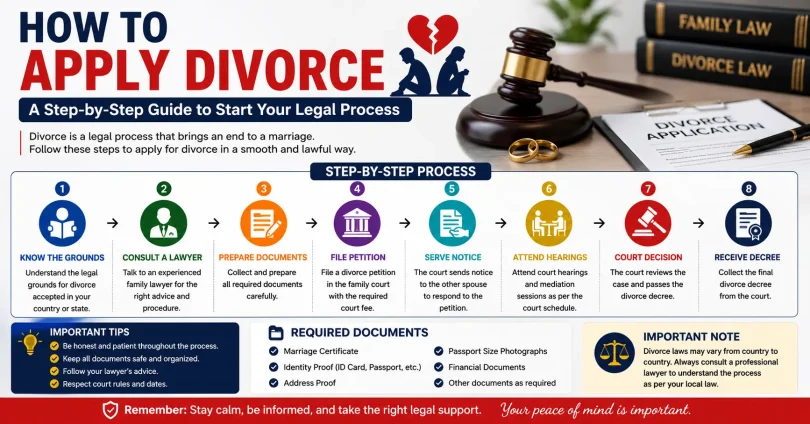
Step-by-Step Process: How to Apply for Mutual Consent Divorce
- Prepare a Memorandum of Understanding: Sit down with your spouse and put alimony, custody, and asset division in writing. This single document prevents most disputes that delay the second motion later.
- Draft and file the joint petition: Both spouses sign a joint petition stating that the marriage has broken down irretrievably and that you have lived apart for a year or more. File it in the family court that has jurisdiction, usually where you last lived together, where the marriage took place, or where the wife currently resides.
- Pay the court fee: A nominal filing fee applies, which varies slightly by state.
- Appear for the first motion: Both spouses appear before the judge, who records statements confirming the petition was filed voluntarily.
- Observe the cooling-off period: The law allows for a wait of six to eighteen months after the first motion, intended to give couples a final chance to reconsider.
- Request a waiver if eligible: Following the Supreme Court’s ruling in Amardeep Singh v. Harveen Kaur, courts can waive the cooling-off period if there is no realistic chance of reconciliation and all terms have already been settled.
- Appear for the second motion: Both spouses confirm again, in person or via video conferencing, that they still want the divorce and that nothing has changed.
- Receive the decree of divorce: Once satisfied, the judge passes the final decree, legally ending the marriage. Keep certified copies safe, as you will need them for future legal and financial matters.
Step-by-Step Process: How to Apply for Contested Divorce
If one spouse does not consent, the other can still apply for divorce, but only on legally recognised grounds.
- Identify a valid legal ground: Common grounds include cruelty, adultery, desertion for over two years, mental disorder, conversion to another religion, or a communicable disease. Wives have an additional ground under the Hindu Marriage Act if the husband is guilty of rape, sodomy, or bestiality.
- Draft and file the petition: A lawyer drafts the petition detailing the grounds, requested reliefs such as custody or maintenance, and supporting facts. File it in the appropriate family or district court.
- Court issues summons: The court sends formal notice to your spouse, informing them that divorce proceedings have begun and setting a hearing date.
- Spouse responds: The other party appears in court and either contests the claims or, occasionally, agrees, allowing the case to convert into a mutual consent matter.
- Mediation attempt: Most family courts first refer the couple to mediation or conciliation to explore a settlement before proceeding to trial.
- Trial and evidence: If mediation fails, both sides present evidence and witnesses. Lawyers examine and cross-examine witnesses. This is usually the longest stage of the process.
- Interim orders: Either spouse can request temporary orders for maintenance or child custody while the case is still ongoing.
- Final judgment: Once the court is satisfied with the evidence, it passes a decree of divorce, or dismisses the petition if the grounds are not proven.
Documents You Will Need
- Marriage certificate
- Address proof for both spouses
- Identity proof such as Aadhaar or passport
- Recent photographs of both spouses
- Evidence of separation, such as separate addresses or witness statements
- Income and asset details, for alimony and property settlement
- Memorandum of Understanding, for mutual consent cases
- Marriage photographs and any supporting evidence, for contested cases
Where to File Your Divorce Petition
Jurisdiction is decided by where the couple last resided together, where the marriage was solemnised, or where the wife currently resides. You can choose whichever of these locations is most convenient, as the law gives you that flexibility.
Alimony, Custody, and Property: What Gets Decided
Alimony or Maintenance
In mutual consent divorce, both spouses decide the amount together, often as a one-time lump sum or staggered monthly payments. In contested divorce, the court decides based on income, lifestyle, and the needs of the dependent spouse. A lump-sum alimony payment is generally treated as a capital receipt and is not taxable, while monthly maintenance is treated as taxable income for the receiving spouse.
Child Custody
Courts in mutual consent cases usually accept the custody arrangement the couple agrees on, as long as it serves the child’s best interest. In contested cases, the court independently examines which parent can better provide for the child’s wellbeing.
Property and Assets
Joint bank accounts, the matrimonial home, and other shared assets need to be divided as part of the settlement. If there is a joint home loan, remember that the divorce decree binds the spouses but not the bank, so you must separately approach the lender for a loan transfer or substitution.
How Long Does the Process Take
| Divorce Type | Typical Duration |
| Mutual consent, with cooling-off period | 6 to 18 months |
| Mutual consent, cooling-off waived | As little as a few weeks to a few months |
| Contested divorce | 2 to 10 years, depending on complexity and court backlog |
Can the Cooling-Off Period Be Waived
Yes. In Amardeep Singh v. Harveen Kaur, the Supreme Court held that the six-month waiting period under Section 13B is directory, not mandatory. If the couple has already settled alimony, custody, and property matters, and there is no realistic chance of reconciliation, the family court can waive the wait and proceed straight to the final decree.
What If One Spouse Withdraws Consent
Consent must remain mutual right up to the point the decree is signed. If either spouse withdraws consent before the second motion, the petition is dismissed, and the other spouse must then file a contested divorce on independent legal grounds instead.
Filing Divorce Without a Lawyer

It is technically possible to file a mutual consent petition without a lawyer, especially when both spouses agree on every term. However, contested cases involve evidence, cross-examination, and procedural rules that are difficult to manage alone. Even in straightforward mutual consent cases, a lawyer helps draft a watertight Memorandum of Understanding, which prevents future disputes over alimony or custody.
Special Situations
NRI Couples
NRI couples can file mutual consent divorce in India if the marriage was solemnised under a recognised personal law or registered under the Special Marriage Act. Jurisdiction follows the wife’s residence or the couple’s last shared residence. Most metro family courts now permit video conferencing for a spouse based abroad, provided they can be identified through their lawyer and the Indian consulate.
Foreign Divorce Decrees
A divorce decree obtained in a foreign court is generally recognised in India under Sections 13 and 14 of the Code of Civil Procedure, provided both parties voluntarily participated and the foreign court reached its decision on merits.
Costs Involved
- Court filing fee: nominal, varies by state, usually a few hundred rupees
- Lawyer fees: vary widely based on city, experience, and whether the case is mutual or contested
- Mediation fees: minimal in most family courts, sometimes free
- Additional costs: stamp duty for the Memorandum of Understanding, and any agreed alimony or settlement payments
Mistakes to Avoid
- Paying full alimony upfront: in mutual consent cases, since the other spouse could still withdraw consent before the decree is final. Many lawyers recommend staggered payments or escrow instead.
- Leaving the Memorandum of Understanding vague: an unclear agreement on custody or assets often becomes the reason the second motion gets delayed or contested.
- Filing in the wrong jurisdiction: this can lead to the petition being transferred or dismissed, costing valuable time.
- Ignoring loan and asset transfers: a divorce decree does not automatically update bank or property records, so each asset needs to be handled separately.
Frequently Asked Questions
Do I need to be separated before filing for mutual consent divorce?
Yes, both spouses must have lived separately for at least one year before filing.
Can the six-month cooling-off period be skipped?
Yes, courts can waive it if reconciliation is impossible and all settlement terms are already agreed.
Is alimony compulsory in every divorce?
No, alimony depends on mutual agreement or the court’s assessment of need and ability to pay.
Can I file for divorce without a lawyer?
Yes, in simple mutual consent cases, though legal help is strongly recommended for drafting the settlement.
What happens if my spouse does not respond to the summons?
The court may proceed with an ex-parte hearing and decide the case based on available evidence.
Is a foreign divorce decree valid in India?
Yes, if both parties voluntarily took part and the foreign court ruled on the merits of the case.
Final Thoughts
Filing for divorce, whether by mutual consent or through a contested case, follows a defined legal path once you know which law applies and what the court expects at each stage. Mutual consent is faster and less stressful when both spouses are willing to settle terms honestly. Contested divorce takes longer, but it remains available when an agreement is not possible. Whichever path applies to you, keep your documents organised, settle financial and custody matters clearly in writing, and consider speaking with a family law expert before you file, so the process moves as smoothly as the law allows.
You May Also Like It:
How to Download RC Book Online