
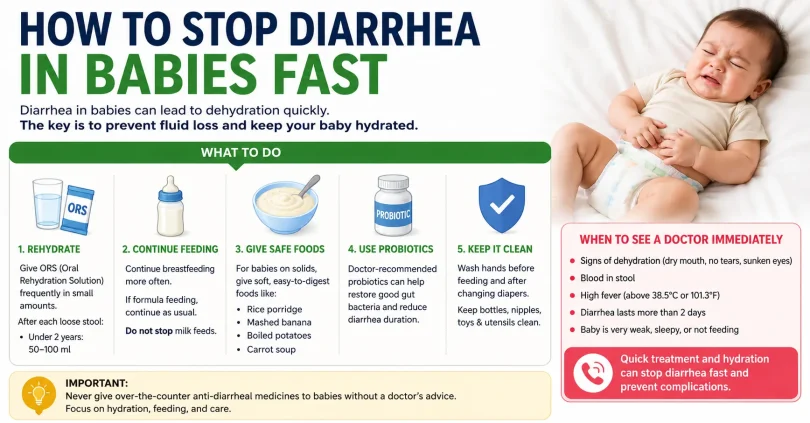
How to Stop Diarrhea in Babies Fast A blown-out diaper at 2 a.m. has a way of making any parent panic. The good news is that most baby diarrhea is short-lived, treatable at home, and rarely dangerous as long as you know what to watch for. This guide walks you through exactly what to do right now to help your baby feel better, how to tell normal baby poop from true diarrhea, and the warning signs that mean it is time to call your pediatrician.
Quick Answer
- Hydrate first. Offer breast milk or formula more often, in smaller amounts, to replace lost fluids.
- Skip instant cures. Nothing stops diarrhea immediately. Viral diarrhea usually runs its course in 5 to 14 days, though babies often feel noticeably better within 24 to 48 hours once they are well hydrated.
- Avoid anti-diarrheal medicine. Over-the-counter diarrhea drugs are not safe for babies unless a pediatrician specifically prescribes them.
Call your pediatrician immediately if: your baby is under 3 months old, has blood or mucus in the stool, or shows any sign of dehydration (see the checklist below).
What Counts as Diarrhea in a Baby?
Not every loose poop is diarrhea. Baby poop is naturally softer than adult poop, and what counts as “normal” depends on how your baby eats.
Normal Baby Poop, by Feeding Type
- Breastfed babies: Yellow, seedy, and loose, sometimes almost watery. Frequency ranges from several times a day in the early weeks to once every few days after about 6 weeks. This is normal, not diarrhea.
- Formula-fed babies: Thicker, pastier, and more formed than breastfed baby poop, usually a few times a day.
- Babies eating solids: Poop becomes firmer and more variable depending on what they have eaten.
So When Is It Actually Diarrhea?
Diarrhea means a sudden change from your baby’s usual pattern: stools that are noticeably more watery, more frequent, and often too loose to be contained by the diaper. As a general rule, three or more distinctly watery stools in 24 hours is considered diarrhea.
Doctors often grade diarrhea by how many watery episodes happen in a day:
| Severity | Watery stools per day | What it usually means |
| Mild | 3 to 5 | Manageable at home with extra fluids and close monitoring. |
| Moderate | 6 to 9 | Watch closely for dehydration; call your pediatrician for guidance. |
| Severe | 10 or more | Higher dehydration risk; contact your pediatrician promptly. |
What Causes Diarrhea in Babies?
Most baby diarrhea is caused by an infection that has to run its course. Common causes include:
- Viral gastroenteritis: The most common cause by far. Rotavirus and norovirus are the leading culprits and often come with vomiting or a low fever.
- Bacterial infections: Salmonella, E. coli, or campylobacter, sometimes linked to contaminated food or water. These can cause blood or mucus in the stool and need medical attention.
- Parasites: Giardia is common in daycare settings and can cause diarrhea that lingers longer than a typical virus.
- Antibiotics: A course of antibiotics can disrupt your baby’s gut bacteria and trigger temporary diarrhea.
- New foods or too much juice: Introducing solids or giving large amounts of fruit juice can loosen stools.
- Underlying conditions: Cow’s milk protein intolerance, celiac disease, or other digestive conditions can cause diarrhea that lasts more than two weeks. These need a pediatrician’s evaluation, not home treatment.
Myth Check: Does Teething Cause Diarrhea?
Teething itself does not cause true diarrhea. Babies who are teething drool more, which can occasionally loosen stool very slightly, but real diarrhea happening around the same time as teething is almost always caused by an unrelated bug, not the new tooth.
How to Stop Diarrhea in Babies Fast: Step-by-Step Home Care
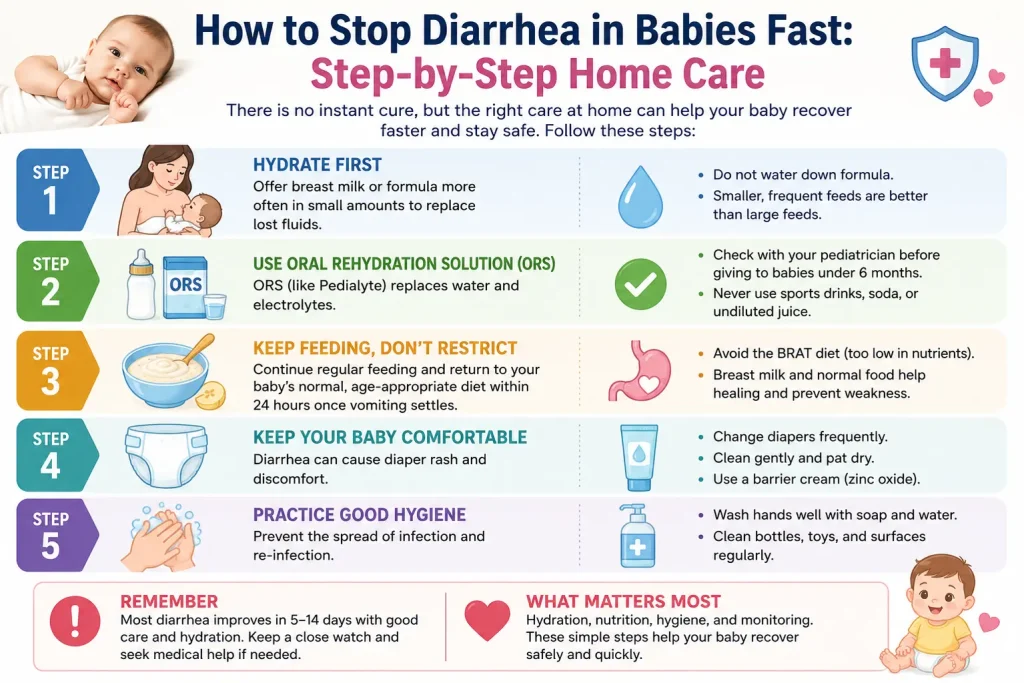
There is no switch you can flip to end diarrhea instantly, and you should be cautious of anything that claims otherwise. What you can do is support your baby’s body so it recovers as quickly and as comfortably as possible. Here is the order that actually matters.
Step 1: Hydrate Before Anything Else
Dehydration, not the diarrhea itself, is what makes this illness dangerous. Keep breastfeeding or bottle-feeding as usual, but offer smaller amounts more often if your baby is losing fluids quickly. Do not water down formula to “stretch” it, since this reduces the nutrition and electrolytes your baby needs.
Step 2: Ask About an Oral Rehydration Solution
An oral rehydration solution (ORS), such as Pedialyte, replaces both water and the electrolytes lost through diarrhea. Many pediatricians recommend it for babies with moderate diarrhea or any vomiting. ORS comes as a ready-to-drink liquid, powder, or freezer pop.
- Check with your pediatrician before giving ORS to a baby younger than 6 months.
- Never substitute sports drinks, soda, or undiluted juice for ORS. Their sugar content can pull more water into the gut and make diarrhea worse.
If commercial ORS is not available and a doctor advises a homemade option, the World Health Organization formula is 1 liter (about 4 cups) of clean drinking water mixed with 6 level teaspoons of sugar and 1/2 level teaspoon of salt. Measurements must be exact, since too much salt can be harmful to an infant. Commercial ORS is the safer choice whenever you can get it.
Step 3: Keep Feeding, Don’t Restrict
You may have heard of the BRAT diet (bananas, rice, applesauce, toast) for stopping diarrhea. The American Academy of Pediatrics moved away from recommending it because it is too low in protein, fat, and fiber to support recovery. Current guidance is to let your baby return to their normal, age-appropriate diet within 24 hours, as soon as vomiting has settled. Studies show that babies who keep eating normally recover at least as fast as, and often faster than, babies kept on a restricted diet.
- Continue breast milk or formula as the main source of nutrition.
- If your baby already eats solids, offer their usual foods in small, frequent amounts. There is no need to limit them to bland starches.
- Skip high-sugar foods and drinks, fruit juice, and soda while your baby is recovering.
Step 4: Protect Sensitive Skin
Frequent, acidic stools can cause diaper rash fast. Reduce irritation by:
- Changing diapers as soon as they are soiled.
- Cleaning gently with warm water or a soft cloth instead of scented wipes.
- Letting the skin air-dry fully before putting on a clean diaper.
- Applying a zinc oxide barrier cream at every change.
Step 5: Track Wet Diapers and Stool Count
Keep a simple tally of wet diapers and watery stools over 24 hours. This single habit makes it much easier to answer your pediatrician’s questions accurately and to notice early if things are getting worse rather than better.
What NOT to Do
- Do not give over-the-counter anti-diarrheal medicine (such as loperamide or bismuth products) to a baby unless a doctor specifically prescribes it. These drugs can be dangerous for infants.
- Do not give full-strength fruit juice, soda, or sports drinks. The high sugar content can worsen diarrhea.
- Do not dilute formula beyond what your pediatrician specifically recommends.
- Do not withhold food to “rest the gut.” Fasting can prolong illness and increases the risk of dehydration.
- Do not rely on herbal remedies, essential oils, or unproven supplements in place of medical guidance.
What Stops Diarrhea Naturally?
Parents often search for a natural fix, so it is worth being honest about what the evidence actually supports.
- Hydration is the intervention that matters most. Nothing else comes close. A well-hydrated baby recovers more comfortably and faces far less risk, even while the underlying infection runs its course.
- Resuming a normal diet speeds recovery better than a restricted, bland diet, according to current pediatric guidance.
- Zinc supplementation is recommended by the World Health Organization for children with diarrhea, but most of the supporting research comes from regions where zinc deficiency is common. Benefits in well-nourished infants are less clear-cut, so ask your pediatrician before giving any zinc supplement.
- Probiotics have mixed evidence. Some smaller studies suggest specific strains may shorten diarrhea by about a day, but large, rigorous U.S. trials have found no real benefit over a placebo. Probiotics are generally considered safe to try, but they are not a guaranteed fix, and you should check with your pediatrician first, especially for very young infants.
- Rice water, herbal teas, and other folk remedies lack solid evidence in infants and are not recommended as a substitute for hydration and normal feeding.
How Long Does Baby Diarrhea Usually Last?
How quickly diarrhea clears up depends mainly on what is causing it.
| Cause | Typical duration | Notes |
| Viral gastroenteritis | 5 to 14 days | Worst symptoms are usually in the first 24 to 48 hours, then gradually improve. |
| Bacterial infection | A few days to about a week | May need antibiotics; blood or mucus in stool needs prompt medical review. |
| Antibiotic-associated | Improves within days of stopping or switching the antibiotic | Talk to the prescribing doctor before stopping any medication. |
| Chronic or persistent | More than 2 weeks | Needs pediatric evaluation to find an underlying cause. |
Signs of Dehydration: What to Watch For
Babies and young children can become dehydrated faster than adults. Dehydration, not the diarrhea itself, is the real danger to watch for.
| Mild to moderate dehydration | Severe dehydration: seek emergency care |
| Fewer than 6 wet diapers in 24 hours • Dry mouth or lips • Fewer tears when crying • More irritable or unusually sleepy • Slightly sunken soft spot (fontanelle) | No wet diaper for 8 or more hours • Very sunken eyes or fontanelle • Cold, pale, or blotchy skin • Lethargic, very hard to wake, or limp • Refusing all fluids • Rapid breathing |
When to Call the Doctor (and When to Go to the ER)
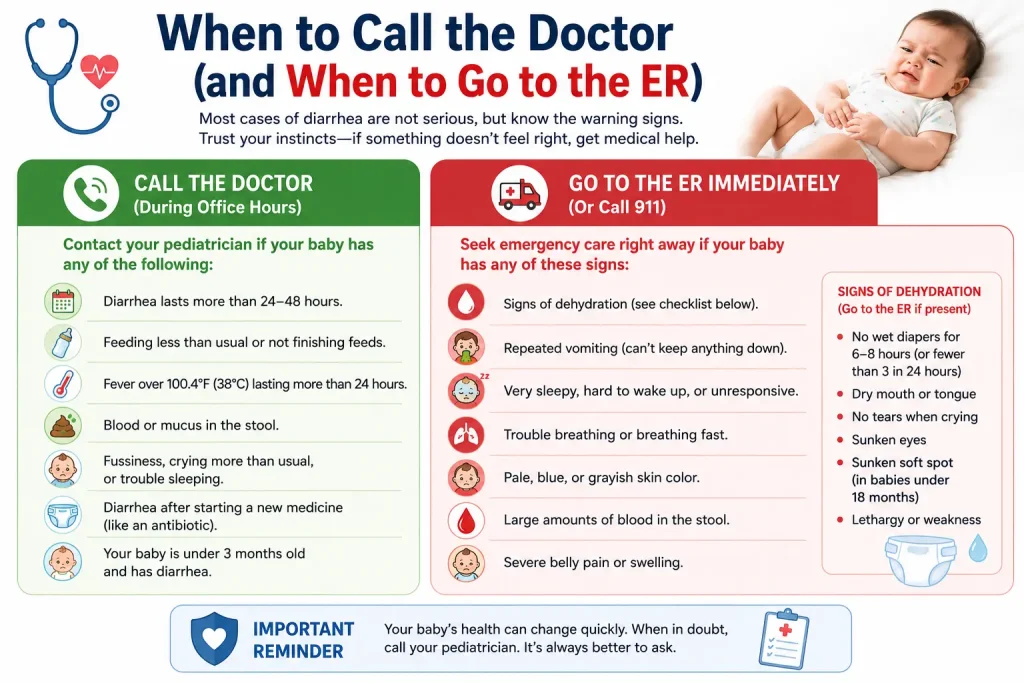
Call Your Pediatrician Promptly If:
- Your baby is younger than 3 months old and has any diarrhea.
- Diarrhea comes with a fever.
- Vomiting will not stop.
- Diarrhea lasts longer than a week without improving.
- You notice any sign of mild dehydration from the checklist above.
Seek Emergency Care Immediately If:
- There is blood or mucus in the stool.
- Your baby shows any sign of severe dehydration.
- Your baby is unusually lethargic, very hard to wake, or seems limp.
- Your baby refuses all fluids.
- A very young infant develops a high fever.
When in doubt, call. Pediatric offices and after-hours nurse lines exist exactly for these judgment calls, and no one will think less of you for checking.
How to Help Prevent Future Episodes
- Stay current on vaccines. The rotavirus vaccine protects against one of the most common causes of infant diarrhea.
- Wash hands often, especially before feeding your baby and after every diaper change.
- Breastfeed if possible. Breast milk passes along antibodies that help protect against the infections that cause diarrhea.
- Practice safe food and water hygiene when preparing formula or solid foods.
- Keep sick babies home from daycare until they have gone 24 hours without a loose stool, to limit spread to other children.
Frequently Asked Questions
How can I stop my baby’s diarrhea fast?
There is no instant cure. Focus on hydration with smaller, more frequent feeds, keep offering a normal diet, skip anti-diarrheal medicine, and ask your pediatrician about an oral rehydration solution. Most babies start improving within 24 to 48 hours.
How many times should a baby poop if they have diarrhea?
Three or more distinctly watery stools in 24 hours, looser than your baby’s usual pattern, counts as diarrhea. Six to nine episodes a day is considered moderate, and ten or more is severe and needs prompt medical attention.
What stops diarrhea naturally?
Nothing stops it instantly. Staying hydrated and resuming a normal diet support the fastest natural recovery. Zinc and probiotics may help in some cases, but the evidence is mixed, so check with your pediatrician before giving either one.
How long does it take for baby diarrhea to go away?
Most viral diarrhea clears up within 5 to 14 days, with the worst symptoms in the first 24 to 48 hours. Diarrhea that lasts longer than two weeks needs a pediatrician’s evaluation.
Can teething cause diarrhea in babies?
Not directly. Any diarrhea during teething is almost always caused by an unrelated illness happening at the same time, not the new tooth itself.
Is it safe to give my baby Pedialyte?
Usually yes, but check with your pediatrician first, especially for babies younger than 6 months, to confirm the right amount for your baby’s age and weight.
Conclusion
In conclusion, how to stop diarrhea in babies fast is less about finding an instant cure and more about preventing dehydration, continuing regular feeding, and closely monitoring your baby’s condition. Most cases of baby diarrhea are caused by viral infections and improve within a few days with proper care. Breast milk, formula, and oral rehydration solutions can help replace lost fluids and support recovery. Parents should avoid over-the-counter anti-diarrheal medications unless specifically recommended by a pediatrician. Most importantly, watch for warning signs such as dehydration, blood in the stool, persistent vomiting, or unusual sleepiness, as these may require immediate medical attention. By staying calm, keeping your baby hydrated, and seeking medical advice when needed, you can safely manage the illness and help your little one recover comfortably.
You May Also Like It: