
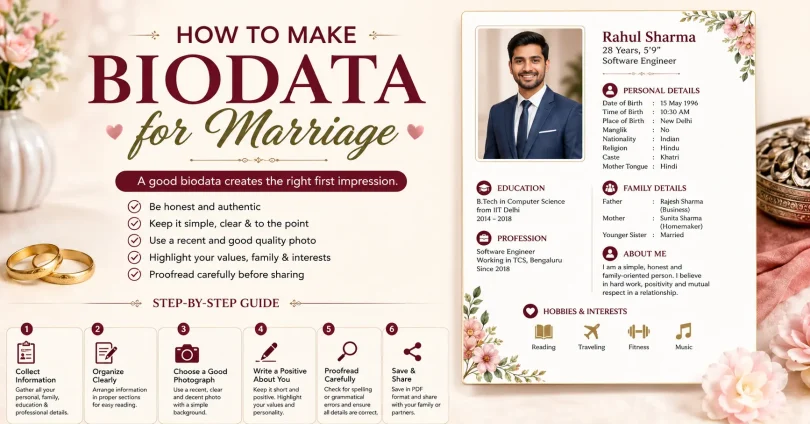
How to Make Biodata for Marriage. A well-written marriage biodata is often the very first thing a family or a potential partner sees about you. It can decide whether someone wants to know more — or moves on to the next profile. This guide walks you through everything you need: what to include, free formats in Word and PDF, real examples for boys and girls, and mistakes that quietly hurt good profiles.
What Is a Marriage Biodata?
A marriage biodata (also called a matrimonial biodata or marriage resume) is a short, structured document that summarises your personal, educational, family, and professional background for the purpose of finding a life partner. It is widely used across Hindu, Muslim, Sikh, Christian, Jain, and Punjabi communities in India, Pakistan, and other South Asian countries, both for arranged marriages and for matrimonial sites.
Unlike a job resume, a marriage biodata focuses on character, family values, lifestyle, and compatibility rather than work achievements alone.
Why a Good Biodata Format Matters
- First impression in seconds: Families often decide whether to respond within the first glance at layout and photo.
- Faster compatibility check: A clear structure lets the other family scan education, profession, and expectations quickly.
- Shows seriousness: A neat, error-free biodata signals that you are genuinely prepared for marriage.
- Works everywhere: A good format can be shared on WhatsApp, email, or matrimonial sites without losing its look.
What to Include in a Marriage Biodata: Section-by-Section Guide
Every biodata, regardless of religion or community, should generally include the sections below. Use only what is relevant to you.
1. Photograph
Use a recent, clear, well-lit photo, ideally a simple portrait without sunglasses, filters, or group photos. A good photo can be more persuasive than a long paragraph of text.
2. Personal Details
- Full name
- Date, time, and place of birth
- Height and complexion (complexion is optional in modern biodatas)
- Religion, caste, and gotra (only if relevant to your family)
- Marital status (never married, divorced, or widowed)
- Blood group
- Languages known
3. Educational Background
- Highest qualification and specialisation
- Name of college or university
- Year of completion
4. Professional Details
- Current job title and company, or business details
- Work location
- Annual income (optional, include only if comfortable)
5. Family Background
- Father’s name and occupation
- Mother’s name and occupation
- Number of siblings, their marital status and occupation
- Family type: nuclear or joint family
- Native place and current residence
6. Lifestyle and Interests
Keep this short and genuine: 2-3 hobbies are enough. Avoid generic entries like “reading” unless it is true; specific interests stand out more and start better conversations.
7. Contact Details
- Phone number
- Email address
- City and address (street-level address is usually not needed)
8. Partner Expectations (Optional)
If you choose to add this section, keep it brief, specific, and respectful. Mention only the qualities that genuinely matter to you, such as values, education level, or location preference, rather than a long checklist.
Marriage Biodata Format: Ready Reference Table
Use this table as a quick checklist while drafting your biodata in Word, PDF, or any online maker.
| Field | Details to Include |
| Full Name | Your complete legal name as on official documents |
| Date of Birth | DD/MM/YYYY |
| Time of Birth | Optional, useful if horoscope matching is needed |
| Place of Birth | City and state |
| Height | In feet/inches or cm |
| Complexion | Optional, many modern biodatas skip this |
| Religion / Caste | As applicable to your family preference |
| Gotra / Manglik Status | If relevant to your community |
| Blood Group | Optional but useful |
| Marital Status | Never married / Divorced / Widowed |
| Education | Highest degree, college, year of passing |
| Profession | Job title, company, annual income (optional) |
| Father’s Name & Occupation | Full name and profession |
| Mother’s Name & Occupation | Full name and profession |
| Siblings | Names, marital status, occupation |
| Family Type | Nuclear / Joint family |
| Address & Contact | City, phone number, email |
| Hobbies & Interests | 2-3 genuine interests |
| Partner Expectations | Brief, respectful preferences |
How to Make Biodata for Marriage: Step-by-Step Process
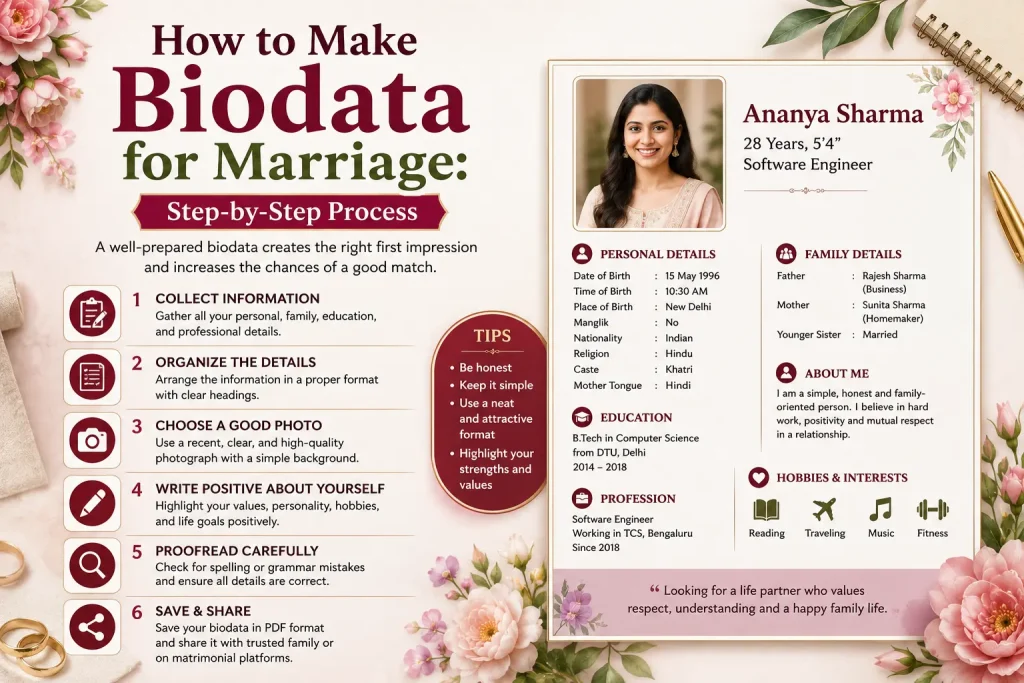
- Choose your format first: Decide whether you need Word, PDF, or both. Word is best if you expect to edit it again; PDF is best for final sharing.
- Pick a clean template: Choose a simple, readable layout. Avoid overly decorative fonts or too many colours, which can look unprofessional and may not print well.
- Add a recent photograph: Place it at the top right or top centre of the page.
- Fill in personal details: Start with your name, date of birth, and basic personal information.
- Add education and profession: Keep this factual and to the point.
- Add family background: Include parents, siblings, and family type.
- Add hobbies and partner expectations: Keep both sections short and honest.
- Proofread carefully: Check spelling, dates, and contact details at least twice.
- Save in two formats: Keep an editable Word copy and a PDF copy ready to share.
How to Make Biodata for Marriage in Word (Free Template Structure)
To create your biodata in Microsoft Word or Google Docs:
- Open a blank document and set page size to A4 with 1-inch margins.
- Insert a text box or table at the top for your photo, aligned to the right.
- Use a simple heading, such as “Biodata for Marriage”, centred at the top.
- Create a two-column table: left column for field names (Name, DOB, Height), right column for your details. This keeps everything aligned and easy to scan.
- Use a readable font such as Calibri, Garamond, or Arial at 11-12pt body size.
- Save the file as both .docx and .pdf using “Save As” or “Export”.
This Word-table method is the same structure used by most professional biodata makers, and it gives you full control to edit details any time without depending on an online tool.
How to Make Biodata for Marriage Online (Free Tools)
If you prefer not to design from scratch, several free online biodata makers let you fill a form and instantly generate a PDF or Word file. When choosing one, check for:
- No mandatory sign-up or hidden charges for a basic download
- Templates available for both PDF and Word formats
- Options suited to your community (Hindu, Muslim, Christian, Sikh, Jain, Punjabi)
- A live preview so you can check the layout before downloading
- Clear privacy policy on how your personal data is stored or deleted
Online makers are fast, but always download an editable copy too, in case you need to update details later, such as a new job or qualification.
Free Biodata for Marriage: Word vs PDF vs Online Maker
| Format | Best For | Limitation |
| Word (.docx) | Easy editing, adding photo, sharing on email | Formatting can shift between devices |
| Final sharing on WhatsApp, matrimonial sites | Harder to edit once created | |
| Online Maker | Quick, no design skill needed | Limited template ownership, watermark on some tools |
Biodata for Marriage for Boys: What to Highlight
A boy’s biodata is generally evaluated closely on career stability, education, and family responsibility. Along with the standard sections, consider emphasising:
- Career growth and current designation clearly stated
- Whether you live with family or independently, and willingness to relocate
- Property or financial stability, only if you are comfortable sharing it
- Family responsibilities, such as caring for parents or siblings
Biodata for Marriage for Girls: What to Highlight
A girl’s biodata should represent her authentically, balancing personal achievements with family values. Useful additions include:
- Education and career achievements, stated with confidence
- Personal values and interests that reflect your personality
- Willingness to work after marriage or preference, if relevant to you
- Family background and values, presented honestly
Sample Marriage Biodata (Text Format)
Below is a simple sample you can adapt. Replace the bracketed details with your own information.
Biodata for Marriage
- Name: [Your Full Name]
- Date of Birth: [DD/MM/YYYY] | Time: [HH:MM] | Place: [City]
- Height: [5’6″] | Complexion: [Fair/Wheatish]
- Religion: [Hindu/Muslim/Christian/Sikh] | Caste: [Optional] | Gotra: [Optional]
- Education: [B.Tech, Computer Science, XYZ University, 2020]
- Profession: [Software Engineer, ABC Pvt. Ltd., Bangalore]
- Father’s Name: [Name], [Occupation]
- Mother’s Name: [Name], [Occupation]
- Siblings: [One younger sister, pursuing MBA]
- Family Type: [Nuclear Family]
- Address: [City, State]
- Contact: [Phone Number] | [Email Address]
- Hobbies: [Travelling, Painting, Badminton]
Common Mistakes to Avoid in a Marriage Biodata
- Using a blurry, outdated, or group photograph
- Spelling errors or inconsistent dates
- Overloading the page with too much text or too many colours
- Exaggerating income, education, or achievements
- Leaving out contact details or using an inactive phone number/email
- Making the file too large to share easily on WhatsApp or email
- Forgetting to update the biodata after a job change or new qualification
Religion and Community-Specific Tips
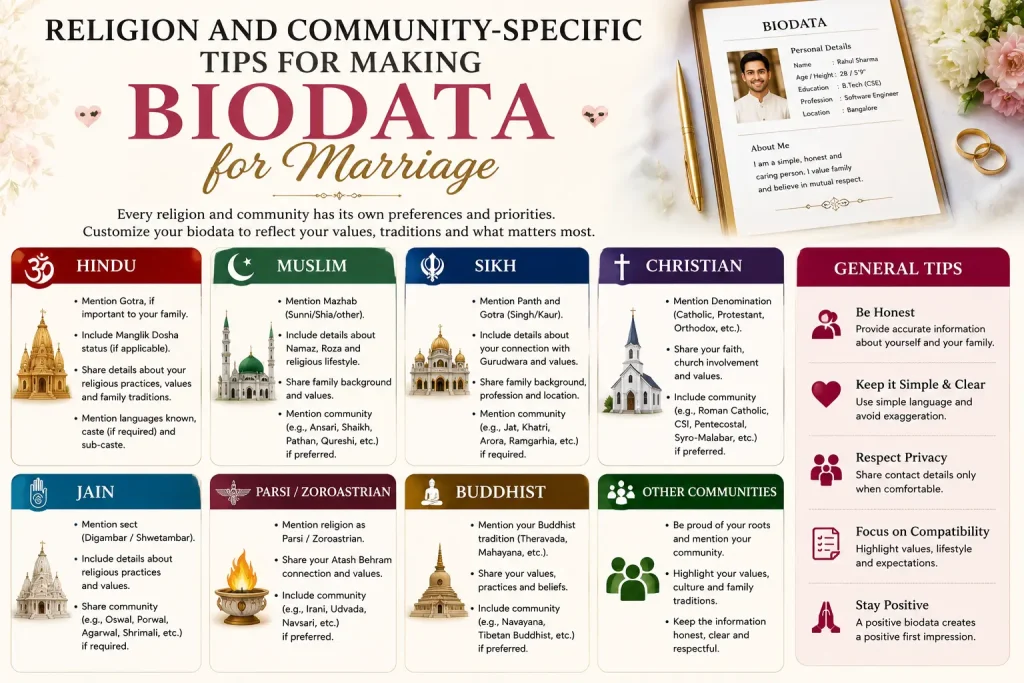
Hindu Biodata
Often includes gotra, nakshatra, manglik status, and horoscope details, especially if the family follows traditional matchmaking practices.
Muslim Biodata
Usually focuses on family background, religious practice, and education, and may skip horoscope-related fields entirely.
Sikh and Punjabi Biodata
Commonly includes family gotra and native village details alongside standard personal information.
Christian Biodata
Typically a simpler structure focused on education, profession, and family values, without caste or horoscope fields.
How Long Should a Marriage Biodata Be?
One page is ideal. A biodata is meant to be scanned quickly, not read like a detailed profile. If you have extensive achievements, summarise them in two or three lines rather than listing everything.
Final Checklist Before You Share Your Biodata
- Photo is recent, clear, and appropriately sized
- All personal, family, and contact details are accurate
- No spelling or grammar errors
- File saved in both Word and PDF formats
- File name is professional, for example: Priya_Sharma_Biodata.pdf
- File size is small enough to share easily on WhatsApp or email
Frequently Asked Questions
How to make biodata for marriage for free?
Use a Word or Google Docs table template, or a free online biodata maker, and download it as PDF or Word at no cost.
Which format is best: Word or PDF?
Keep both. Use Word for editing and PDF for final sharing.
Is a horoscope necessary in a biodata?
Only if your family or community follows horoscope matching; otherwise it can be skipped.
Should I mention income in my biodata?
It is optional. Many people prefer to discuss income details later in conversation.
How many photos should I add?
One clear photo is enough; a second casual photo is optional.
Can I reuse the same biodata for matrimonial sites?
Yes, the same PDF can be uploaded to matrimonial sites and shared directly with families.
Conclusion
A strong marriage biodata is simple, honest, and well-organised. Focus on accurate details, a recent photo, and a clean layout in Word or PDF format. Use the structure and sample above to create a biodata that genuinely represents you and helps the right family or partner say yes faster.