
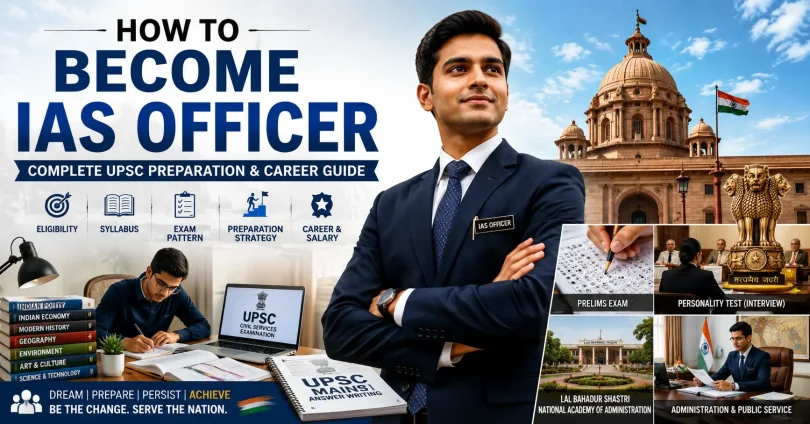
Every year, more than five lakh serious aspirants sit for the UPSC Civil Services Examination with one goal in mind: becoming an IAS officer. The Indian Administrative Service is not just a job title. It is a position of real authority, where a single officer can decide how a district responds to a flood, how a government scheme reaches a village, or how public money gets spent.
If you have typed “how to become IAS officer” into a search bar, you have probably found dozens of articles that repeat the same five points: get a degree, clear prelims, clear mains, clear the interview, get selected. That advice is correct, but it is incomplete. It does not tell you what marks toppers actually score, how the merit list math really works, why most successful candidates need more than one attempt, or how an IAS officer’s career and pay actually grow over thirty years of service.
This guide fills those gaps. It walks you through the role, the eligibility rules, the exact exam structure with current marks distribution, a realistic month-by-month preparation roadmap, the latest topper data, salary figures under the 7th Pay Commission, and a clear comparison between IAS and IPS so you can make an informed decision before you commit the next two to four years of your life to this exam.
Who Is an IAS Officer and What Do They Actually Do?
An IAS officer is a civil servant recruited through the UPSC Civil Services Examination and appointed to the Indian Administrative Service, the senior-most administrative wing of the Indian government. IAS officers run the day-to-day machinery of governance, acting as the link between the policies made in Delhi or the state capital and the citizens who live with the results of those policies.
Entry-Level Roles
A freshly trained IAS officer usually starts as one of the following:
- Sub-Divisional Magistrate (SDM): Manages law and order, revenue matters, and public grievances for a sub-division within a district.
- Assistant Collector: Works under the District Collector while learning the administrative ropes during the probation period.
Within a few years, most officers are elevated to District Magistrate or District Collector, the most visible and powerful position at the district level. The District Collector is often called the face of the government because nearly every major decision in the district, from disaster relief to land records to election conduct, passes through that office.
Mid-Career and Senior Roles
As an IAS officer gains seniority, the responsibilities shift from field administration to policy-making:
- Joint Secretary or Secretary in a state government department, heading a specific policy area such as health, education, or rural development.
- Secretary to the Government of India in a central ministry, shaping national-level policy and budgets.
- Chief Secretary, the senior-most civil servant in a state, advising the Chief Minister directly.
- Cabinet Secretary of India, the highest civilian post in the country, coordinating between all central ministries.
A common myth is that IAS officers only handle paperwork. In reality, the job swings between crisis management, such as coordinating flood relief at 2 a.m., and long-term planning, such as designing a state’s irrigation policy for the next decade.
IAS Eligibility Criteria 2026: Age, Education, and Attempts
Before you plan a single day of preparation, confirm that you meet the basic eligibility conditions set by UPSC. Missing one of these technical requirements is the single most preventable reason candidates get disqualified after clearing the exam.
Educational Qualification
You must hold a bachelor’s degree from a university recognised by the UPSC, or an equivalent professional qualification such as MBBS, BE, or BTech. There is no minimum percentage requirement and no restriction on stream. Candidates in their final year of graduation, awaiting results, can apply for the Preliminary exam, but must produce proof of having passed before sitting for the Mains.
Age Limit and Relaxations
| Category | Minimum Age | Maximum Age | Relaxation |
|---|---|---|---|
| General / EWS | 21 years | 32 years | None |
| OBC (Non-creamy layer) | 21 years | 35 years | 3 years |
| SC / ST | 21 years | 37 years | 5 years |
| Persons with Benchmark Disabilities (PwBD) | 21 years | 42 years | 10 years |
| Ex-servicemen (disabled in duty) | 21 years | 35 to 40 years | 3 to 5 years, category-wise |
Number of Attempts Allowed
| Category | Maximum Attempts |
| General / EWS | 6 attempts |
| OBC | 9 attempts |
| SC / ST | Unlimited, until the upper age limit |
| PwBD (General / OBC) | 9 attempts |
| PwBD (SC / ST) | Unlimited, until the upper age limit |
Nationality
For the IAS and the Indian Foreign Service, you must be a citizen of India. For other civil services, subjects of Nepal or Bhutan, Tibetan refugees who settled in India before 1 January 1962, and certain categories of Indian-origin migrants from specified countries are also eligible, subject to a government eligibility certificate.
UPSC released the CSE 2026 notification on 4 February 2026 for 933 vacancies, with the Preliminary exam held on 24 May 2026. Notification dates shift slightly each year, so always cross-check the live notification on upsc.gov.in before applying.
How to Become an IAS Officer: The Complete Step-by-Step Process
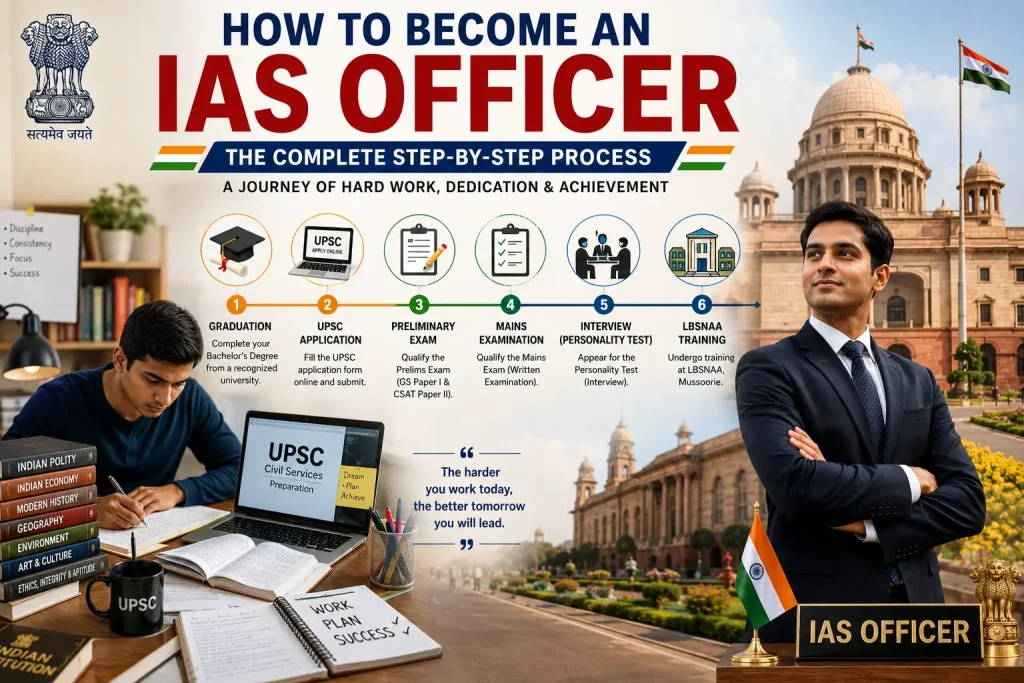
This is the core roadmap. Each step builds on the previous one, and skipping the order will cost you time later.
Step 1: Complete Your Graduation
Choose any degree you can stay genuinely interested in for three to four years, since your final-year self will need the discipline to study UPSC topics alongside college work. Arts subjects such as Political Science, History, Sociology, and Public Administration overlap heavily with the General Studies syllabus, which is why they remain popular, but engineers, doctors, and commerce graduates top the exam every single year. The degree matters far less than how seriously you treat the next two steps.
Step 2: Build Your Foundation Early
You do not need to wait for graduation to finish before starting preparation. The smartest aspirants begin building a base during their final one or two years of college:
- Read NCERT textbooks from Class 6 to Class 12 for History, Geography, Polity, and Economics. These books explain concepts in the plain language UPSC actually rewards.
- Develop a daily newspaper habit using a serious national paper, focusing on editorial and opinion pages rather than just headlines.
- Start writing short essays and answers from week one. Most aspirants postpone writing practice and regret it during Mains, when answer-writing speed becomes the real bottleneck.
- Decide on your optional subject early if your syllabus allows it, since some optional papers have noticeably higher success rates than others.
Step 3: Apply for the UPSC Civil Services Examination
UPSC releases its official notification, typically in February, on upsc.gov.in. The application window usually stays open for about three weeks. You will need to:
- Register on the UPSC One Time Registration (OTR) portal with your personal and educational details.
- Fill in the application form, choose your exam centre, and select your preferred services and cadres.
- Pay the examination fee online (women, SC, ST, and PwBD candidates are exempted from the fee).
- Download your e-admit card closer to the exam date from the UPSC website.
Step 4: Clear the Preliminary Examination
Roughly 10 to 12 lakh candidates apply each year, but only about 5 to 6 lakh actually sit for the exam, and around 10,000 to 14,000 qualify for Mains. Prelims is purely a screening round; its marks are not counted toward your final rank, but you must clear the cutoff to move forward.
Step 5: Clear the Mains Examination
Mains is where your final rank is actually decided. It consists of nine descriptive papers written over several days, testing depth of knowledge, analytical ability, and the skill of writing a complete, well-structured answer within a strict word and time limit.
Step 6: Clear the Personality Test (Interview)
Candidates who clear Mains are called to UPSC headquarters in Delhi for a board interview. This is not a knowledge test; UPSC has already tested your knowledge in Mains. The board is assessing your clarity of thought, emotional balance, and suitability for a position of public responsibility.
Step 7: Final Merit List and Service Allocation
Your Mains and interview marks are combined into a final score, and UPSC publishes a merit list. Allocation to a specific service such as IAS, IPS, or IFS depends on your rank, your category, your service preferences, and the number of available vacancies that year. Because IAS is the most preferred service among nearly all candidates, you typically need a rank within the top few hundred to secure it.
Step 8: Foundation Training at LBSNAA
Selected candidates undergo a joint foundation course at the Lal Bahadur Shastri National Academy of Administration (LBSNAA) in Mussoorie, followed by service-specific training, before being posted to their first assignment in the field.
UPSC Exam Pattern: Prelims, Mains, and Interview Explained
Stage 1: Preliminary Examination
| Paper | Subject | Total Marks | Nature | Negative Marking |
| Paper I | General Studies | 200 | Counts toward Mains cutoff | 1/3rd mark deducted per wrong answer |
| Paper II | CSAT (Aptitude) | 200 | Qualifying only, 33% required | 1/3rd mark deducted per wrong answer |
Stage 2: Mains Examination (9 Papers, 1,750 Marks for Merit)
| Paper | Subject | Marks |
| Paper A | Indian Language (Qualifying) | 300 |
| Paper B | English (Qualifying) | 300 |
| Paper I | Essay | 250 |
| Paper II | General Studies I (History, Geography, Society) | 250 |
| Paper III | General Studies II (Polity, Governance, IR) | 250 |
| Paper IV | General Studies III (Economy, Environment, Security) | 250 |
| Paper V | General Studies IV (Ethics and Aptitude) | 250 |
| Paper VI | Optional Subject, Paper I | 250 |
| Paper VII | Optional Subject, Paper II | 250 |
Stage 3: Personality Test (Interview)
The interview carries 275 marks. Combined with the 1,750 Mains marks, your final score out of 2,025 marks decides your rank and, ultimately, which service you are allocated.
Final Merit Calculation
| Component | Marks |
| Mains Written Papers (I to VII) | 1,750 |
| Personality Test (Interview) | 275 |
| Final Total | 2,025 |
How Difficult Is It to Become an IAS Officer? The Numbers Explained
Most articles call the UPSC exam tough without showing you why. Here is the actual arithmetic behind the difficulty, using recent official data.
- For the CSE 2026 cycle, UPSC announced 933 vacancies across all civil services, of which only a fraction is reserved specifically for the IAS cadre; the rest go to IPS, IFS, IRS, and other Group A and B services.
- Of roughly 10 to 12 lakh applicants in a typical year, only about 5 to 6 lakh sit for Prelims. A large share of applicants drop out before the exam itself.
- Around 10,000 to 14,000 candidates clear Prelims and sit for Mains, but only about 2,000 to 2,700 clear Mains and reach the interview stage.
- In the end, fewer than 1,000 candidates are recommended for appointment across every civil service combined, and IAS allocation typically requires a rank within roughly the top 100 to 200 on general merit, depending on the year’s vacancy count.
- Toppers do not need a perfect score. All-India Rank 1 candidates in recent years have cleared the exam with roughly 50 to 55 percent of the total marks, which means consistent, well-rounded preparation beats chasing perfection in any single paper.
The honest takeaway is this: the exam rewards sustained, serious effort more than raw genius. Most successful candidates clear it on their second, third, or fourth attempt, not their first, so building a multi-year strategy from the outset is far more realistic than expecting a single-attempt miracle.
UPSC Preparation Strategy: A Realistic Roadmap
Clearing the UPSC CSE is not a three-month sprint. Treat it as a structured, 12 to 24 month project with clear phases.
Phase 1: Foundation (Months 1 to 6)
- Complete NCERT textbooks for History, Geography, Polity, and Economics from Class 6 to Class 12.
- Start a daily newspaper habit and begin maintaining short, organised notes rather than copying full articles.
- Choose your optional subject based on genuine interest, scoring trend, and availability of study material, not just because it appears popular online.
Phase 2: Standard Books and Static Syllabus (Months 6 to 12)
- Move to standard reference books for each General Studies paper, building on the NCERT base rather than skipping it.
- Begin daily answer-writing practice for Mains-style questions, even before you feel fully ready; the skill improves only through repetition.
- Start solving previous years’ question papers topic-wise to understand UPSC’s actual question patterns.
Phase 3: Revision and Mock Tests (Months 12 to 18)
- Shift the bulk of your time to revision rather than fresh reading. Most toppers report revising core material five to eight times before the exam.
- Join a structured mock test series for both Prelims and Mains to build exam temperament and timing.
- Track current affairs systematically using monthly compilations rather than trying to remember scattered daily news.
Phase 4: Final Sprint and Interview Preparation (Last 2 to 3 Months)
- Focus on rapid revision, formula sheets, and timed full-length mock tests under exam conditions.
- If you clear Mains, begin interview preparation immediately by revisiting your Detailed Application Form (DAF), your optional subject basics, and current affairs from the past six months.
- Practice mock interviews and work on articulating opinions calmly and concisely, since composure matters as much as content in the Personality Test.
Daily study hours matter less than consistency. Six focused hours a day for eighteen months will outperform twelve chaotic hours a day for six months.
Habits and Qualities of Successful IAS Aspirants
Beyond books and test series, certain habits separate candidates who clear the exam from those who burn out midway.
- Time discipline: Block fixed hours for reading, writing, and revision, and protect that schedule the way you would protect a job.
- Daily current affairs: Read one reliable newspaper end to end rather than skimming multiple sources superficially.
- Active writing practice: Write at least one full-length answer or essay every day from the start of preparation, not just during the final months.
- Physical and mental health: Sleep, exercise, and short breaks are not optional luxuries; burnout is one of the leading reasons serious aspirants drop out before their second attempt.
- A support system: Stay connected with mentors, peer groups, or a coaching ecosystem that can give honest, structured feedback on your answers.
- Resilience after setbacks: Most successful officers failed at least once. Treat a failed attempt as data about what to fix, not as a verdict on your ability.
UPSC Toppers: Who Is Rank 1 and What Can You Learn From Them?
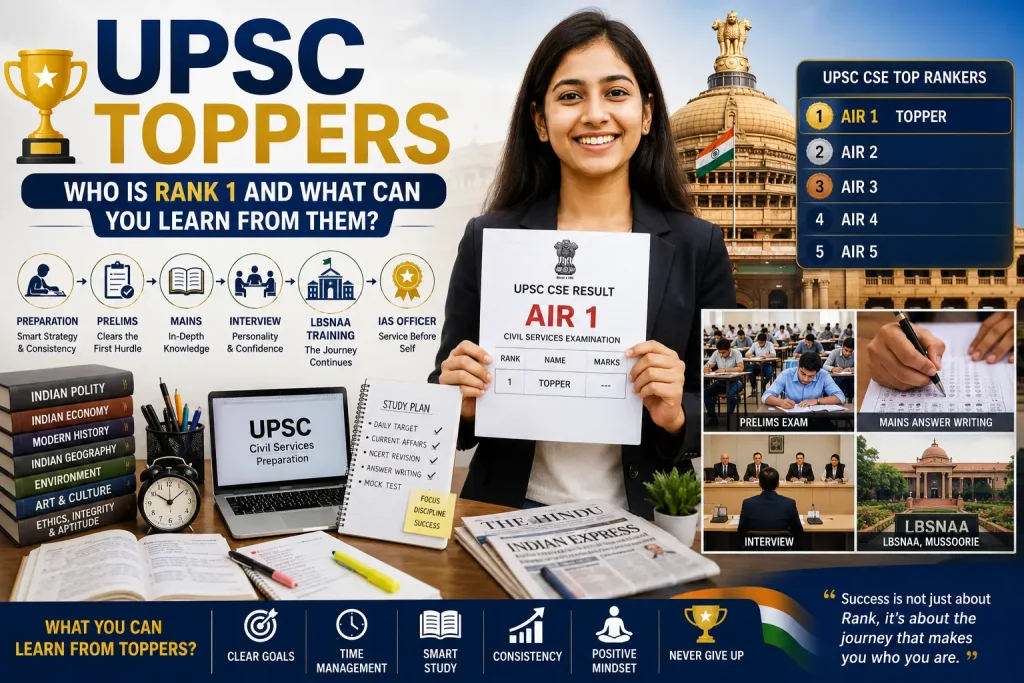
Who Is the Current Rank 1 IAS Topper?
Anuj Agnihotri secured All India Rank 1 in the UPSC Civil Services Examination 2025, with a final score of 1,071 marks out of 2,025. He is an MBBS graduate from AIIMS Jodhpur and cleared the exam on his third attempt, scoring 867 marks in the written Mains papers and 204 in the interview. Rajeshwari Suve M, a former Deputy Collector in Tamil Nadu, secured Rank 2 with 1,067 marks, and Akansh Dhull, a commerce graduate from Shri Ram College of Commerce, secured Rank 3 with 1,057 marks after improving dramatically from a much lower rank the previous year.
What These Results Actually Teach Aspirants
- Background is not destiny: Recent toppers have come from medicine, commerce, engineering, and humanities. UPSC genuinely rewards preparation quality over academic stream.
- The interview carries real weight: Many top-ranked candidates scored 200 or more out of 275 in their interview, often making up ground lost in written papers.
- Multiple attempts are normal, not a failure: Several recent toppers, including Rank 3 in 2025, improved sharply after a weak rank in an earlier attempt rather than clearing the exam outright on try one.
- You do not need a perfect score: A final score in the 50 to 55 percent range of total marks has been enough to secure Rank 1 in multiple recent years, which should ease unnecessary pressure to be flawless in every paper.
IAS Officer Salary in India: Complete Pay Structure
IAS salaries follow the 7th Central Pay Commission pay matrix, structured across Pay Levels 10 to 18 based on seniority. A fresh officer’s basic pay starts at Rs. 56,100 per month, and the gross monthly salary including Dearness Allowance, House Rent Allowance, and Travel Allowance typically works out to around Rs. 1,00,000 to Rs. 1,16,000 in hand at the entry level, depending on the posting city.
| Pay Level | Position / Seniority | Basic Pay (Monthly) | Years of Service |
| Level 10 | Sub-Divisional Magistrate / Assistant Collector | Rs. 56,100 | 0 to 4 years |
| Level 11 | Sub-Divisional Magistrate / Under Secretary | Rs. 67,700 | 5 to 8 years |
| Level 12 | District Magistrate / Deputy Secretary | Rs. 78,800 | 9 to 12 years |
| Level 13 | District Magistrate / Director | Rs. 1,18,500 | 13 to 16 years |
| Level 14 | Joint Secretary, Government of India | Rs. 1,44,200 | 16 to 24 years |
| Level 15 | Additional Secretary | Rs. 1,82,200 | 25 to 30 years |
| Level 16 | Special Secretary | Rs. 2,05,400 | 30 to 33 years |
| Level 17 | Chief Secretary (State) | Rs. 2,25,000 | 34 to 36 years |
| Level 18 | Cabinet Secretary of India | Rs. 2,50,000 | 37+ years |
Beyond basic pay, IAS officers receive Dearness Allowance (revised periodically to offset inflation), House Rent Allowance or a government-provided official residence, a government vehicle with fuel allowance, household staff support, subsidised utility bills, medical coverage, and a pension under the National Pension System. These non-cash benefits make the overall compensation considerably more valuable than the basic pay figure alone suggests.
IAS vs IPS: Which Is More Powerful?
Aspirants frequently compare the IAS and IPS while filling out their service preference form. Both belong to the All India Services and carry similar entry-level pay, but their roles, authority, and career paths differ in important ways.
| Parameter | IAS | IPS |
| Core Function | General administration, policy execution, revenue and welfare schemes | Law and order, crime investigation, police force command |
| Entry-Level Post | Sub-Divisional Magistrate / Assistant Collector | Assistant Superintendent of Police (ASP) |
| Top Post | Cabinet Secretary of India | Director General of Police (DGP) / National Security Advisor track |
| Reporting Structure | Heads the district administration; police report to the District Magistrate on law-and-order coordination | Operationally independent in police matters but coordinates with the District Magistrate |
| Training Academy | LBSNAA, Mussoorie | Sardar Vallabhbhai Patel National Police Academy, Hyderabad |
| Starting Basic Pay | Rs. 56,100 (Pay Level 10) | Rs. 56,100 (Pay Level 10) |
| Scope of Authority | Broader: covers administration, finance, welfare, and coordination across departments | Focused: covers law enforcement, internal security, and investigation |
In terms of formal administrative hierarchy, the District Magistrate, an IAS officer, holds overall coordinating authority at the district level, including oversight of law-and-order coordination, which is why the IAS is often described as the more administratively senior service. However, the IPS holds independent operational command over the police force and significant authority during active law-and-order situations. Neither service is simply stronger than the other; they are built for different kinds of impact, and most aspirants choose based on whether they are drawn to broad administrative policy work or to law enforcement and investigation.
Common Mistakes That Delay IAS Selection
- Starting Mains answer-writing practice only after clearing Prelims, which leaves too little time to build writing speed and structure.
- Treating current affairs as isolated facts instead of linking them to static syllabus topics, which is how UPSC actually frames Mains questions.
- Choosing an optional subject based on a friend’s recommendation rather than personal interest and available guidance.
- Ignoring the CSAT paper because it is “only qualifying,” then failing to clear the 33 percent cutoff and losing the entire attempt.
- Under-preparing for the interview by assuming it only tests knowledge already covered in Mains.
- Giving up after one unsuccessful attempt instead of analysing the specific paper or stage where marks were lost.
Frequently Asked Questions
What are the steps to become an IAS officer?
Complete a bachelor’s degree, apply for the UPSC Civil Services Examination when notified, clear the Preliminary exam, clear the nine Mains papers, clear the Personality Test interview, and secure a rank high enough for IAS allocation based on your category and the year’s vacancies. Selected candidates then complete foundation training at LBSNAA before their first posting.
Who is the Rank 1 IAS topper?
Anuj Agnihotri, an MBBS graduate from AIIMS Jodhpur, secured All India Rank 1 in the UPSC Civil Services Examination 2025 with a final score of 1,071 out of 2,025 marks, on his third attempt
What is the IAS salary in India?
An entry-level IAS officer draws a basic pay of Rs. 56,100 per month under Pay Level 10 of the 7th Pay Commission, with a gross in-hand salary of roughly Rs. 1,00,000 to Rs. 1,16,000 after allowances. Senior-most officers at the Cabinet Secretary level earn a basic pay of Rs. 2,50,000 per month, along with substantial non-cash benefits.
Who is stronger, IAS or IPS?
Neither service is universally stronger; they hold authority in different domains. The IAS, through the District Magistrate, holds broader administrative and coordinating authority at the district level, while the IPS holds independent operational command over policing and law enforcement. Most aspirants choose based on whether they prefer administrative policy work or law enforcement.
Can I apply for UPSC right after Class 12?
No. UPSC requires a bachelor’s degree as the minimum educational qualification. You can begin preparing right after Class 12, but you can only submit your application once you have graduated or are in your final year awaiting results.
How many attempts are allowed for the UPSC exam?
General and EWS candidates get 6 attempts, OBC candidates get 9 attempts, and SC and ST candidates get unlimited attempts until their upper age limit. PwBD candidates get 9 attempts in the General and OBC categories, and unlimited attempts in the SC and ST categories.
How long does it take to clear the UPSC exam?
Most serious aspirants need 12 to 24 months of focused preparation, and most successful candidates clear the exam on their second, third, or fourth attempt rather than their first.
Final Thoughts
Becoming an IAS officer is one of the most demanding career paths in India, but it is also one of the most clearly structured. Every stage, from eligibility to the final interview, follows transparent, publicly available rules, which means your outcome depends overwhelmingly on preparation quality and consistency rather than luck or background.
Start with the NCERT foundation, build a genuine newspaper habit, write answers from day one, and treat the exam as a multi-year project rather than a single make-or-break attempt. Thousands of ordinary, hard-working aspirants clear this exam every year. With a clear roadmap and steady discipline, there is no reason you cannot be one of them.
You May Also Like It: