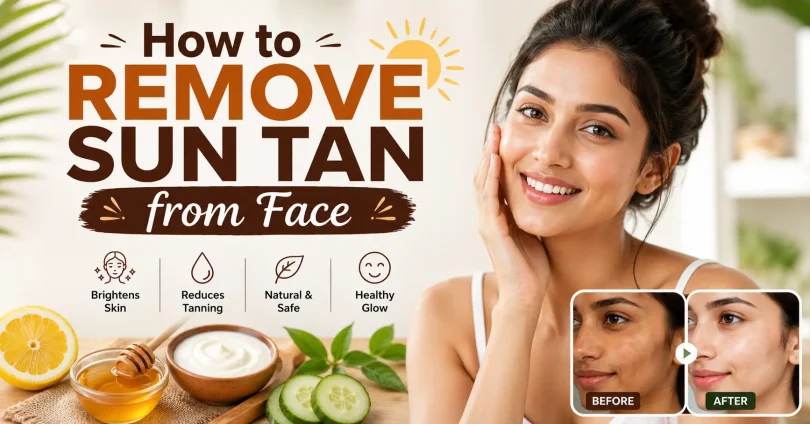
How to Remove Sun Tan from Face Naturally Fast.
You stepped out in the sun for an hour, and now your face looks two shades darker. It happens to almost everyone, and the frustration is real. Sun tan on the face is one of the most common skin concerns in South Asia, especially during summer months when UV index levels are extremely high.
The good news is that you can remove sun tan from your face using simple, science-backed home remedies, improve your results with the right skincare routine, and prevent it from coming back. This complete guide covers everything you need to know, including information most other articles skip entirely.
Read on to understand exactly why tanning happens, which remedies actually work, how fast you can expect results, and what to do when home remedies are not enough.
What Is Sun Tan and Why Does It Happen on the Face?
Sun tan is the darkening of skin caused by exposure to ultraviolet (UV) radiation from the sun. When UV rays hit your skin, cells called melanocytes respond by producing more melanin, the pigment responsible for skin colour. This increased melanin production is your skin’s natural defence mechanism against UV damage.
The face is the most exposed part of the body and therefore tans faster and more visibly than other areas. Three types of UV rays affect the skin:
- UVA rays: These penetrate deep into the dermis, stimulate melanin production, and are the primary cause of tanning. They are present throughout the day and can even pass through glass windows.
- UVB rays: These affect the outer layers of the skin, cause sunburn, and also contribute to tanning. UVB intensity is highest between 10 a.m. and 4 p.m.
- UVC rays: These are mostly absorbed by the atmosphere and do not significantly affect the skin.
Factors that make the face tan faster include thinner facial skin, more frequent sun exposure, inadequate sunscreen use, hormonal changes (especially during pregnancy or with oral contraceptives), and existing conditions like melasma, which can worsen with UV exposure.
Does Face Tan Go Away Naturally?
Yes, a tan does fade naturally over time. Your skin constantly sheds dead skin cells through a process called cellular turnover, which typically takes 28 to 40 days depending on your age and skin condition. As the tanned cells shed, fresh, less-pigmented cells rise to the surface, gradually restoring your original skin tone.
However, natural fading is slow and uneven. Without active intervention, a noticeable tan can linger for four to eight weeks. If you continue exposing your face to the sun without protection during this time, the tan deepens further and becomes harder to reverse. That is why targeted home remedies and consistent sun protection are both essential.
Can Tanned Skin Return to Its Original Colour?
Tanned skin can return to its natural colour with consistent care. A temporary tan caused by recent sun exposure will fade completely with proper skincare, sun avoidance, and the use of brightening home remedies. However, the timeline depends on how deep the pigmentation is.
Repeated or prolonged sun exposure without protection can lead to chronic hyperpigmentation, which is harder to reverse. In such cases, professional treatments may be necessary. It is also important to understand that these remedies restore your natural skin tone. No home remedy or cosmetic treatment can make your skin lighter than its natural colour, nor should that be the goal.
How Can You Remove Tan from Your Face Fast?

There is no overnight solution for tan removal, but you can significantly speed up the process by combining regular exfoliation, active brightening ingredients, and strict sun protection. Using a lemon and honey pack or potato juice daily, paired with consistent sunscreen use, can show visible improvement within one to two weeks.
For faster results, professional treatments such as chemical peels or laser toning can reduce a tan more rapidly under a dermatologist’s supervision. These are covered later in this guide.
12 Proven Home Remedies to Remove Sun Tan from Face
The following remedies work by exfoliating dead skin cells, inhibiting melanin production, or calming sun-damaged skin. Always do a patch test on your inner arm before applying any remedy to your face.
1. Lemon and Honey Pack
Lemon juice contains citric acid, which acts as a natural alpha-hydroxy acid (AHA). It gently exfoliates the outer layer of skin and inhibits tyrosinase, the enzyme responsible for melanin synthesis. Honey adds moisturising and antibacterial properties.
- Mix one tablespoon of fresh lemon juice with one tablespoon of raw honey.
- Apply to the face, avoiding the area around the eyes.
- Leave on for 15 to 20 minutes, then rinse with cool water.
- Use two to three times a week.
Important note: Lemon juice increases photosensitivity. Never go outside with lemon juice on your face. If you have sensitive skin, dilute with equal parts rose water or aloe vera gel.
2. Raw Potato Juice
Potatoes contain catecholase, a natural enzyme that lightens skin pigmentation and reduces dark spots. They also contain vitamin C, which further helps inhibit melanin production. This is one of the more effective and gentle remedies for facial tan.
- Grate a small raw potato and squeeze out the juice using a muslin cloth.
- Apply to the face using a cotton pad and let it dry for 20 minutes.
- Rinse with cool water. Repeat daily for best results.
3. Tomato and Yoghurt Mask
Tomatoes are rich in lycopene, a powerful antioxidant that protects skin from UV-induced oxidative damage. They also contain natural acids that brighten the complexion. Yoghurt provides lactic acid, an AHA that gently exfoliates and evens skin tone.
- Blend one small ripe tomato and mix with two tablespoons of plain yoghurt.
- Apply evenly and leave for 20 minutes.
- Rinse with cool water and pat dry. Use three to four times a week.
4. Besan (Gram Flour) and Turmeric Pack
This is one of the most trusted traditional de-tan remedies in South Asian skincare. Besan exfoliates dead skin cells mechanically, while turmeric contains curcumin, which has proven anti-inflammatory and melanin-inhibiting properties. Together, they make an effective and inexpensive face pack.
- Mix two tablespoons of besan, a small pinch of turmeric, and enough plain yoghurt or milk to form a smooth paste.
- Apply and let dry for 15 to 20 minutes.
- Dampen fingers and gently scrub off in circular motions, then rinse.
- Use once or twice a week.
5. Aloe Vera Gel
Aloe vera contains aloesin, a compound shown in studies to suppress melanin production by inhibiting tyrosinase activity. It also contains antioxidants, polysaccharides, and amino acids that soothe sunburned or UV-stressed skin. Aloe vera is safe for all skin types, including sensitive skin.
- Use fresh gel directly from an aloe leaf or a pure, additive-free gel.
- Apply a generous layer to the face and leave on for 30 minutes or overnight.
- Rinse in the morning with cool water. Use daily.
6. Cucumber Juice
Cucumber has a high water content and contains caffeic acid and vitamin C, which help cool inflamed skin and gradually lighten surface pigmentation. It is particularly effective for post-sun exposure skin that feels hot or irritated.
- Blend half a cucumber and strain the juice.
- Apply with a cotton pad and leave for 20 minutes, then rinse.
- You can also mix cucumber juice with aloe vera gel for a more potent cooling mask.
7. Papaya and Honey Mask
Papaya contains papain, a proteolytic enzyme that breaks down and removes dead, pigmented surface cells. It also contains vitamin A (beta-carotene) and vitamin C, both of which support skin renewal and brighten uneven tone. This remedy delivers measurable results.
- Mash two tablespoons of ripe papaya and mix with one teaspoon of honey.
- Apply and leave on for 20 minutes, then rinse with cool water.
- Use two to three times a week. Avoid if you are allergic to latex, as papaya cross-reacts with latex in some individuals.
8. Coconut Milk and Saffron Pack
Coconut milk provides intense hydration and contains mild lauric acid, which helps balance skin tone. Saffron contains crocin and safranal, bioactive compounds that research suggests may help inhibit melanin synthesis and reverse UV-induced pigmentation. This combination is gentle enough for dry and sensitive skin types.
- Soak four to five saffron strands in two tablespoons of fresh coconut milk for two hours.
- Apply to the face and leave on for 15 minutes, then rinse.
- Use three to four times a week.
9. Multani Mitti (Fuller’s Earth) and Rose Water Mask
Multani mitti is a natural clay rich in magnesium, calcium, and silica. It draws out impurities, absorbs excess oil, and mildly exfoliates the outer skin layer. Rose water acts as a gentle astringent and anti-inflammatory agent that soothes sun-stressed skin. This combination is especially effective for oily and acne-prone skin types.
- Mix two tablespoons of multani mitti with enough rose water to form a smooth paste.
- Add a few drops of lemon juice for enhanced brightening.
- Apply and leave on until almost dry (about 15 to 20 minutes), then rinse with cool water.
- Use twice a week. Avoid overuse, as it can dry out the skin.
10. Yoghurt and Oatmeal Scrub
Yoghurt delivers lactic acid to the skin’s surface, which loosens the bonds between dead skin cells and gradually fades pigmentation. Oatmeal provides gentle physical exfoliation and contains beta-glucan, which has anti-inflammatory properties that calm post-sun irritation. This scrub is ideal for dry or combination skin types.
- Mix two tablespoons of plain yoghurt with one tablespoon of finely ground oatmeal.
- Gently massage onto the face in circular motions for one to two minutes.
- Leave on for 10 minutes and rinse with cool water.
- Use once or twice a week. Over-scrubbing can aggravate sensitive skin.
11. Curd and Buttermilk Toner
Both curd and buttermilk are natural sources of lactic acid, which is one of the most well-researched skin-brightening agents. Lactic acid exfoliates gently, improves cell turnover, and reduces surface pigmentation without the irritation that stronger acids can cause. This is an excellent daily toner for people with sensitive or reactive skin.
- Soak a cotton pad in fresh buttermilk and apply across the face.
- Leave on for 20 minutes, then rinse with cool water. No scrubbing needed.
- Can be used daily as part of your skincare routine.
12. Vitamin C-Rich Orange Peel Powder
Orange peel is one of the richest natural sources of vitamin C, which is scientifically proven to inhibit tyrosinase activity, reduce melanin synthesis, and brighten skin tone. Dried orange peel powder also provides mild exfoliation.
- Sun-dry orange peels and grind them into a fine powder. Store in an airtight container.
- Mix one tablespoon of orange peel powder with two tablespoons of yoghurt or rose water to form a paste.
- Apply to the face and leave on for 20 minutes, then rinse.
- Use two to three times a week.
Which Remedy Works Best for Your Skin Type?
Not all remedies suit all skin types. Using the wrong one can cause irritation or dryness. The table below helps you choose the right remedy based on your skin type.
| Skin Type | Best Remedies | Avoid |
| Oily Skin | Multani Mitti, Lemon + Honey, Tomato + Yoghurt | Coconut Milk (too heavy) |
| Dry Skin | Aloe Vera, Coconut Milk + Saffron, Yoghurt + Oatmeal | Multani Mitti (drying), undiluted lemon |
| Sensitive Skin | Aloe Vera, Curd/Buttermilk, Cucumber Juice | Lemon juice (even diluted, test first) |
| Normal / Combination | Besan + Turmeric, Orange Peel Powder, Papaya + Honey | No specific exclusions |
| Acne-Prone Skin | Aloe Vera, Curd, Tomato Pulp | Heavy oils, Coconut Milk |
Skin-Brightening Active Ingredients to Look for in Products
If you want to support your home remedies with commercial skincare products, look for these clinically proven active ingredients that help remove sun tan from the face and prevent hyperpigmentation:
- Niacinamide (Vitamin B3): Reduces melanin transfer to skin cells by up to 68%, visibly evening out skin tone over four weeks of consistent use.
- Vitamin C (Ascorbic Acid): Inhibits tyrosinase activity directly, making it one of the most scientifically validated brightening agents available.
- Alpha Arbutin: A gentler alternative to hydroquinone that inhibits melanin without the side effects. Effective for persistent tan lines and post-inflammatory marks.
- Kojic Acid: Derived from fermentation, it blocks melanin production and is commonly found in de-tan serums and creams.
- Licorice Extract (Glabridin): Disperses melanin and inhibits UVB-induced pigmentation. Particularly effective when combined with vitamin C.
- Retinoids (Retinol or Tretinoin): Accelerate skin cell turnover, pushing tanned cells to the surface faster. Available over the counter (retinol) or on prescription (tretinoin). Use at night only.
A Daily Skincare Routine to Remove Face Tan Faster
Following a consistent routine amplifies the effect of individual remedies. This is the daily routine that supports faster tan removal.
Morning Routine
- Gentle Cleanser: Wash your face with a mild, sulphate-free cleanser to remove overnight sweat and product residue.
- Vitamin C Serum: Apply 4 to 5 drops of a vitamin C serum to a clean face. This provides antioxidant protection and brightening throughout the day.
- Niacinamide Moisturiser: Use a lightweight moisturiser containing niacinamide to keep the skin barrier intact and continue melanin reduction.
- Broad-Spectrum Sunscreen SPF 50+: Apply at least two finger lengths of sunscreen to your face 15 to 20 minutes before stepping outside. This step is non-negotiable. Without it, all other efforts are undone each time you are exposed to sun.
Evening Routine
- Double Cleanse: Start with micellar water or cleansing oil to remove sunscreen and pollution, then follow with a gentle face wash.
- Home Remedy Mask (3 to 4 times a week): Choose one of the 12 remedies above based on your skin type and apply for the recommended duration.
- Alpha Arbutin or Kojic Acid Serum (optional): For deeper or more stubborn tans, add a brightening serum to your evening routine after rinsing off the mask.
- Night Cream or Retinol (optional): A retinol cream used two to three nights a week accelerates cell turnover and speeds up tan fading. Beginners should start with 0.1 to 0.25% concentration.
Weekly De-Tan Routine
- Exfoliate once or twice: Use the yoghurt and oatmeal scrub or besan pack to remove the buildup of dead, pigmented cells. Never over-exfoliate.
- Deep treatment mask once: Use the papaya mask or the orange peel powder mask for intensive brightening.
- Sheet masking: A niacinamide or vitamin C sheet mask can be used once a week to boost brightening results.
Professional Treatments for Stubborn Face Tan
When home remedies do not deliver sufficient results after four to six weeks of consistent use, professional treatments can make a significant difference. These should always be performed or supervised by a qualified dermatologist.
- Chemical Peels: Use glycolic acid, lactic acid, or salicylic acid to remove layers of tanned skin. Superficial peels are suitable for mild tan, while medium peels address deeper pigmentation.
- Laser Toning: A dermatologist uses a Q-switched Nd:YAG laser to break down excess melanin deposits in the skin without damaging surrounding tissue. Results are usually visible within three to five sessions.
- Microdermabrasion: A mechanical exfoliation method that removes the outermost layer of dead, tanned skin using fine crystals or a diamond-tip applicator. It also stimulates collagen production.
- PRP (Platelet-Rich Plasma) Therapy: Though primarily used for skin rejuvenation, PRP also helps reduce hyperpigmentation and improves overall skin tone.
How to Prevent Sun Tan on the Face
Prevention is the most effective strategy. The following steps, applied consistently, reduce the likelihood of tanning significantly:
- Apply SPF 50+ broad-spectrum sunscreen daily: Do this even on cloudy days, as UVA rays penetrate clouds. Reapply every two hours if outdoors.
- Wear physical sun protection: A wide-brimmed hat, UV-filter sunglasses, and a scarf significantly reduce direct UV exposure to the face.
- Avoid peak sun hours: UV intensity is highest between 10 a.m. and 4 p.m. Limit outdoor exposure during this window.
- Stay hydrated: Dehydrated skin is more vulnerable to UV damage. Drink at least eight glasses of water daily.
- Eat a diet rich in antioxidants: Foods high in vitamin C (citrus fruits, bell peppers), vitamin E (nuts, seeds), and carotenoids (carrots, tomatoes) help protect the skin from UV-induced oxidative damage from within.
- Use sun-protective makeup: Foundations and BB creams with SPF provide an additional layer of protection on top of sunscreen.
- Never skip sunscreen because of tinted glass or car windows: Standard glass blocks UVB but not UVA. You can tan through windows.
When to See a Dermatologist
Most face tans respond well to home remedies within two to six weeks. However, you should consult a dermatologist if:
- The tan does not fade after six weeks of consistent home treatment and sun protection.
- You experience skin irritation, redness, or allergic reactions from home remedies.
- You have conditions like melasma, post-inflammatory hyperpigmentation (PIH), or conditions that mimic tanning.
- You notice unusual skin changes such as new dark patches, asymmetric colouring, or moles that have changed in size or shape.
- You have a history of heavy sun exposure or sunburns over many years and are concerned about long-term skin health.
Foods That Help Remove Sun Tan from Inside Out

What you eat directly affects your skin’s ability to repair UV damage and reduce pigmentation. These foods support de-tanning from within:
- Tomatoes: Rich in lycopene, which has been shown in clinical research to reduce UV-induced skin damage when consumed regularly.
- Citrus Fruits: Oranges, lemons, and amla (Indian gooseberry) are high in vitamin C, which reduces melanin production internally.
- Green Tea: Contains epigallocatechin gallate (EGCG), a potent antioxidant that reduces UV-induced inflammation and pigmentation.
- Almonds and Walnuts: Provide vitamin E, which protects cell membranes from UV-induced oxidative damage.
- Carrots and Sweet Potatoes: High in beta-carotene, which acts as a natural internal sun protectant and supports even skin tone.
Common Mistakes People Make While Trying to Remove Face Tan
Understanding what not to do is just as important as knowing the right remedies. Avoiding these mistakes can significantly speed up your results:
- Over-exfoliating: Scrubbing too often disrupts the skin barrier, causes inflammation, and can trigger post-inflammatory hyperpigmentation, which is worse than the original tan.
- Applying lemon juice undiluted and going outdoors: This causes phototoxic reactions, which can result in dark patches that are far harder to treat.
- Switching remedies too frequently: Home remedies need two to four weeks of consistent use to show results. Jumping between remedies every few days prevents any single ingredient from working.
- Skipping sunscreen: This single mistake cancels all de-tanning efforts. Apply sunscreen every single morning, without exception.
- Using multiple active ingredients at once: Combining too many acids or brightening actives simultaneously causes irritation and sensitisation. Introduce one new ingredient at a time.
Frequently Asked Questions
How can I remove tan from my face fast?
Combine daily application of aloe vera gel or potato juice with a weekly exfoliating pack such as besan and turmeric, and use a vitamin C serum every morning. These steps together produce the fastest visible improvement at home. For faster clinical results, consult a dermatologist about chemical peels or laser toning.
Can tanned skin become white again?
With consistent skincare and sun protection, tanned skin can return to its original natural colour. However, remedies restore your natural tone only. They cannot make your skin lighter than it naturally is.
Does face tan go away on its own
Yes, but slowly. Natural skin cell turnover takes 28 to 40 days. Without active treatment and sun protection, a tan can persist for months and deepen with continued sun exposure.
How long do home remedies take to show results?
Typically two to four weeks of consistent daily use. Mild surface tans respond faster. Deeper or older tans may take six to eight weeks, or may require professional treatment.
Is it safe to use lemon juice on the face daily?
Not recommended. Lemon juice is acidic and can cause irritation, photosensitivity, and phototoxic reactions with sun exposure. Use it two to three times a week, always diluted, and never before going outside.
Which sunscreen is best for preventing face tan?
Use a broad-spectrum sunscreen with SPF 50 or higher that protects against both UVA and UVB rays. For Indian climate conditions, a lightweight water-resistant formula is ideal. Mineral sunscreens containing zinc oxide or titanium dioxide are preferable for sensitive or acne-prone skin.
Conclusion
Removing sun tan from the face is absolutely achievable with the right approach. The key is consistency. Choose a remedy suited to your skin type, pair it with a structured morning and evening skincare routine, never skip sunscreen, and give your skin the two to four weeks it needs to visibly improve.
If your tan does not respond after six weeks, or if you have conditions like melasma or persistent hyperpigmentation, a dermatologist can offer professional treatments that deliver faster and more permanent results. Your skin works hard to protect you from UV damage every day. Treat it with the care it deserves.
You May Also Like It: