
Are you dreaming of a career at sea — traveling the world, earning a high salary, and working in one of the most adventurous professions on Earth? If yes, the Merchant Navy could be your perfect career path.
This guide explains everything you need to know about how to join Merchant Navy — from merchant navy qualification requirements and merchant navy entrance exams to merchant navy courses, salary packages, and a clear step-by-step process.
Whether you are a student after 10th, 12th, or a graduate, this article is your complete 2026 roadmap.
What You Will Learn in This Guide
- What is the Merchant Navy and how it works
- Merchant navy age limit and eligibility criteria
- Merchant navy qualification required (10th, 12th, Graduate)
- How to join Merchant Navy — step-by-step process
- Merchant navy entrance exam: IMUCET, AIMNET, and more
- Types of merchant navy courses and durations
- Medical fitness standards
- Salary at every rank (updated 2026 figures)
- Career progression from Cadet to Captain
- Tips to avoid scams and fake institutes
- Frequently Asked Questions (FAQs)
What Is the Merchant Navy?
The Merchant Navy is a civilian fleet of commercial ships responsible for transporting goods, cargo, oil, gas, and passengers across the world’s oceans. It is the backbone of global trade — more than 90% of world trade is carried by sea.
Unlike the Indian Navy, which focuses on national defense, the Merchant Navy is a civilian profession regulated by the Directorate General of Shipping (DGS).
Key Functions of the Merchant Navy
- Transporting bulk cargo like coal, grain, and fertilizers
- Carrying crude oil and petroleum products
- Container shipping for manufactured goods
- LNG and LPG transportation
- Passenger services on cruise liners and ferries
- Offshore support for oil rigs and platforms
Key Fact: India is among the top maritime nations in the world and employs thousands of seafarers globally.
Is Merchant Navy a Government or Private Job?
This is one of the most common questions among students.
The Merchant Navy is not a government job. It is a private-sector profession where you work for shipping companies.
However, it is regulated and licensed by the government through the Directorate General of Shipping (DGS).
Merchant Navy vs Indian Navy
Indian Navy
- Government defense job
- Protects national security
- Entry through NDA/CDS
Merchant Navy
- Commercial private job
- Focuses on trade and cargo
- Entry through exams and training courses
Merchant Navy Age Limit & Eligibility Criteria
Before applying, you must meet eligibility criteria.
Merchant Navy Age Limit
GP Rating (After 10th)
- Minimum age: 17.5 years
- Maximum age: 25 years
Deck Cadet / DNS (After 12th)
- Minimum age: 17 years
- Maximum age: 25 years
B.Sc Nautical Science
- Minimum age: 17 years
- Maximum age: 25 years
B.Tech Marine Engineering
- Minimum age: 17 years
- Maximum age: 25 years
Graduate Marine Engineering (GME)
- Minimum age: 17 years
- Maximum age: 28 years
Educational Qualification Requirements
After 10th Grade
You can apply for:
- GP Rating
- Deck Rating
- Engine Rating
- Saloon Rating
- Seaman Technician
Requirements:
- Minimum 40–50% marks in 10th
- Science and Mathematics required
- English proficiency preferred
- After 12th Grade
Requirements:
- Minimum 60% marks in PCM (Physics, Chemistry, Mathematics)
- At least 50% marks in English
Eligible courses:
- Diploma in Nautical Science (DNS)
- B.Sc Nautical Science
- B.Tech Marine Engineering
- Naval Architecture
- After Graduation
Eligible for:
- Graduate Marine Engineering (GME)
- Electro Technical Officer (ETO)
- Specialized officer programs
Requirements: Engineering or Science degree depending on course.
Physical & Medical Fitness Standards
Medical fitness is extremely important in the Merchant Navy.
You must pass a medical examination from a DGS-approved doctor.
Basic Medical Requirements
- Good eyesight (6/6 preferred)
- No color blindness
- Normal hearing ability
- Healthy BMI and body fitness
- Normal blood pressure
- No major physical disability affecting sea work
Important: Candidates using glasses can still join in many positions if corrected vision meets standards.
Merchant Navy Courses — Types, Duration, and Eligibility
There are mainly two career pathways in the Merchant Navy:
- Officer Pathway
- Rating Pathway
Let’s understand them in detail.
Pre-Sea Courses (Entry-Level)
GP Rating (General Purpose Rating)
- Eligibility: 10th pass (Science + Math preferred)
- Duration: 6 months
- Role after course: Deck or Engine crew member on ships
Pre-Sea Deck Rating
- Eligibility: 10th pass
- Duration: 4–6 months
- Role: Deck operations
Pre-Sea Engine Rating
- Eligibility: 10th pass (ITI preferred)
- Duration: 4–6 months
- Role: Engine room support
Saloon Rating / Steward
- Eligibility: 10th pass
- Duration: 3–4 months
- Role: Catering and hospitality onboard
Seaman Technician
Eligibility: 10th + ITI preferred
Duration: Around 4 months
Role: Technical engine support
Officer-Level Courses (After 12th)
B.Sc Nautical Science
- Eligibility: 12th PCM with 60% marks
- Duration: 3 years
- Degree: Bachelor’s Degree
B.Tech Marine Engineering
- Eligibility: 12th PCM with 60% marks
- Duration: 4 years
- Degree: B.Tech
Diploma in Nautical Science (DNS)
- Eligibility: 12th PCM
- Duration: 1 year + sea training
- Outcome: Officer-level career
Naval Architecture
- Eligibility: 12th PCM
- Duration: 4 years
- Role: Ship design and structure
Graduate-Level Courses
Graduate Marine Engineering (GME)
- Eligibility: Engineering graduates
- Duration: 1 year + sea training
- Role: Marine Engineer Officer
Electro Technical Officer (ETO)
- Eligibility: Electrical/Electronics background
- Duration: Few months training + sea time
- Role: Electrical systems onboard
Merchant Navy Entrance Exam
To get admission in a good maritime academy, you often need to clear a merchant navy entrance exam.
IMUCET (Indian Maritime University Common Entrance Test)
This is one of the most important exams.
Exam Details
- Conducted by: Indian Maritime University (IMU)
- Mode: Online
- Duration: 3 Hours
- Questions: Multiple Choice Questions (MCQs)
Subjects Included
- English
- General Aptitude
- Physics
- Chemistry
- Mathematics
Eligibility
- 12th PCM with at least 60% marks
AIMNET (All India Merchant Navy Entrance Test)
Another entrance exam used by some institutes.
Subjects
- English
- Physics
- Mathematics
- General Knowledge
Eligibility
- 10th or 12th depending on course
Sponsorship Route (Without National Exam)
Some shipping companies directly sponsor cadets.
In this process:
- Apply to a DGS-approved institute
- Institute shortlists students
- Shipping company selects candidates
- Training begins with job opportunities later
Tip: Sponsored cadets usually have better job security.
Step-by-Step Process: How to Join Merchant Navy
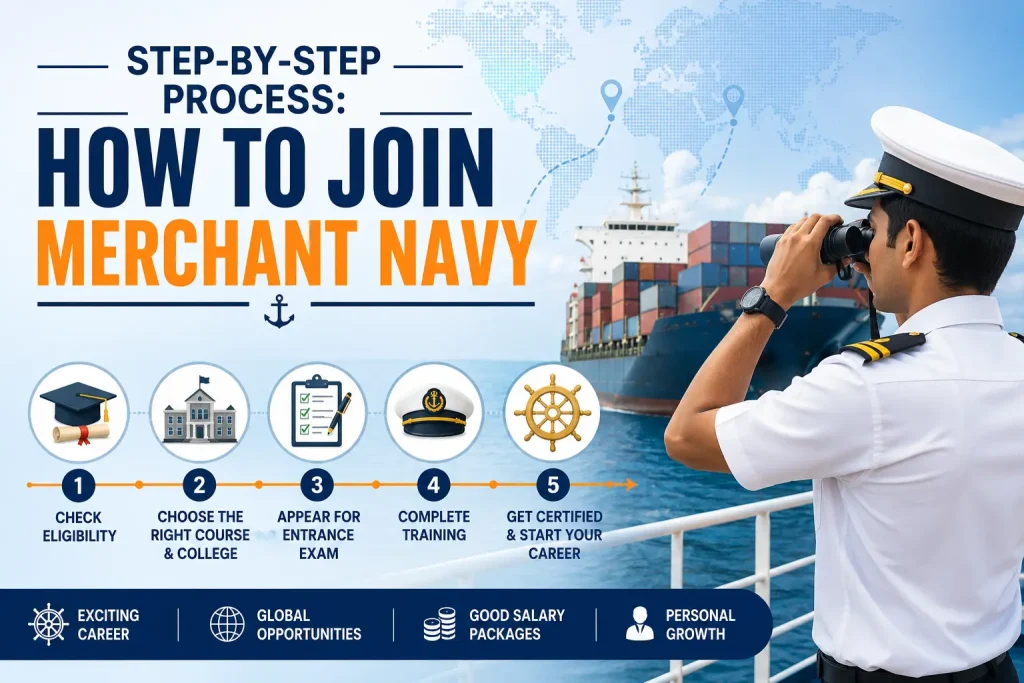
Here is the complete roadmap:
Step 1: Complete Education
Finish 10th, 12th, or graduation depending on your target role.
Step 2: Choose Your Career Path
Decide whether you want to become:
- Rating Crew
- Deck Officer
- Marine Engineer
- Catering Staff
Step 3: Pass Medical Test
Get medical clearance from a DGS-approved doctor.
Step 4: Clear Entrance Exam
Appear in:
- IMUCET
- AIMNET
- Institute-level exams
Step 5: Join a DGS-Approved Institute
Always verify institute approval before admission.
Step 6: Complete Training and Sea Time
After classroom learning, onboard training is mandatory.
You will receive:
- CDC (Continuous Discharge Certificate)
- STCW Certificate
- INDOS Number
Important Warning
Never join a fake institute.
Before taking admission:
- Verify DGS approval
- Avoid fake job guarantees
- Don’t trust agents promising shortcuts
- Confirm institute authenticity online
Top DGS-Approved Maritime Institutes in India
Choosing the right institute is very important because only DGS-approved institutes are valid for Merchant Navy careers.
Here are some top institutes:
Indian Maritime University (IMU)
- Location: Chennai + multiple campuses
- Courses: B.Sc Nautical Science, Marine Engineering, DNS
Tolani Maritime Institute (TMI)
- Location: Pune, Maharashtra
- Courses: DNS, Marine Engineering, ETO
Samundra Institute of Maritime Studies (SIMS)
- Location: Maharashtra
- Courses: DNS, GME, ETO
Anglo-Eastern Maritime Academy
- Location: Maharashtra
- Courses: DNS, Marine Engineering
HIMT (Hindustan Institute of Maritime Training)
- Location: Chennai
- Courses: GP Rating, DNS, Marine Engineering
Pro Tip: IMU is one of the most trusted maritime universities in India.
Required Documents for Merchant Navy
Before applying, keep these documents ready:
- 10th Marksheet & Certificate
- 12th Marksheet & Certificate
- Valid Passport
- Medical Fitness Certificate
- ID Card (Aadhaar/National ID)
- Passport-size photographs
- Birth Certificate or Age Proof
- CDC (after training)
- STCW Certificate
Important Passport Note
A passport is compulsory.
Without a passport, you cannot:
- Join a ship
- Get CDC
- Travel internationally for sea jobs
So apply for a passport as early as possible.
Merchant Navy Salary in 2026
One of the biggest reasons students choose Merchant Navy is the high salary.
Deck Department Salary
Deck Cadet
- Salary: $500–$1,000 per month
3rd Officer
Salary: $2,500–$4,500 per month
2nd Officer
- Salary: $4,000–$6,000 per month
Chief Officer
- Salary: $6,500–$10,000 per month
Captain / Master
- Salary: $10,000–$18,000 per month
Engine Department Salary
Engine Cadet
- Salary: $500–$1,000 per month
4th Engineer
- Salary: $2,000–$3,500 per month
3rd Engineer
- Salary: $3,000–$5,000 per month
2nd Engineer
- Salary: $5,000–$8,000 per month
Chief Engineer
- Salary: $10,000–$17,000 per month
Rating Salary
GP Rating / Able Seaman
- Salary: $800–$1,500 per month
Bosun
- Salary: $1,200–$2,000 per month
Engine Room Rating
- Salary: $800–$1,500 per month
Steward / Catering Staff
- Salary: $700–$1,200 per month
Tax Benefit
Many Merchant Navy employees enjoy tax-free income benefits if they stay outside their country for required days according to tax laws.
Career Progression in Merchant Navy
Merchant Navy offers a clear career path.
Deck Department Career Path
- Deck Cadet
- 3rd Officer
- 2nd Officer
- Chief Officer
- Captain / Master
Engineering Department Career Path
- Engine Cadet
- 4th Engineer
- 3rd Engineer
- 2nd Engineer
- Chief Engineer
Shore-Based Career Opportunities
After years of sailing, you can shift to land jobs such as:
- Marine Surveyor
- Port Captain
- Maritime Lecturer
- Shipping Company Manager
- Safety Inspector
- Offshore Consultant
Life Onboard a Merchant Navy Ship
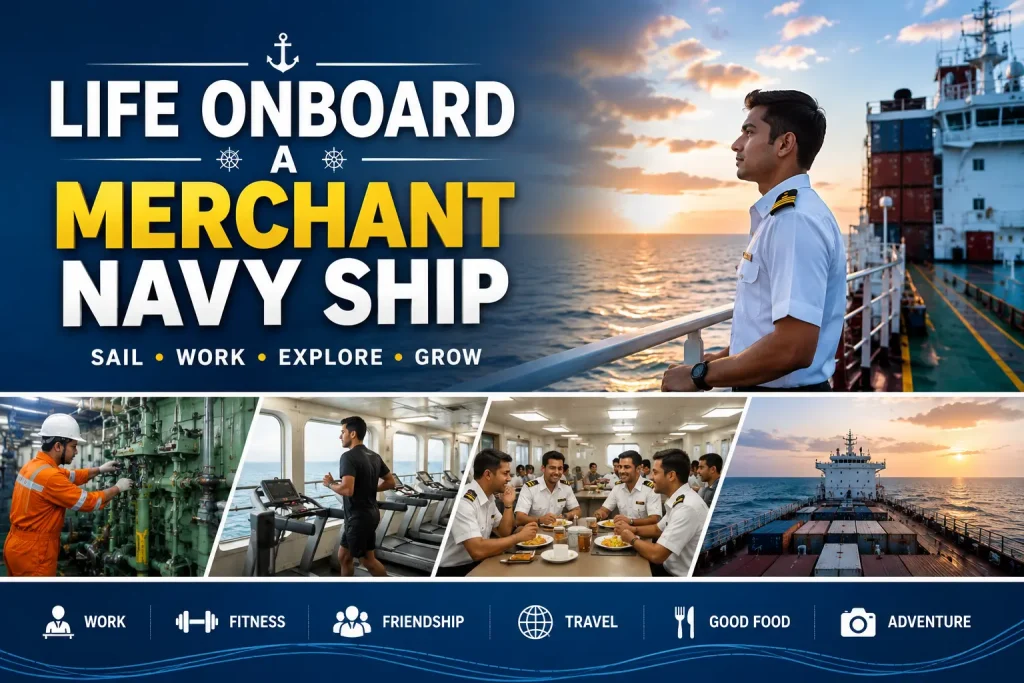
Many people wonder what life at sea looks like.
Work Schedule
- 8–12 working hours daily
- Shift-based work system
- Contracts usually last 3–9 months
- Long holidays after contracts
Facilities on Modern Ships
- Private rooms
- Food and dining facilities
- Gym and entertainment rooms
- Limited internet access
- Medical support
Challenges
- Staying away from family
- Long contracts at sea
- Tough weather conditions
- Physical and mental pressure
Reality Check: Merchant Navy is exciting, but it requires discipline and dedication.
FAQs
Can I join Merchant Navy after 10th?
Yes, you can join through GP Rating, Deck Rating, or Engine Rating courses.
What is the minimum age for Merchant Navy?
The minimum age is 17–17.5 years, depending on the course.
Is PCM required for Merchant Navy?
Yes, Physics, Chemistry, and Mathematics (PCM) are required for officer-level courses.
Is the Merchant Navy exam difficult?
No, with proper preparation of 3–4 months, it is manageable.
Is swimming compulsory?
No, but basic swimming and safety training are included later.
Can girls join the Merchant Navy?
Yes, women can join as Deck Officers, Engineers, and other roles.
Can I join Merchant Navy with glasses?
Yes, if your corrected eyesight meets medical standards.
What is the salary of a fresher?
Freshers can earn around $500–$1,500 per month, depending on role.
What is CDC in Merchant Navy?
CDC (Continuous Discharge Certificate) is a seafarer’s work and identity document.
Is Merchant Navy a government job?
No, it is a private commercial profession.
How long does it take to become a Captain?
Usually around 10–15 years with promotions and sea experience.
Is Merchant Navy salary tax-free?
In many cases, yes, depending on time spent outside the country.
What is STCW?
It is an international safety certification required for seafarers.
Which entrance exam is required?
IMUCET is the most common exam for Merchant Navy admission.
Can I join Merchant Navy after graduation?
Yes, graduates can join through GME or ETO courses.
Conclusion
The Merchant Navy is one of the most rewarding and high-paying careers for students who dream of working at sea.
Whether you want to join after 10th, 12th, or graduation, there is a pathway available for everyone.
Quick Recap: How to Join Merchant Navy
- Complete required education
- Choose your career path
- Pass the medical fitness test
- Clear the entrance exam
- Join a DGS-approved institute
- Complete sea training
- Get CDC and certifications
- Start your career and grow toward Captain or Chief Engineer
If you are passionate about travel, adventure, discipline, and high earnings, the Merchant Navy can be a life-changing career option for you.
You May Also Like It:
I Have Sensitive Skin. How Gentle Are Nivea’s Creams Compared to Aveeno?
My Son Can’t See How Do I Explain Colours to Him?
Compare Corbett and Ranthambore for a 5-Day Wildlife Photography Trip in November on a 50K Budget