
Most students run into the same problem at the end of a semester: the result sheet shows an SGPA, but the form they are filling out – for a job, a scholarship, or an admission abroad – asks for a CGPA. The two numbers look similar, but they are not the same thing, and converting one into the other incorrectly is more common than it should be.
This guide explains exactly how to calculate CGPA from SGPA, with the correct formula, fully worked examples, the mistakes that quietly distort results, and the points where most online guides go wrong or leave out important context.
Quick Answer
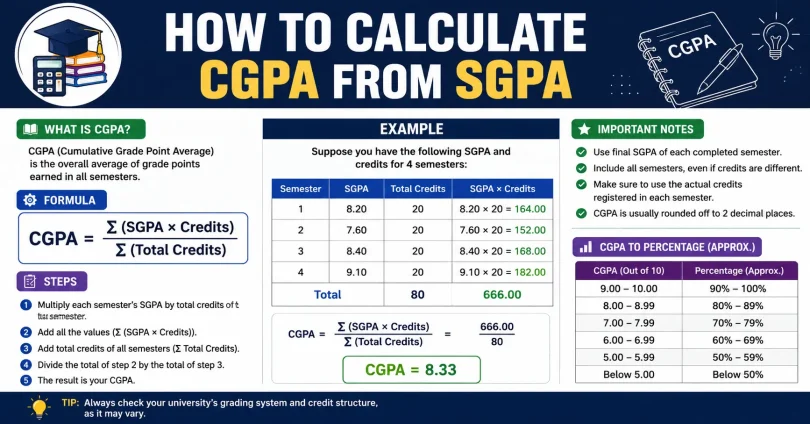
CGPA = Σ (SGPA × Semester Credits) ÷ Σ (Semester Credits)
Multiply each semester’s SGPA by the total credits for that semester, add up these values, then divide by the total credits across all semesters. This is the credit-weighted method used by most universities. If every semester carries the exact same number of credits, a simpler formula gives the identical result: CGPA = (Sum of all SGPAs) ÷ (Number of semesters).
What Is SGPA?
SGPA stands for Semester Grade Point Average. It is a single number that summarises how a student performed across all the subjects taken in one semester. Each subject carries a credit value based on its weekly teaching hours or importance, and each subject also earns a grade point based on the marks scored. SGPA combines these two figures into one weighted score for that semester only.
Because SGPA resets with every semester, it is the most accurate short-term measure of academic performance. A difficult semester with tough electives will show up clearly in that semester’s SGPA, even if earlier semesters went well.
What Is CGPA?
CGPA stands for Cumulative Grade Point Average. It combines the SGPA of every completed semester into a single overall score that represents performance across the whole degree or programme, not just one term.
CGPA is the figure that appears on the final transcript, degree certificate, and most job or admission forms. It is more stable than SGPA because one weak semester gets averaged against several strong ones, and it only moves a little with each new result.
SGPA vs CGPA: Key Differences
| Aspect | SGPA | CGPA |
| Full form | Semester Grade Point Average | Cumulative Grade Point Average |
| Time span | One semester only | All completed semesters combined |
| What it shows | Performance in that specific term | Overall academic performance to date |
| Changes how often | Calculated fresh every semester | Updated each semester, but moves gradually |
| Where it is used | Internal tracking, semester mark sheets | Final transcripts, placements, higher studies, scholarships |
| Stability | Can swing sharply between terms | Smooths out single-semester ups and downs |
The Two Formulas Used to Calculate CGPA from SGPA
This is where most students get stuck, because different websites quote different formulas. The confusion exists for a simple reason: there are two correct formulas, and each one applies to a different situation. Using the wrong one for your situation is the single biggest cause of an inaccurate CGPA.
Method 1: Simple Average Formula
Use this only when every semester in your course carries the exact same total number of credits.
Formula
CGPA = (SGPA of Sem 1 + SGPA of Sem 2 + … + SGPA of Sem n) ÷ Total number of semesters
Method 2: Credit-Weighted Average Formula
This is the official method followed by most AICTE- and UGC-affiliated universities, and it works correctly whether or not your semester credits are equal.
Formula
CGPA = Σ (SGPA × Semester Credits) ÷ Σ (Semester Credits)
Here, Σ means “sum of.” You multiply each semester’s SGPA by that semester’s total credit value, add all those results together, then divide by the sum of all the credits.
Which Formula Should You Use?
Check your academic transcript or examination handbook for the total credits assigned to each semester.
- If every semester has the same total credits, both formulas will return the exact same CGPA. The simple average is, mathematically, just a shortcut version of the weighted formula for that special case.
- If even one semester has a different credit total than the others (common when a project semester, internship, or elective-heavy term carries fewer or more credits), you must use the credit-weighted formula. The simple average will give you a noticeably incorrect number.
- When in doubt, use the credit-weighted formula. It always gives the correct result, regardless of whether credits are equal or different.
Why This Matters
Several SGPA-to-CGPA guides only show the simple average formula because it looks easier. This works fine in courses with identical credit loads every semester, but it silently produces a wrong CGPA the moment credit loads differ – which happens in most engineering, BBA, B.Com, and B.Sc programmes by the final year, once project work and electives change the credit structure.
How to Calculate CGPA from SGPA: Step-by-Step (Credit-Weighted Method)
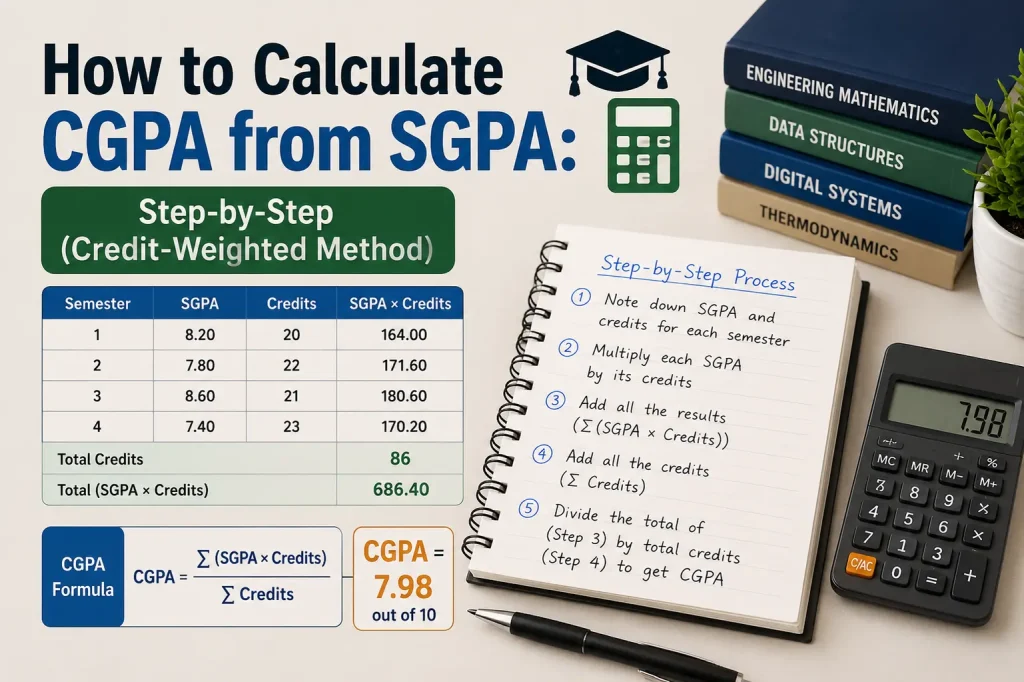
- List the SGPA you scored in every completed semester.
- Note the total credits assigned to each of those semesters, from your transcript or curriculum handbook.
- Multiply each semester’s SGPA by that semester’s total credits.
- Add up all the resulting values from step 3.
- Add up the total credits across all semesters.
- Divide the total from step 4 by the total from step 5. The result is your CGPA, usually rounded to two decimal places.
Worked Example: An 8-Semester B.Tech Programme
Suppose a student has completed all eight semesters of an engineering programme with the following SGPA and credit values, which vary from semester to semester, as they typically do once project and elective credits change the load.
| Semester | SGPA | Credits | SGPA × Credits |
| 1 | 7.80 | 22 | 171.60 |
| 2 | 8.00 | 21 | 168.00 |
| 3 | 7.60 | 23 | 174.80 |
| 4 | 8.20 | 22 | 180.40 |
| 5 | 8.50 | 20 | 170.00 |
| 6 | 8.30 | 21 | 174.30 |
| 7 | 8.70 | 18 | 156.60 |
| 8 | 9.00 | 16 | 144.00 |
| Total | – | 163 | 1339.70 |
CGPA = 1339.70 ÷ 163 = 8.22
This student’s overall CGPA across all eight semesters is 8.22, even though their average SGPA looks slightly different from a simple average because the credit weighting accounts for the heavier first-year semesters.
How to Calculate CGPA Using the Simple Average Method
This method applies only when every semester carries identical total credits.
- List the SGPA for every semester.
- Add all the SGPA values together.
- Divide the total by the number of semesters.
Worked Example: Four Semesters With Equal Credits
Suppose a student has completed four semesters, each worth 20 credits, with SGPA values of 8.1, 7.6, 8.4, and 8.7.
- Sum of SGPAs = 8.1 + 7.6 + 8.4 + 8.7 = 32.8
- CGPA = 32.8 ÷ 4 = 8.20
Notice that running the same numbers through the credit-weighted formula gives the identical result, because the 20-credit weight is the same for every term and cancels out: (8.1×20 + 7.6×20 + 8.4×20 + 8.7×20) ÷ 80 = 656 ÷ 80 = 8.20. This is the proof that the simple average is only a special case of the credit-weighted formula, not a separate or competing rule.
How to Calculate SGPA First (If You Need It)
If your result sheet only shows individual subject grades and credits rather than a ready-made SGPA, calculate SGPA first using this formula.
SGPA Formula
SGPA = Σ (Credit × Grade Point) ÷ Σ (Credits) for that semester
- List the credit value of every subject in the semester.
- Multiply each subject’s credit by the grade point earned in that subject.
- Add up all the results from step 2.
- Add up the credits of all subjects.
- Divide the total from step 3 by the total from step 4.
Worked Example
| Subject | Credits | Grade Point | Credit × Grade Point |
| Data Structures | 4 | 9 | 36 |
| Mathematics III | 4 | 8 | 32 |
| Electronics | 3 | 7 | 21 |
| Communication Skills | 2 | 9 | 18 |
| Workshop Practice | 1 | 10 | 10 |
| Total | 14 | – | 117 |
SGPA = 117 ÷ 14 = 8.36
How to Convert CGPA to Percentage
There is no single formula used everywhere. Different boards and universities apply different multipliers, and using the wrong one can change your reported percentage by several points – which matters for job cut-offs and admission eligibility. Always confirm the exact formula on your official transcript or examination handbook before reporting a percentage anywhere.
| Common Formula | Typically Associated With | Example (CGPA 8.2) |
| Percentage = CGPA × 9.5 | CBSE (Class 10/12) and many universities following the CBSE-style convention | 8.2 × 9.5 = 77.9% |
| Percentage = (CGPA − 0.5) × 10 | AICTE’s recommended formula for technical/engineering institutions | (8.2 − 0.5) × 10 = 77% |
| Percentage = CGPA × 10 | Some universities that use a direct 10-point multiplier | 8.2 × 10 = 82% |
Because the same CGPA can produce a different percentage depending on which formula applies, never assume a formula from a different university or board applies to your own marksheet. If your transcript does not state the formula, contact your examination department for the official conversion rule.
Does a Backlog or Failed Subject Affect Your CGPA?
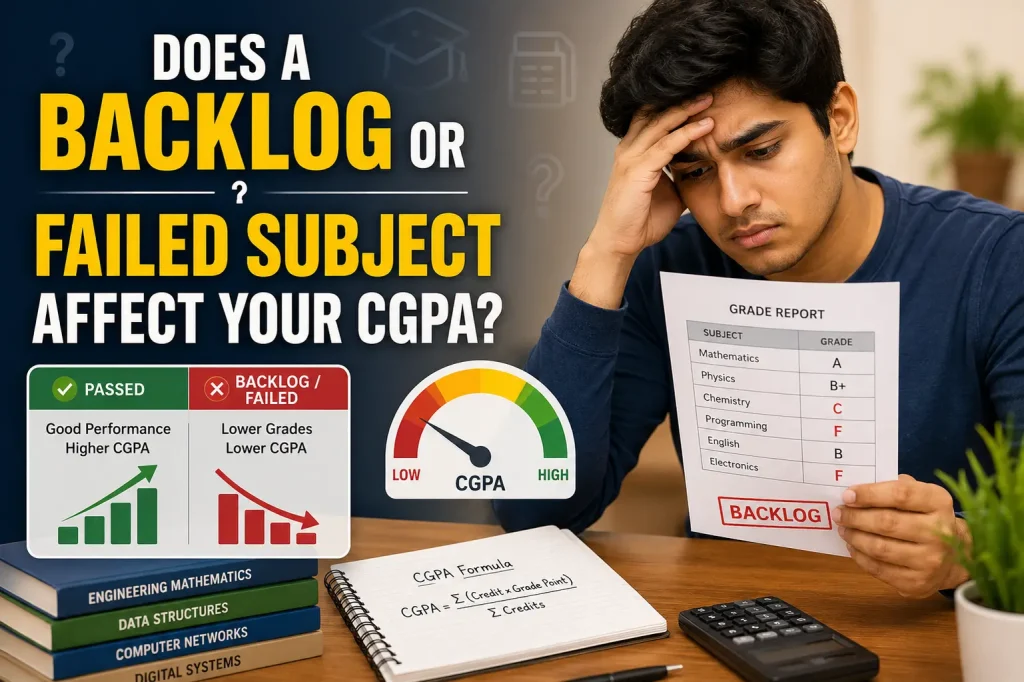
Yes, and this is one of the most overlooked parts of the conversion process.
- A failed subject is usually recorded with a grade point of zero, but its credits still count toward the semester’s total credits. This pulls both the SGPA and the resulting CGPA down until the subject is cleared.
- Once you clear a backlog through a re-examination, supplementary exam, or improvement attempt, most universities recalculate that semester’s SGPA using the new grade point, which then changes your CGPA going forward.
- Policy on whether the old failing attempt is averaged with the new one, or fully replaced by it, varies by university. Check your examination regulations rather than assuming either rule applies automatically.
- If you are a Direct Second Year Entry (lateral entry / DSE) student, your CGPA calculation typically begins from semester three onward, since you do not have SGPA records for the first two semesters.
Common Mistakes Students Make When Converting SGPA to CGPA
- Using the simple average when credits differ: this is the most frequent error, and it happens because the simple formula is easier to remember. If your semesters carry different credit loads, this method understates or overstates your real CGPA.
- Rounding too early: rounding off SGPA or intermediate totals before the final step introduces small errors that add up. Keep full decimal values throughout and round only the final CGPA.
- Ignoring failed or backlog subjects: leaving out a failed subject’s credits inflates your CGPA and does not match your official transcript.
- Mixing up credit systems: some institutions use a 10-point scale, others use 4-point or 7-point scales. Confirm your scale before comparing or converting figures.
- Applying the wrong CGPA-to-percentage formula: borrowing a multiplier from a friend’s university or a generic website, instead of checking your own institution’s official formula.
- Forgetting lateral entry rules: DSE or diploma-entry students sometimes apply a formula meant for students who completed all semesters from year one, producing a CGPA that does not match official records.
- Confusing CGPA with international GPA: a 10-point CGPA and a 4-point GPA are not directly interchangeable by simple division; study-abroad applications usually require an official conversion certificate, not a manual estimate.
SGPA vs CGPA vs GPA: What Is the Difference?
GPA (Grade Point Average) is the broader, international term. SGPA and CGPA are the India-specific terms for the same underlying idea, split into semester-wise and cumulative versions.
| Term | Scope | Common Scale | Typically Used In |
| GPA | Can mean either one semester or the full course, depending on context | 4.0 scale (commonly) | USA, Canada, and many international institutions |
| SGPA | One semester only | 10-point scale (commonly) | India and several Asian universities |
| CGPA | All semesters combined | 10-point scale (commonly) | India and several Asian universities |
Why CGPA Matters for Your Future
- Placements: many recruiters set a minimum CGPA cut-off before shortlisting candidates for interviews.
- Higher studies: postgraduate, MBA, and study-abroad applications almost always ask for a CGPA, and sometimes an equivalent percentage or GPA.
- Scholarships: most scholarship schemes set a minimum CGPA threshold for eligibility and renewal.
- Self-tracking: comparing your CGPA across semesters shows whether your overall trend is improving or slipping, which is more useful than looking at a single semester’s SGPA in isolation.
Frequently Asked Questions
How do I calculate CGPA from SGPA?
Multiply each semester’s SGPA by that semester’s credits, add the results, then divide by the total credits across all semesters.
Can I just average my SGPA values to get CGPA?
Only if every semester has the same total credits. Otherwise, use the credit-weighted formula for an accurate result.
Is CGPA always lower than SGPA?
No. CGPA can be higher or lower than your latest SGPA, depending on how earlier semesters compare to your most recent one.
Does a backlog affect my CGPA?
Yes. A failed subject’s credits still count toward the total, which lowers your CGPA until the subject is cleared.
How do I convert CGPA to percentage?
Use your university’s official formula. Common ones include CGPA × 9.5 and (CGPA − 0.5) × 10, but they are not interchangeable.
What is a good CGPA?
On a 10-point scale, 7.5 and above is generally considered good, and 8.5 and above is considered excellent by most recruiters.
Is my first-semester CGPA the same as my SGPA?
Yes. With only one semester completed, CGPA and SGPA are identical, since there is nothing else to average in yet.
Which matters more, SGPA or CGPA?
CGPA carries more weight for placements and higher studies, but a strong SGPA every semester is what builds a strong CGPA over time.
Final Summary
Knowing how to calculate CGPA from SGPA is essential for placements, scholarships, and higher studies. Use the simple average only if all semesters have equal credits; otherwise, use the credit-weighted formula for accurate results. Always verify your university’s grading and percentage conversion rules before reporting your CGPA to ensure it matches your official academic records
You May Also Like It: