
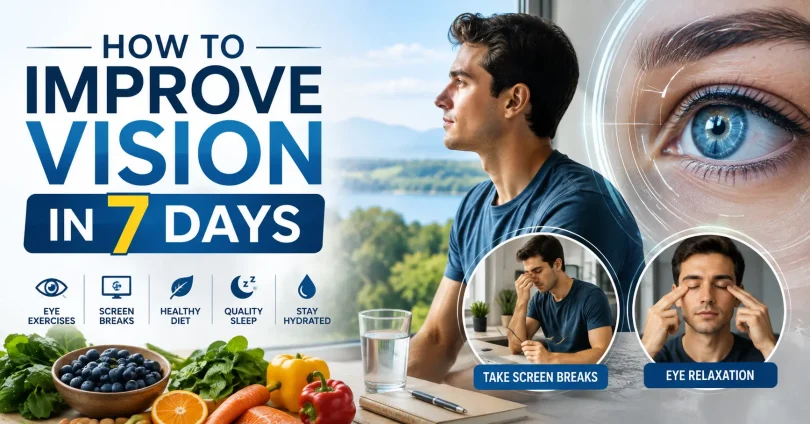
You can noticeably reduce eye strain, dryness, and screen-related blur within 7 days by resetting your blinking habits, lighting, sleep, and hydration, alongside two or three targeted eye exercises daily. What a week cannot do is reverse a genuine refractive error such as myopia, hyperopia, or astigmatism. Those need glasses, contacts, or a professional exam. Think of this plan as clearing the fog around your everyday vision, not rewriting your prescription.
I get why the phrase “how to improve vision in 7 days” gets typed into Google so often. Your eyes feel tired by 3pm, the screen looks slightly hazy by evening, and you’re not ready to book an eye exam just yet. The good news: most of that daily blur isn’t your prescription failing. It’s strain, dryness, and bad screen habits stacking up. Fix those, and your eyes genuinely feel sharper within a week. This guide walks through exactly how, without the vague “just blink more” advice you’ve probably already read.
What a Week Can Actually Fix (and What It Can’t)
Most articles on this topic blur two very different problems together. One is functional: your eyes are tired, dry, or straining from screens. The other is structural: your eyeball’s shape or lens curvature bends light incorrectly, which is what causes nearsightedness, farsightedness, and astigmatism.
Functional blur responds fast. Dry eye, digital eye strain, and accommodative fatigue (the ciliary muscle staying locked in “close-up mode”) can visibly improve in days once you remove the trigger.
Structural blur doesn’t move on a 7-day timeline. A refractive error is a measurement of how light bends inside your eye. No amount of blinking exercises changes the physical curve of your cornea or the length of your eyeball. If your last exam showed a prescription, that number won’t shift in a week, regardless of what a headline promises.
Knowing which one you’re dealing with changes how you should read the rest of this article. If your blur is new, gradual, and tied to screens, sleep, or stress, the plan below will help a lot. If it’s been the same blur for months and glasses correct it instantly, you’re looking at a structural issue that needs an optometrist, not a routine.
Why Your Eyes Feel Blurry Right Now

Before jumping into the plan, it helps to know what’s actually happening physically. This is the part most competitor articles skip entirely.
Your blink rate is cut in half
Under normal conditions, people blink somewhere between 15 and 20 times a minute. Put a screen in front of the same person and that rate drops to roughly 4 to 6 blinks a minute. Fewer blinks means the tear film, the thin layer keeping your cornea smooth, breaks up faster than it can be replenished. A dry, uneven tear film scatters light unevenly across your cornea, which is exactly what produces that hazy, out-of-focus feeling by mid-afternoon.
Your ciliary muscle gets stuck in near-focus mode
Reading a phone or laptop for hours keeps the small muscle that changes your lens shape, the ciliary muscle, contracted almost continuously. Look up at something far away afterward and it can take a beat to refocus. This temporary lag is sometimes called pseudo-myopia. It feels like your distance vision got worse, but it’s muscle fatigue, not a new prescription.
Sleep debt shows up in your cornea before it shows up anywhere else
Your cornea swells slightly overnight because it gets less oxygen with your eyes closed. Normal sleep lets that swelling resolve within the first hour of waking. Cut sleep short, sleep in contacts, or wake up repeatedly, and that corneal edema lingers longer, leaving a soft blur that clears slowly through the morning instead of immediately.
Dehydration thickens your tears in the wrong way
Tear film isn’t just water. It’s a balance of water, oils, and mucus. Mild dehydration raises the salt concentration of your tears (osmolarity), which irritates the ocular surface and triggers the same gritty, blurry sensation as classic dry eye, even if you’re drinking what feels like enough water.
The 7-Day Vision Reset Plan
This is a structured week, not a random list of tips. Each day builds on the last one, so habits stack instead of competing for your attention.
| Day | Main Focus | What To Do |
| Day 1 | Baseline & screen setup | Move your screen to arm’s length, raise the top of the monitor to eye level, and increase text size until you stop leaning forward to read. |
| Day 2 | Blink retraining | Set a recurring 20-minute alarm. Each time it goes off, do 10 full, deliberate blinks (fully closing the eyelids, not partial blinks). |
| Day 3 | The 20-20-20 rule, properly | Every 20 minutes, look at something 20 feet away for a full 20 seconds, not a glance. Pair it with the blink alarm from Day 2. |
| Day 4 | Lighting audit | Match your room lighting to your screen brightness so neither is dramatically brighter than the other. Kill glare from windows and overhead lights. |
| Day 5 | Hydration and diet check | Track water intake and add one omega-3 and one vitamin-A rich food to your meals (see the food list below). |
| Day 6 | Accommodative exercises | Add the near-far focus drill and figure-eight tracking exercise (details below), 5 minutes each, morning and evening. |
| Day 7 | Sleep and recovery | Aim for a full, uninterrupted 7 to 8 hours. Remove contacts at least an hour before bed. Note how your eyes feel on waking versus Day 1. |
Run all seven habits together by Day 7, not sequentially. Each day just introduces the next layer so it doesn’t feel overwhelming.
Eye Exercises: What Has Real Evidence Behind It
Eye exercises get oversold constantly, and Healthline and other medical sources are right to point out that most of them won’t fix a genuine refractive error. But a handful have legitimate clinical backing for something narrower: eye coordination and focusing stamina, particularly for a diagnosed condition called convergence insufficiency, where the eyes struggle to turn inward together for close work.
| Exercise | What It’s For | Evidence Level | How To Do It |
| Near-far focus shift | Rebuilding focusing flexibility after screen fatigue | Moderate, used in vision therapy | Hold a thumb 10 inches from your face. Focus on it for 5 seconds, then shift focus to an object 20 feet away for 5 seconds. Repeat 10 times. |
| Pencil push-ups | Convergence insufficiency (diagnosed by an eye doctor) | Good, clinically studied | Hold a pencil at arm’s length, focus on the tip, slowly bring it toward your nose until it doubles, then back out. Repeat 10 to 15 times. |
| Figure-eight tracking | Eye muscle coordination and smooth pursuit | Limited but low-risk | Picture a large figure eight 10 feet away. Trace it slowly with your eyes only, for one minute each direction. |
| Palming | Relaxing eye muscles and reducing strain-related tension | Anecdotal, not proven to change vision | Rub palms warm, cup them gently over closed eyes without pressing, breathe slowly for 60 seconds. |
| Eye rolling / rotations | General “eye workout” claims | No credible evidence for vision improvement | Not recommended as a vision-improvement technique; fine as a stretch break, nothing more. |
If you have a diagnosed binocular vision problem, ask your optometrist about a structured vision therapy program rather than freelancing exercises from an article. That includes this one.
Small Details That Make a Bigger Difference Than People Expect

These rarely show up in generic “7 day vision” listicles, but they’re often the actual reason someone’s eyes feel better or worse.
The 3:1 brightness ratio
Your screen shouldn’t be more than three times brighter, or three times dimmer, than the room around it. A blazing screen in a dark room forces your pupils to constantly readjust, which reads as eye fatigue and blur by the end of the day. Match the two, and that adjustment workload disappears.
Eyeliner on the waterline
This one surprises people. Applying liner or mascara right along the inner lash line can block the tiny meibomian gland openings that release the oily layer of your tear film. Blocked glands mean faster tear evaporation and more midday dryness. Keeping makeup just outside the lash line protects that oil layer without changing your look.
Stretching contact lens wear past its schedule
Wearing daily lenses for two or three days, or biweekly lenses for a month, is common and it’s a frequent, overlooked cause of blur. Protein and lipid deposits build up on the lens surface faster than most people expect, scattering light before it even reaches your cornea. If you’re mid-reset week and still wearing stretched lenses, swap to a fresh pair and note the difference.
Real food beats supplements for this particular week
Supplement bottles promise fast results, but a week is too short to meaningfully shift blood nutrient levels through pills alone, and high-dose vitamin A supplements carry a real toxicity risk if you overdo it. Food sources are safer and still useful:
- Omega-3s: salmon, sardines, walnuts, chia seeds, ground flaxseed
- Vitamin A (as carotenoids): carrots, sweet potato, spinach, red peppers, butternut squash
- Lutein and zeaxanthin: kale, corn, egg yolks
- Vitamin C: citrus, bell peppers, broccoli
Outdoor daylight matters more than blue light glasses
A lot of the current blue-light-glasses marketing overstates the case; the evidence that blue light from screens damages your eyes is thin. What does have solid research behind it, particularly in children and teens, is that time spent outdoors in natural daylight is linked to slower myopia progression. You won’t reverse an existing prescription in a week outside, but stepping away from screens into daylight during breaks does more for genuine eye health than a blue-light filter does.
When to Stop the 7-Day Plan and Call an Eye Doctor
A home routine is not the right tool for every kind of blur. Book an appointment, or seek urgent care, if you notice any of the following instead of continuing the plan:
- Sudden vision loss or a sudden increase in floaters and flashes of light
- Blurry vision on only one side, paired with slurred speech, facial drooping, or one-sided weakness (these can signal a stroke; treat as an emergency)
- Eye pain, redness, or light sensitivity along with the blur
- Blurry vision that started after a blow to the head
- Gradual blur that’s been building for months rather than days, especially if reading or driving has become noticeably harder
- Blur alongside symptoms of diabetes, high blood pressure, or thyroid problems
None of these respond to eye exercises or hydration, and treating them like a home-fixable problem just delays real treatment.
What to Realistically Expect by Day 7
Run this plan consistently and most people notice fewer end-of-day headaches, less end-of-day dryness, and an easier time refocusing between screen and distance by the middle of the week. Sleep quality improvements often show up fastest, sometimes within 48 hours.
What you won’t see: a change in your actual refractive prescription, a cure for an eye disease, or a permanent fix if you go straight back to 10-hour unbroken screen sessions the following week. This is a reset, not a one-time fix. The habits only keep working if you keep them.
Frequently Asked Questions
Can I really improve my eyesight in just 7 days?
You can meaningfully reduce blur caused by strain, dryness, and fatigue in a week. You cannot reverse a true refractive error like myopia or astigmatism in that time; those require corrective lenses or a clinical treatment plan.
Do eye exercises actually reverse nearsightedness?
No credible research supports eye exercises reversing myopia. Some exercises do help with diagnosed focusing and coordination issues, which is a different problem from nearsightedness.
What’s the fastest way to relieve eye strain from screens today?
Start with the 20-20-20 rule, raise your screen to eye level, and match your screen brightness to the room. Most people feel a difference within a single afternoon of doing all three consistently.
How much water should I drink for eye health?
There’s no special eye-specific target beyond general hydration guidance, roughly 2 to 3 liters a day for most adults, adjusted for body size, climate, and activity level. Consistent hydration through the day helps more than one large glass at once.
Are blue light blocking glasses worth buying for this week?
They’re not necessary for a 7-day reset. The stronger evidence points to blink habits, screen distance, and lighting setup as the bigger levers. If you already own a pair and find them comfortable, they won’t hurt, but don’t expect them to do the heavy lifting.
How often should I actually be blinking?
Aim for a natural, complete blink roughly 15 to 20 times a minute, which is your baseline off-screen rate. The blink-retraining alarm in the Day 2 plan is designed specifically to close the gap between that number and the 4 to 6 blinks a minute most people drop to while reading a screen.
Conclusion
A week is enough time to notice a real difference in how your eyes feel and function, as long as you’re targeting the right problem. Screen habits, blinking, lighting, sleep, and hydration are all fixable within days, and the plan above tackles each one in a specific order so the changes stick instead of getting abandoned by Wednesday.
What a week won’t do is replace an eye exam. If your blur has been around for months, runs in the family, or comes with any of the warning signs listed above, treat this plan as a supplement to professional care, not a substitute for it. Do both, and you get the fastest possible relief along with the long-term answer.
You May Also Like It: