
How to choose a wedding venue picking a venue is the first domino in your whole wedding. Get it right and your budget, guest list, and vendor lineup fall into place a lot easier. Get it wrong and you spend the next year fighting the space instead of enjoying the planning.
Quick answer: Choose a wedding venue by locking in your guest count and budget first, then touring only places that fit both without add-on fees pushing you over. Read the contract line by line for cancellation terms, vendor restrictions, and overtime charges before you sign, and always confirm a weather or backup plan in writing.
Set Your Real Budget Before You Fall in Love with Anywhere
Most couples tour venues first and do the math later. That’s backwards, and it’s how people end up 15% over budget before they’ve even booked a florist.
Venue and catering usually eat 40 to 50 percent of a total wedding budget in most markets. If your total budget is $30,000, that means roughly $12,000 to $15,000 is realistic for the space plus food and drink, not just the room rental fee by itself.
A trick that actually works: ask every venue for their “all-in” quote for your headcount before you tour, not their starting rate. Starting rates are marketing numbers. All-in quotes include service charges, taxes, and mandatory add-ons, and that’s the number that will actually hit your bank account.
- Get a written quote for your exact guest count, not a round number like 100.
- Ask what percentage is service charge or gratuity, since some venues tack on 22 to 24 percent.
- Ask if the quote includes tax, since a lot of brochures quietly leave it off.
Match the Venue Type to How You Actually Want to Celebrate
Every venue category comes with its own hidden trade-offs that don’t show up in the photos. Here’s how the main options actually stack up once you get past the marketing.
| Venue Type | Typical Cost Range (USD) | Best For | Watch Out For |
| Hotel Ballroom | $8,000 – $25,000 | Large guest lists, out-of-town guests who need rooms, cold-weather dates | Generic decor, food and beverage minimums, other events happening same night |
| Barn or Farm | $3,000 – $12,000 | Rustic or relaxed style, DIY couples, long guest lists needing space to spread out | Bathrooms and climate control often bare-bones, gravel or grass in heels, bugs in summer |
| Restaurant or Private Dining Room | $4,000 – $15,000 | Small guest counts (under 60), food-focused couples, weeknight weddings | Limited dance floor, noise bleed to other diners, tight vendor load-in windows |
| Historic Estate or Mansion | $10,000 – $40,000 | Couples wanting built-in character and photo backdrops | Preservation rules limit candles, confetti, nails in walls, and sometimes heels |
| Backyard or Private Property | $1,500 – $8,000 | Personal, sentimental settings and full creative control | You are building a venue from scratch: power, restrooms, parking, permits, insurance |
| All-Inclusive Resort | $6,000 – $30,000 (often bundled) | Destination weddings, couples who want one point of contact | Guest travel cost, limited date flexibility, resort’s in-house vendor lock-in |
A barn wedding photographs beautifully in autumn light, but I’ve seen couples discover on the walkthrough that the only bathroom option is a rented trailer parked behind the tent. That’s not a dealbreaker, but it’s the kind of detail you want to know in month three of planning, not week two before the wedding.
Do the Capacity Math Before You Tour
A room that comfortably seats 150 for dinner usually cannot also fit a dance floor, a bar, a DJ booth, and a cake table for that same 150 guests. Venues quote maximum capacity based on chairs alone, which is close to useless for planning your actual layout.
- Seated dinner capacity assumes round tables of 8 to 10 with standard spacing. Long farm tables eat more square footage per guest.
- Cocktail or standing capacity is usually 30 to 50 percent higher than seated capacity, since people don’t need chairs.
- Dance floor space gets carved out of whatever room is left after tables, so ask the venue to show you a floor plan for your specific headcount, not a generic one from their website.
If a venue can’t produce an actual floor plan for your number of guests within a day or two of asking, that’s a small but real warning sign about how organized the rest of the booking process will be.
Read the Contract Like a Lawyer, Not Like a Romantic
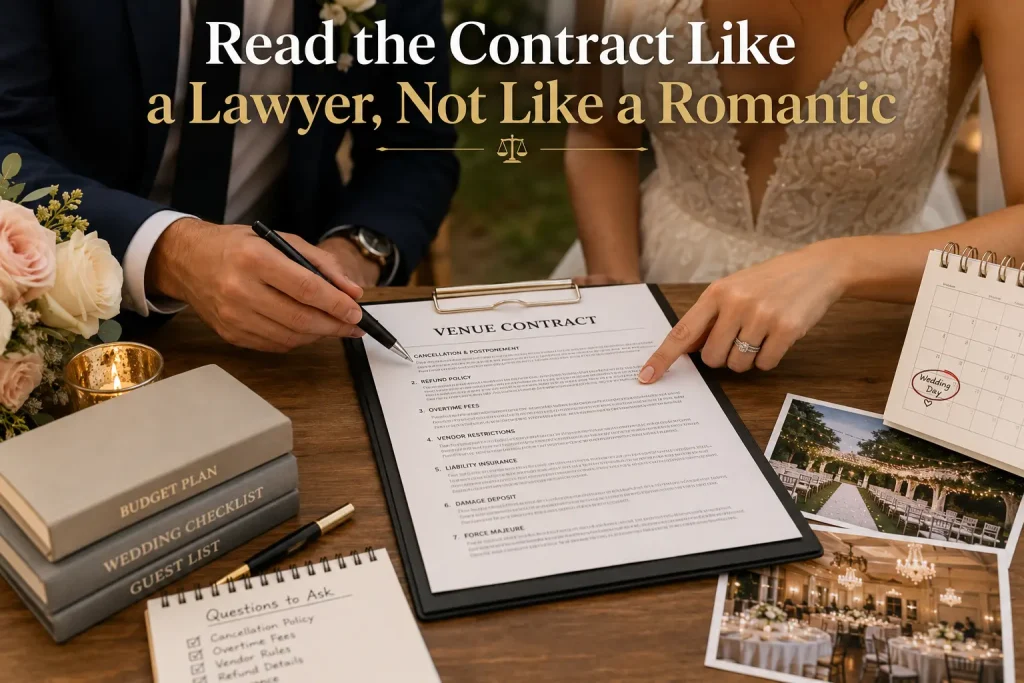
This is the section most engagement-excited couples skim, and it’s the one that causes the most regret later. A venue contract is a legal document, and it deserves fifteen focused minutes before you sign anything or hand over a deposit.
- Cancellation and postponement terms. Ask exactly what you get back, and by when, if you have to move the date. Some contracts keep 100 percent of the deposit after a certain cutoff.
- Liability insurance requirements. Many venues now require couples to carry their own wedding liability policy, which usually runs $75 to $200. Find out before booking, not the week of.
- Overtime fees. Find the exact per-hour rate if the reception runs long, since it’s often steep and billed on the spot.
- Force majeure language. Since 2020, most solid contracts spell out what happens in a genuine emergency closure. If a contract is silent on this, ask them to add a clause.
- Damage deposit refund timeline. Ask how many days after the wedding it’s returned, and get it in writing rather than a verbal promise from your tour guide.
Ask About Hidden Fees That Blow Up Budgets
The base rental fee is rarely the final number. Venues make real money on the extras, and the ones that don’t disclose them upfront are the ones that cause budget blowouts three weeks before the wedding.
- Cake-cutting fee, corkage fee if you bring your own alcohol, and cleaning fee on top of the security deposit.
- Ceremony fee charged separately from the reception fee, even if it’s the same building.
- Vendor meal charges for your photographer, videographer, and band, usually $35 to $75 per vendor.
- Early access or rehearsal fee if you want to drop off decor the day before.
- Parking or valet fees passed on to guests, which matters if your invite promises free parking.
Ask for an itemized quote, not a lump sum. If a coordinator hesitates to break it down in writing, treat that as information, not just paperwork friction.
Timing Changes the Price More Than People Expect
The venue itself doesn’t change month to month, but its price absolutely does. This is one of the biggest levers couples never pull.
- Friday and Sunday dates often run 20 to 30 percent cheaper than Saturday at the same venue.
- January, February, and parts of summer in hot climates are off-peak in most regions, and venues will often negotiate on these dates.
- Daytime weddings that wrap by early evening can cost less than an evening reception that runs into premium hours.
- Booking 10 to 14 months out usually gets first pick of Saturdays, but booking inside 4 to 6 months can unlock last-minute discounts on dates that didn’t sell.
If your dream venue is out of reach on a Saturday in June, ask directly what a Friday in October would cost. The answer is sometimes a few thousand dollars less for the identical space.
Vendor Restrictions and Preferred Vendor Lists
Some venues hand you a locked list of approved caterers, florists, and rental companies. Others let you bring in anyone with proof of insurance. Neither approach is automatically better, but the difference changes your total cost and your creative control significantly.
A closed vendor list can actually save money and stress, since those vendors already know the loading dock, the power outlets, and the venue coordinator by name. An open vendor policy gives you more freedom but more logistics to manage yourself.
- Ask directly: “Is your vendor list required or recommended?” Those are two very different answers, and venues sometimes blur the line during a tour.
- Ask about exclusivity fees. Some venues charge an outside caterer fee of $500 to $1,500 if you don’t use their in-house kitchen.
Noise Curfews, Permits, and the Neighbors
This is the section competitors almost never cover, and it trips up more urban and backyard weddings than anything else on this list.
City and county noise ordinances often force outdoor music to stop between 9 and 11 p.m., regardless of what the venue brochure promises. A rooftop or backyard venue in a residential zone may need a temporary event permit, and some jurisdictions cap guest counts for private property gatherings separately from the venue’s own capacity limit.
- Ask the venue for the exact legal cutoff time for amplified music, not an approximate one.
- For backyard or private property weddings, call your local city or county office directly to ask about event permits, since the property owner may not know the current rules.
- If neighbors have complained about past events at that address, a good venue coordinator will tell you honestly if you ask.
Accessibility and Guest Comfort Details Most Couples Skip
It’s easy to picture your wedding through your own eyes and forget that your 80-year-old grandmother, your cousin who uses a wheelchair, or your friend who’s seven months pregnant will be navigating the same space all night.
- Count the actual steps between parking, ceremony, and reception areas, since gravel paths and staircases are common at rustic and historic venues.
- Check restroom proximity and whether there’s an accessible option, especially at barns, backyards, and outdoor estates.
- Ask about shade and seating during outdoor ceremonies, since standing in direct sun for a 30-minute ceremony is rough on older guests.
- Confirm climate control for extreme heat or cold months, not just “there are fans” or “there are heaters,” but how many and where.
Weather Contingency Beyond Just Having a Tent
Almost every venue will tell you they have a backup plan for rain. Fewer will tell you what that backup plan actually looks like in practice, and that gap matters.
- Ask to see the indoor backup space, not just hear about it. A backup room that seats half your guest list is not a real backup plan.
- Ask how late you can call it, meaning how close to the ceremony time you can still decide to move things indoors without extra fees or chaos.
- Ask who moves the furniture. At some venues, that’s included staff. At others, it’s on you or your day-of coordinator, which changes your timeline and your rental order.
How to Actually Evaluate a Venue During a Tour
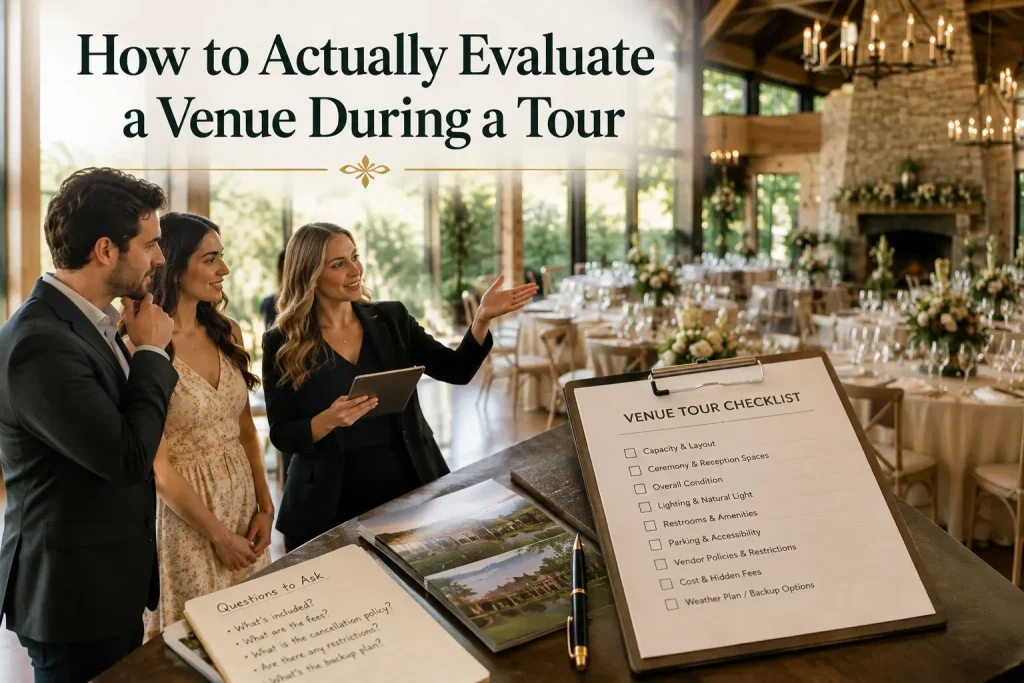
Walk in with a plan instead of just wandering and admiring the chandeliers. A structured tour catches problems a dreamy one misses.
- Visit at the same time of day and, if possible, the same season as your actual wedding date, since golden hour in June looks nothing like 4 p.m. in November.
- Stand where the ceremony will happen and check the sightlines, sun direction, and any distracting background noise like traffic or a nearby kitchen fan.
- Walk the route your food will travel from kitchen to tables, since a long walk means cold plates by the time they reach the back tables.
- Ask to see a wedding actually set up, if the venue hosts one on a day near your visit, rather than an empty room.
- Trust your gut reaction when you first walk in. If it feels like a fit for the two of you and the people you’re inviting, that instinct is usually right.
Frequently Asked Questions
How far in advance should we book a wedding venue?
Popular Saturday dates at in-demand venues often book 12 to 18 months out. Off-peak days like Fridays, Sundays, or winter weekdays can sometimes be booked inside 6 months, and occasionally even less if a venue has a last-minute cancellation.
What’s a reasonable deposit to hold a wedding venue?
Deposits typically run 20 to 50 percent of the total estimated cost, though some smaller venues ask for a flat holding fee instead. Always confirm in writing whether the deposit is refundable, partially refundable, or non-refundable under any circumstances.
Can we negotiate the price with a wedding venue?
Yes, especially on off-peak dates, daytime slots, or during a venue’s slower booking season. Venues are more flexible on add-ons like extra hours, complimentary tastings, or reduced service charges than on the core rental fee itself.
Should we book the venue before hiring other vendors?
Generally yes. The venue locks in your date, your guest capacity, and often your catering and vendor restrictions, all of which shape which other vendors you can even consider hiring afterward.
Conclusion
Choosing the right wedding venue is about more than finding a beautiful location—it’s about selecting a space that fits your budget, guest list, and wedding vision without creating unnecessary stress. By comparing venue types, asking the right questions, reviewing contracts carefully, and understanding hidden costs before signing, you can avoid expensive surprises later. Take your time, visit multiple venues, and focus on practicality as much as aesthetics. With thoughtful planning, you’ll find a venue that creates the perfect setting for a memorable celebration.
You May Also Like It:
How to Reduce Heat in the Body