
If you have ever looked at your school or college portal and felt confused about your how to calculate attendance percentage, you are not alone. Most students know they need to maintain a certain attendance threshold, but very few understand exactly how that number is calculated, what it means in practice, and what they can do when it drops below the required limit.
This guide walks you through everything: the basic formula, step-by-step examples, subject-wise calculations, monthly tracking, what happens when your attendance falls short, and how institutions across schools, colleges, and workplaces apply attendance rules differently.
By the end, you will be able to calculate your own attendance percentage manually, understand how much room you have before you fall short, and plan your classes accordingly.
What Is Attendance Percentage?
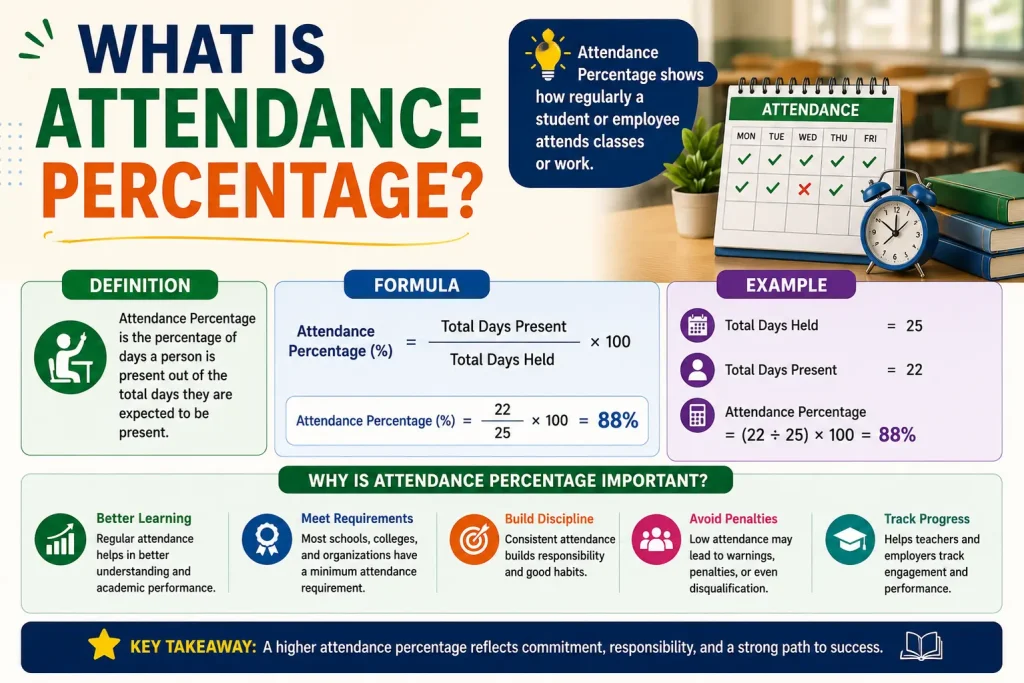
Attendance percentage is a numerical measure that tells you how many classes or working days you attended out of the total classes or days held during a specific period.
It answers one simple question: out of every 100 opportunities you had to attend, how many did you actually show up for?
This number matters because:
- Schools and colleges use it to determine exam eligibility.
- Universities require a minimum attendance to issue hall permits or admit cards.
- Employers track attendance for payroll, performance reviews, and compliance.
- Medical and law institutions have stricter requirements due to regulatory guidelines.
A student with 60 out of 80 classes attended has a 75% attendance percentage. It does not matter how well they perform in class; if the attendance rule requires 75%, they are right at the borderline.
The Basic Formula for Calculating Attendance Percentage
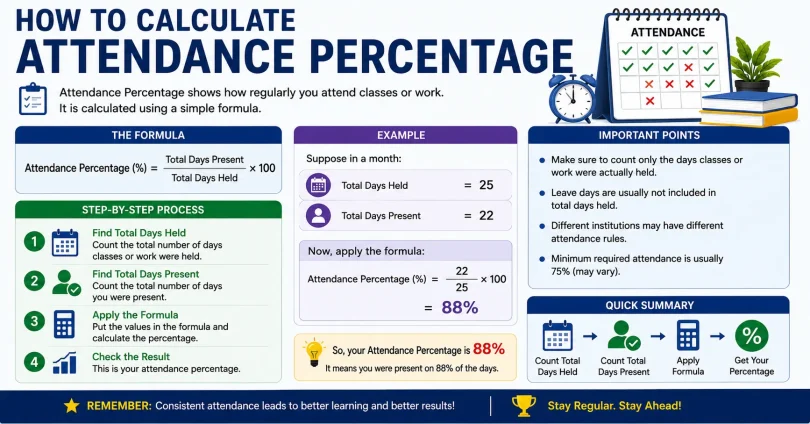
The standard formula used by schools, colleges, and most institutions worldwide is:
- Attendance Percentage = (Number of Classes / Days Attended / Total Classes / Days Held) x 100
Let us break down each part of this formula:
- Number of Classes Attended:
- Classes / Days Attended: The total count of classes or working days you were actually present.
- Total Classes / Days Held: The total count of classes or working days the institution conducted, whether you were there or not.
- x 100: Multiplying by 100 converts the decimal into a percentage.
Step-by-Step Calculation with Examples
Example 1: Basic Student Attendance
A student attended 54 classes out of 72 total classes held in a semester.
| Data Point | Value |
| Classes attended | 54 |
| Total classes held | 72 |
| Formula | (54 / 72) x 100 |
| Attendance Percentage | 75.00% |
Result: The student has exactly 75% attendance. In most colleges, this is the minimum acceptable threshold.
Example 2: Attendance Below the Minimum Threshold
A student attended 40 classes out of 72 total classes held.
| Data Point | Value |
| Classes attended | 40 |
| Total classes held | 72 |
| Formula | (40 / 72) x 100 |
| Attendance Percentage | 55.56% |
This student is 19.44 percentage points below the 75% requirement. This section of the guide explains what they can do to recover.
Example 3: Employee Monthly Attendance
An employee worked 19 days out of 26 working days in a month.
| Data Point | Value |
| Days present | 19 |
| Total working days | 26 |
| Formula | (19 / 26) x 100 |
| Attendance Percentage | 73.08% |
How to Calculate Subject-Wise Attendance Percentage
Many colleges and universities track attendance separately for each subject. This means you can have a strong overall attendance percentage but still fall short in one specific subject.
The formula is the same, but you apply it per subject:
- Subject Attendance % = (Classes Attended in Subject / Total Classes Held in Subject) x 100
Here is a practical subject-wise example for a college student:
| Subject | Classes Attended | Total Classes Held | Attendance % | Status |
| Mathematics | 22 | 28 | 78.57% | Safe |
| Physics | 19 | 28 | 67.86% | Short |
| Chemistry | 24 | 28 | 85.71% | Safe |
| English | 20 | 26 | 76.92% | Safe |
| Computer Science | 15 | 26 | 57.69% | Short |
Even though this student’s overall attendance might average above 75%, they are short in Physics and Computer Science. Many institutions will flag these subjects individually and require the student to attend additional classes or face consequences in those specific papers.
How to Calculate Monthly Attendance Percentage
Monthly attendance percentage is used by employers, coaching institutes, and some schools to track attendance in shorter reporting cycles. The formula remains the same.
- Monthly Attendance % = (Days Present in the Month / Total Working Days in the Month) x 100
Monthly Breakdown Example for an Employee
| Month | Days Present | Working Days | Monthly Attendance % |
| January | 21 | 23 | 91.30% |
| February | 16 | 20 | 80.00% |
| March | 18 | 26 | 69.23% |
| April | 22 | 25 | 88.00% |
To calculate the average attendance across multiple months, add all monthly percentages and divide by the number of months, or better yet, add all days present and divide by all total working days for greater accuracy.
- Overall % = (Total Days Present Across All Months / Total Working Days Across All Months) x 100
Important: Averaging the monthly percentages gives a different result than dividing total days present by total days. Always use the second method for accuracy, especially when months have different total working days.
How to Calculate How Many More Classes You Need to Attend
This is one of the most practical calculations for students. If your current attendance is below the required percentage, you need to know exactly how many consecutive classes you must attend to reach the threshold.
- Classes Needed = (Required % x Total Classes After Attending x – Classes Attended) / (100 – Required %)
This formula is iterative, but there is a simpler way to approach it. Use the following derived formula:
- Additional Classes Needed = (Required % x Total Classes Held – 100 x Classes Attended) / (100 – Required %)
Worked Example
Current situation: 40 classes attended out of 72 held. Required minimum: 75%.
| Step | Calculation | Result |
| Step 1: Current attendance | 40 / 72 x 100 | 55.56% |
| Step 2: Apply formula | (75 x 72 – 100 x 40) / (100 – 75) | (5400 – 4000) / 25 = 56 |
| Step 3: Verify | (40 + 56) / (72 + 56) x 100 | 96 / 128 x 100 = 75% |
This student needs to attend 56 more consecutive classes without missing a single one to reach exactly 75%. If even one more class is missed during this recovery period, the number increases further.
How Many Classes Can You Skip While Staying Above the Limit?
If your attendance is currently above the required percentage, you may want to know how many classes you can miss before you fall below the threshold.
- Classes You Can Skip = (Attendance % – Required %) x Total Classes / (Required % – nothing; see formula below)
The correct formula is:
- Skippable Classes = (Classes Attended – Required % / 100 x Total Classes Held) / (Required % / 100)
Example
You have attended 65 out of 80 classes held. Required attendance: 75%.
| Step | Calculation | Result |
| Current attendance | 65 / 80 x 100 | 81.25% |
| Minimum classes needed now | 75% of 80 = 0.75 x 80 | 60 classes |
| Classes you can skip | 65 – 60 | 5 classes |
You can miss up to 5 more classes before your attendance hits exactly 75%. Missing a 6th would drop you below.
Attendance Percentage Rules: School vs College vs Workplace
Different institutions apply different attendance rules, thresholds, and consequences. Here is a clear comparison:
| Institution Type | Typical Required % | Consequence of Shortage | Exemptions Available |
| CBSE Schools (India) | 75% | Barred from board exam | Medical, family emergencies |
| Indian Universities / UGC | 75% | Debarred from exam / not eligible for hall permit | Medical leave with certificate |
| Medical Colleges (MCI) | 75% per subject | Not allowed to appear in university exam | Very limited; strict enforcement |
| Law Schools (BCI) | 70% | Ineligible for exams | Rare |
| IITs and IIMs | 75-80% | Grade penalty or deregistration | Varies by institute |
| Corporate Workplaces | Varies by company | Loss of pay, warning, termination | Earned leave, sick leave |
| Coaching Institutes | 60-75% | Not allowed in tests or exam batches | Depends on institute policy |
Note: University Grants Commission (UGC) guidelines recommend a minimum of 75% attendance for all undergraduate and postgraduate courses in India. Individual universities may set higher thresholds.
How to Calculate Attendance Percentage in Excel or Google Sheets
If you track attendance manually or need to calculate it for multiple students, Excel or Google Sheets makes this very efficient.
Basic Formula in Excel
Assume Column A has student names, Column B has classes attended, and Column C has total classes held.
| Cell | Content |
| A1 | Student Name |
| B1 | Classes Attended |
| C1 | Total Classes Held |
| D1 | Attendance % |
| D2 (formula) | =(B2/C2)*100 |
| D2 (display as %) | =TEXT((B2/C2),”0.00%”) |
To apply this to multiple students, drag the formula down from D2 through the remaining rows. Excel will automatically adjust the row references.
Conditional Formatting Tip
To highlight students with attendance below 75%, select the Attendance % column, go to Conditional Formatting, and set a rule: if the cell value is less than 75, apply a red fill. This gives you a quick visual overview.
Attendance Percentage Calculation for a Class or Group
Teachers and administrators often need to calculate the attendance percentage for an entire class, not just one student. Two methods apply:
Method 1: Student-Level Average
Calculate each student’s attendance percentage, then find the average.
- Class Attendance % = Sum of All Student Attendance % / Number of Students
Method 2: Session-Level Calculation (More Accurate)
Count total student-sessions attended across the class and divide by total student-sessions possible.
- Class Attendance % = (Total Student Presences Across All Sessions / Total Student-Sessions Possible) x 100
For example, if 30 students could attend 20 sessions each, the total possible student-sessions is 600. If actual total presences recorded is 450, the class attendance is 450 / 600 x 100 = 75%.
What Counts as Attendance: Presence, Leave, and Duty Leave
One gap in most competitor articles is the nuance around what actually counts as attendance. Many students assume that any approved leave counts as attendance. This is not always true.
Types of Absence and How They Affect Calculation
| Type of Absence | Usually Counted as Present? | Notes |
| Medical Leave with Certificate | Varies by institution | Some colleges exclude medical days from the denominator. Others count them as absent. |
| Duty Leave / Official Duty | Yes, in most cases | Representing college in sports, events, or NCC counts as present. |
| Unauthorised Absence | No | Counted as absent with no adjustment to total days. |
| College Holiday / Closure | Not counted | Holidays are excluded from the denominator. No impact on percentage. |
| Online Class (if marked) | Yes | If the institution records online attendance, it counts the same as physical presence. |
| Late Arrival | Depends on policy | Some institutions mark late arrivals as half-day absent. Check your specific rules. |
Always read your institution’s attendance policy carefully. The biggest surprise for students is discovering that approved medical leave is still counted as an absence in their institution’s system.
How to Handle Attendance Shortage: Practical Steps
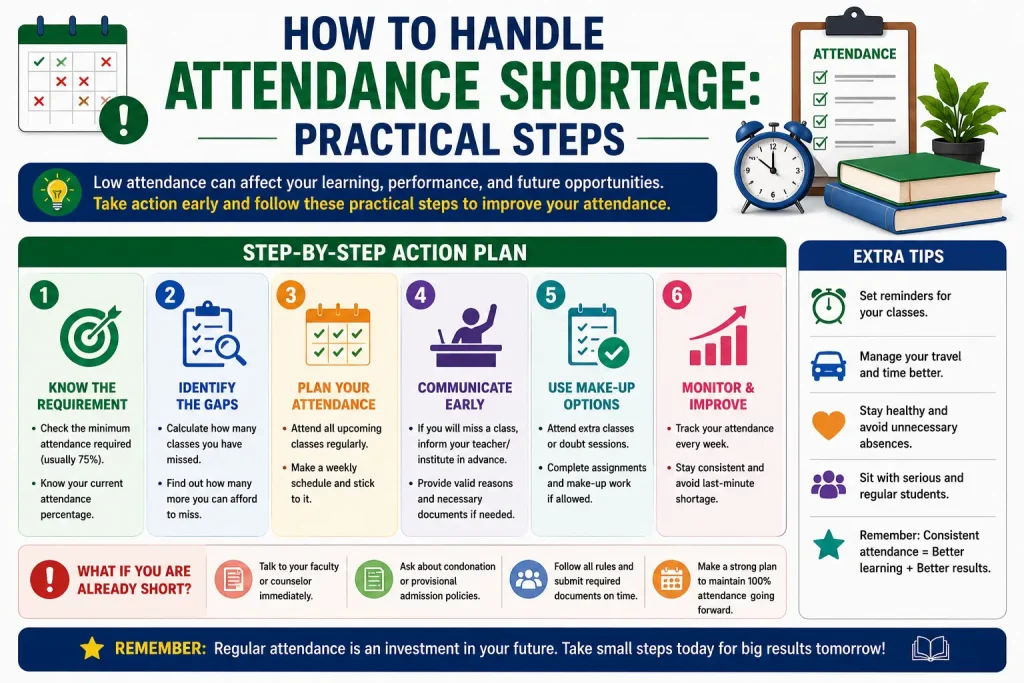
If you are already short on attendance, here is what you can do:
- Calculate your exact shortage first. Use the formula in Section 6 to find how many classes you need to attend consecutively.
- Stop missing any more classes immediately. Every additional absence increases the recovery requirement significantly.
- Apply for medical condonation if applicable. If your absence was due to illness, submit a medical certificate to the examination office. Some institutions reduce your denominator by excluding verified sick days.
- Check if your institution has a condonation policy. Many colleges allow attendance condonation of up to 5 to 10 percentage points for students with valid reasons, with or without a fine.
- Request a special consideration from the principal or head of department. First-time cases with good academic records are sometimes handled with leniency.
- Check if duty leave can be applied. If you missed classes for official college events, sports, or NCC/NSS, request that those days be converted to duty leave.
Attendance Percentage vs Attendance Rate: Is There a Difference?
These two terms are often used interchangeably, but there is a subtle distinction in how organisations use them.
| Term | What It Means | Where It Is Used |
| Attendance Percentage | (Classes Attended / Total Held) x 100 | Schools, colleges, coaching |
| Attendance Rate | Same formula; used as a population-level metric | Government education reports, HR analytics |
| Absenteeism Rate | (Days Absent / Total Working Days) x 100 | Workplace HR reporting |
In practice, attendance percentage and attendance rate use the same formula. Absenteeism rate is the reverse: it measures absence rather than presence.
Quick Reference: Attendance Percentage Table
Use this table to quickly see your approximate status based on classes attended and total classes held:
| Classes Attended | Total Classes Held | Attendance % | Status (75% rule) |
| 75 | 100 | 75.00% | Borderline |
| 80 | 100 | 80.00% | Safe |
| 60 | 100 | 60.00% | Short by 15% |
| 54 | 72 | 75.00% | Borderline |
| 60 | 72 | 83.33% | Safe |
| 40 | 72 | 55.56% | Short by 19.44% |
| 45 | 60 | 75.00% | Borderline |
| 50 | 60 | 83.33% | Safe |
| 38 | 60 | 63.33% | Short by 11.67% |
Common Mistakes When Calculating Attendance Percentage
Students and teachers sometimes make errors in attendance calculations. Here are the most common ones and how to avoid them:
| Mistake | Why It Happens | How to Fix It |
| Using percentage instead of fraction | Dividing attended/total without multiplying by 100 | Always multiply the fraction by 100 |
| Including holidays in total days | Counting all calendar days, not just working/class days | Use only days the institution was open |
| Averaging monthly percentages incorrectly | Adding percentages and dividing instead of using total counts | Use total days present / total days held across all months |
| Confusing classes and subjects | Treating overall attendance as per-subject attendance | Calculate attendance separately for each subject |
| Not accounting for duty leave | Forgetting to reclassify eligible absences | Check institution policy and apply duty leave where valid |
Frequently Asked Questions
Q1. What is the formula for attendance percentage?
The formula is: Attendance Percentage = (Classes Attended / Total Classes Held) x 100. This applies to students, employees, and any institution tracking presence.
Q2. What is the minimum attendance percentage required in India?
Most Indian universities and schools follow UGC guidelines requiring a minimum of 75% attendance. Medical colleges require 75% per subject. Law schools require 70% under BCI guidelines.
Q3. Does approved leave count as attendance?
It depends on the institution. Duty leave for official activities often counts as present. Medical leave may or may not reduce the denominator. Unauthorised absences always count as absent.
Q4. How do I calculate how many classes I can skip?
Use this approach: find the minimum classes you must attend (Required % / 100 x Total Classes Held). Subtract that from your current attendance count. The result is the number of classes you can still miss.
Q5. How do I recover from low attendance?
Stop missing classes immediately, apply for any valid condonation your institution offers, submit medical certificates for illness-related absences, and request duty leave conversion for official activities. Use the recovery formula to calculate exactly how many consecutive classes you need to attend.
Q6. Is attendance percentage the same as absenteeism rate?
No. Attendance percentage measures presence. Absenteeism rate measures absence: (Days Absent / Total Working Days) x 100. They are complementary but different metrics.
Final Summary
Calculating attendance percentage is straightforward once you know the right formula. Divide the number of classes or days you attended by the total held, then multiply by 100. Apply the same formula for each subject separately, and use the recovery formula if you need to know how many classes to attend to meet the required threshold.
The most important habit is tracking your attendance in real time rather than waiting until the end of the semester to discover a shortage. A simple spreadsheet or even manual counting every week gives you enough time to course-correct before it becomes a serious problem.
Whether you are a student managing your college attendance, a teacher tracking your class, or an HR professional monitoring workforce presence, the core formula stays the same. What changes is only the context and the rules your institution applies.
You May Also Like It: