

How to Calculate Percentile in JEE. Every year, over 12 lakh students appear for JEE Main, and most of them ask the same question: why did my classmate score fewer marks but still get a higher percentile? The answer lies in how NTA calculates and normalises percentile scores across multiple exam sessions.
This article explains the complete JEE Main percentile calculation process in plain language, including the official NTA formula, subject-wise percentile calculation, the normalisation method, and how your percentile connects to your rank and college admissions.
Whether you just received your result or are preparing your strategy for an upcoming attempt, this guide covers everything you need.
What is a JEE Main Percentile Score?
The JEE Main percentile score is NOT the percentage of marks you scored. It is a relative score that tells you what percentage of candidates scored equal to or below you in your specific exam session.
Example: If your percentile is 94.5, it means you performed better than 94.5% of all candidates who appeared in the same session as you.
NTA uses percentile scores instead of raw marks for one important reason: JEE Main is held in multiple sessions, and each session may have a different difficulty level. Comparing raw marks directly would be unfair. Percentile scores level the playing field.
Key things to remember:
- The topper of each session always gets 100 percentile, regardless of their raw marks.
- Your percentile changes if you appear in a different session because it depends on your competition in that session.
- Percentile is calculated separately for each subject and then for the overall paper.
Key Terms You Must Understand
| Term | What It Means |
| Raw Score / Marks | Total marks obtained out of 300 in the actual exam. |
| Percentile Score | The percentage of candidates who scored equal to or below you. Not the same as percentage. |
| NTA Score | NTA’s official name for percentile score. The two terms mean the same thing. |
| Normalisation | A process to adjust scores across sessions of different difficulty to make them comparable. |
| Session | A specific date and shift of the JEE Main exam. JEE Main typically has 2 sessions per year. |
| Rank | Your position among all candidates based on your best NTA score across sessions. |
| Merit List | The final ranked list used by JoSAA and CSAB for seat allocation. |
The Official NTA Formula for Percentile Calculation
NTA uses the following formula to calculate percentile scores:
Percentile Score = (Number of candidates who scored EQUAL TO OR LESS than you / Total number of candidates in the session) x 100
Let us break this down further.
- Numerator: Count of candidates in your session whose score is less than or equal to your score.
- Denominator: Total number of candidates who appeared in your session.
- Result: Multiply by 100 to get the percentile out of 100.
Note: NTA rounds the percentile to 7 decimal places in official results. You may see scores like 97.2354891 on your scorecard.
Step-by-Step Example: How to Calculate Percentile in JEE Main
Suppose 10,000 candidates appeared in Session 1. You scored 220 marks. Among all 10,000 students, 8,500 candidates scored 220 or below (including you).
| Given Data | Value |
| Total candidates in session | 10,000 |
| Candidates who scored 220 or below | 8,500 |
| Your raw score | 220 / 300 |
Applying the formula:
| Percentile = (8,500 / 10,000) x 100 = 85.00 percentile |
This means you scored better than 85% of all candidates in your session. Your NTA score on your marksheet will show 85.0000000.
How Is Subject-Wise Percentile Calculated?
JEE Main has three subjects: Physics, Chemistry, and Mathematics. NTA calculates a separate percentile for each subject in addition to the overall percentile.
The process is the same for each subject. The formula applies separately to your marks in each subject compared to all other candidates’ marks in the same subject from the same session.
| Subject | Your Marks (out of 100) | Candidates Scoring <= Your Marks | Total Candidates | Your Percentile |
| Physics | 72 | 8,200 | 10,000 | 82.0000000 |
| Chemistry | 80 | 8,700 | 10,000 | 87.0000000 |
| Mathematics | 68 | 7,500 | 10,000 | 75.0000000 |
| Overall (Total) | 220 | 8,500 | 10,000 | 85.0000000 |
Your scorecard shows all four percentile values. However, for ranking and admission purposes, the Overall (Total) percentile is used, not the subject-wise percentiles.
What is Normalisation and Why Does NTA Use It?
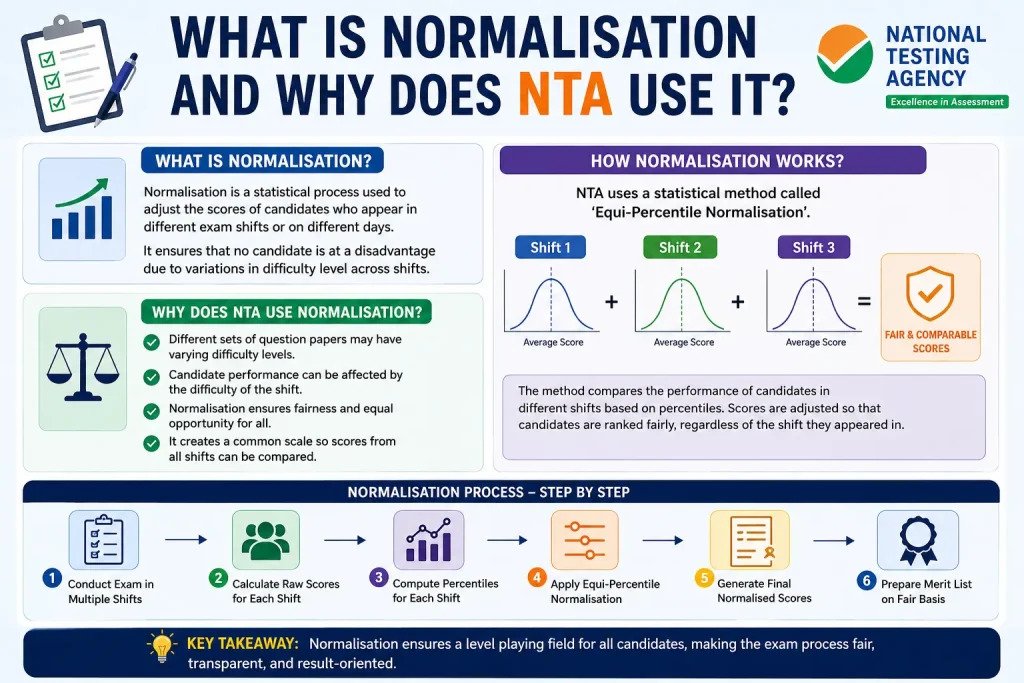
Since JEE Main is conducted in multiple shifts across multiple days, the difficulty of each paper can vary. Normalisation is the process NTA uses to ensure that students who appeared in a harder shift are not penalised compared to those who had an easier paper.
How Normalisation Works
NTA does NOT change your raw marks. Instead, it calculates your percentile within your session. Since percentile is a relative measure, a student who scored 160 in a hard session may end up with the same percentile as a student who scored 200 in an easy session, if both performed equally well relative to their respective peer groups.
This is why normalisation is built into the percentile formula itself. The formula already accounts for session difficulty by comparing you only to others in your session.
Key Insight: You are NEVER directly compared to candidates from another session using raw marks. You are compared using percentiles. This is the fairness mechanism.
Multi-Session Normalisation Process
- Step 1: Each session’s percentile scores are calculated independently using the NTA formula.
- Step 2: The percentile distributions from all sessions are aligned so that top performers from each session receive 100 percentile.
- Step 3: Final merged merit list is prepared using these normalised percentile scores.
How Is the Final Rank Calculated from Percentile?
Your final JEE Main rank is determined based on your best NTA score (highest percentile) across all sessions you appeared in. If you appeared in both Session 1 and Session 2, NTA will pick your higher percentile.
The rank is then calculated using this approximate formula:
Estimated Rank = (1 – Percentile / 100) x Total number of candidates who appeared
| Percentile Score | Approx. Rank (out of 12 lakh candidates) |
| 99.9 percentile | Around 120 |
| 99.5 percentile | Around 600 |
| 99.0 percentile | Around 1,200 |
| 95.0 percentile | Around 6,000 |
| 90.0 percentile | Around 12,000 |
| 85.0 percentile | Around 18,000 |
| 75.0 percentile | Around 30,000 |
Note: These are estimates based on approximately 12 lakh total candidates. The actual rank depends on the exact number of candidates who appeared in your exam year.
Percentile vs Marks vs Percentage: What is the Difference?
Students often confuse percentile, percentage, and marks. Here is a clear comparison:
| Concept | What It Measures | Example |
| Raw Marks | Absolute score you obtained | 220 out of 300 |
| Percentage | Marks as a share of total marks | 220/300 x 100 = 73.3% |
| Percentile | Relative rank among all test-takers | 85 percentile = better than 85% of candidates |
A student can score 73% but have only 50 percentile if most other candidates also scored similarly. Conversely, a student scoring 55% can have 90 percentile if the exam was very hard and most others scored lower.
JEE Main Marks vs Percentile: Reference Chart (Session-Wise Estimates)
The following table shows approximate marks-to-percentile mapping based on past JEE Main data. These are indicative values and can vary between sessions and years.
| Marks Range (out of 300) | Expected Percentile Range | Approx. Category |
| 280 – 300 | 99.90 – 100 | Extremely high / Topper |
| 250 – 279 | 99.50 – 99.89 | Very high |
| 200 – 249 | 97.00 – 99.49 | High |
| 170 – 199 | 94.00 – 96.99 | Above average |
| 140 – 169 | 88.00 – 93.99 | Average to good |
| 100 – 139 | 75.00 – 87.99 | Below average |
| Below 100 | Below 75 | Needs improvement |
Important: This table is approximate. Actual percentile depends on the difficulty of your specific session and the performance of your co-candidates. A harder session can yield a higher percentile for the same raw score.
Tie-Breaking Rules in JEE Main Ranking
When two or more candidates have the same overall percentile, NTA uses the following tie-breaking rules in order:
- Higher percentile in Mathematics is given preference.
- If still tied, higher percentile in Physics is preferred.
- If still tied, higher percentile in Chemistry is preferred.
- If still tied, the candidate with the lower absolute age (older candidate) gets the higher rank.
Understanding tie-breaking is important for candidates who are near important cutoff ranks, where even a small difference in subject percentile can change your rank by hundreds of positions.
Subject-Wise Percentile and Its Role in Eligibility
While the overall percentile determines your rank and admission eligibility, subject-wise percentiles do matter in specific situations:
- Some state-level counselling processes (outside JoSAA) consider subject-wise percentile for eligibility criteria.
- Certain NITs and other institutions may require a minimum subject-wise percentile score in addition to the overall percentile.
- JEE Advanced eligibility is based purely on the overall JEE Main rank, not individual subject percentiles.
- Your scorecard shows all four scores: Physics percentile, Chemistry percentile, Maths percentile, and Overall percentile.
What Happens When You Appear in Multiple Sessions?
JEE Main is typically held in two sessions: Session 1 (January/February) and Session 2 (April). If you appear in both:
- NTA records your percentile from both sessions separately.
- Your best percentile score (across both sessions) is used for merit list preparation.
- There is no averaging of percentiles. Only the best score counts.
- You do not lose anything by appearing in both sessions. It can only help your rank.
Strategy Tip: If your Session 1 percentile is satisfactory, you can still appear in Session 2 to try to improve. NTA will automatically consider the better of the two scores.
How Percentile Affects JEE Advanced Eligibility
To appear for JEE Advanced, candidates must qualify JEE Main by securing a rank within the top 2,50,000 in the Common Rank List (CRL). The category-wise cutoff percentiles for past years have been approximately:
| Category | Approx. Cutoff Percentile (General Indicator) |
| General (CRL) | Around 89 – 91 percentile |
| General-EWS | Around 75 – 78 percentile |
| OBC-NCL | Around 74 – 77 percentile |
| SC | Around 54 – 56 percentile |
| ST | Around 44 – 47 percentile |
| PwD | Around 0.11 – 1 percentile |
Note: These are approximate historical values. The actual cutoff changes every year based on the number of candidates and their performance.
Common Misconceptions About JEE Main Percentile

Misconception 1: A high percentile means high percentage of marks.
This is incorrect. A 90 percentile does not mean you scored 90% of the total marks. It means you scored better than 90% of test-takers in your session.
Misconception 2: Percentile from different sessions can be directly added or averaged.
Incorrect. Percentile scores from different sessions cannot be averaged. NTA picks the single best percentile score from all your sessions.
Misconception 3: Normalisation means your marks are changed.
Incorrect. Normalisation operates on the percentile framework itself. Your raw marks are never altered. The percentile comparison across sessions is what achieves fairness.
Misconception 4: The candidate with the highest raw marks always gets 100 percentile.
The candidate with the highest raw marks in their particular session gets 100 percentile. It is possible that the highest scorer in Session 1 and the highest scorer in Session 2 both receive 100 percentile, even if their raw marks differ.
How to Check Your JEE Main Percentile
After results are declared, follow these steps to access your scorecard:
- Visit the official NTA JEE Main website: jeemain.nta.ac.in
- Click on the link for Result or Score Card.
- Enter your Application Number and Date of Birth.
- Click Submit.
- Your scorecard will display your raw score, subject-wise percentiles, and overall NTA score.
Your scorecard will show:
- Raw marks in each subject and total
- Percentile score in Physics, Chemistry, and Mathematics
- Overall NTA percentile score
- Total number of candidates who appeared in your session
How to Use Your Percentile to Estimate College Chances
Once you have your percentile, you can estimate your chances of getting into various institutes. Here is a broad reference:
| Percentile Range | Likely College Options (General Category) |
| 99.5 and above | Top NITs (NIT Trichy, NIT Warangal, NIT Surathkal) in preferred branches |
| 98 to 99.5 | Good NITs, IIITs, and GFTIs in popular branches |
| 95 to 98 | Mid-tier NITs, IIITs, and some state government colleges |
| 90 to 95 | IIITs, GFTIs, and strong private engineering colleges |
| 80 to 90 | State government colleges and reputed private institutions |
| Below 80 | Private colleges, state-level exams, and other options |
Practical Tips to Improve Your Percentile in the Next Attempt
If your current percentile is lower than your target, here is what you can do:
- Focus on Mathematics: Math has the highest weight in separating candidates at the top of the percentile ladder. A strong Maths score pushes your overall percentile significantly.
- Analyse the session difficulty: If your session was easier, more competition means your rank matters more. Target accuracy over speed.
- Attempt Session 2 if you already appeared in Session 1: You have nothing to lose and everything to gain.
- Practise with full-length timed tests: The exam is 3 hours for 90 questions. Time management directly affects how many questions you can attempt and attempt correctly.
- Target attempted accuracy over total attempts: A 90% accuracy on 60 attempts beats a 60% accuracy on 90 attempts every time.
Frequently Asked Questions
Q1. Is JEE Main percentile the same as percentage of marks?
No. Percentile measures your rank relative to other candidates. Percentage measures your marks relative to the maximum possible marks. These are completely different values.
Q2. Can two candidates have the same percentile?
Yes. Multiple candidates can share the same percentile, especially at lower ranges. At the top (99.9+), candidates are usually separated more distinctly.
Q3. Is there a minimum percentile required to qualify JEE Main?
For JEE Advanced eligibility, candidates need to be in the top 2,50,000 rank holders. For direct NIT/IIIT admissions through JoSAA, different institutes have their own cutoff percentiles which vary by branch and category.
Q4. What is a good percentile in JEE Main?
For top NITs in core branches (CSE, ECE), a percentile above 98 to 99 is generally required for the General category. For JEE Advanced eligibility, around 89 to 91 percentile is the approximate General category cutoff.
Q5. Does appearing in JEE Main twice in a year improve my percentile?
It can. If your second session performance is better than the first, NTA will use the higher percentile for your final rank. Appearing twice only benefits you; it never hurts.
Q6. How does NTA handle candidates who appear in both sessions?
NTA takes the best NTA Score (highest percentile) across all sessions a candidate appeared in for that year. Both session percentiles remain on record but only the best one is used for the merit list.
Q7. Why did my friend score less than me but get a better rank?
This happens when your friend appeared in a harder session where fewer people scored high. Since percentile is relative to your session, a lower raw score in a tough session can translate to a higher percentile than a higher raw score in an easy session.
Final Thoughts
Understanding how JEE Main percentile is calculated removes a lot of unnecessary anxiety about results. Your NTA score is a fair, session-adjusted measure of where you stand among all candidates who appeared with you.
The key formula is simple: divide the number of candidates who scored equal to or below you by the total candidates in your session, then multiply by 100. The rest, including normalisation, tie-breaking, and rank estimation, follows from this foundation.
Focus on improving your raw score, especially in Mathematics, and let the percentile calculation take care of the rest. If you appear in multiple sessions, always try your best in each because only your best counts.
You May Also Like It: