You put time, money, and emotion into a bouquet. Maybe it was your wedding day flowers, a gift from someone you love, or the first blooms from your garden. And then, almost overnight, they start to wilt.
The good news? You do not have to let them go.
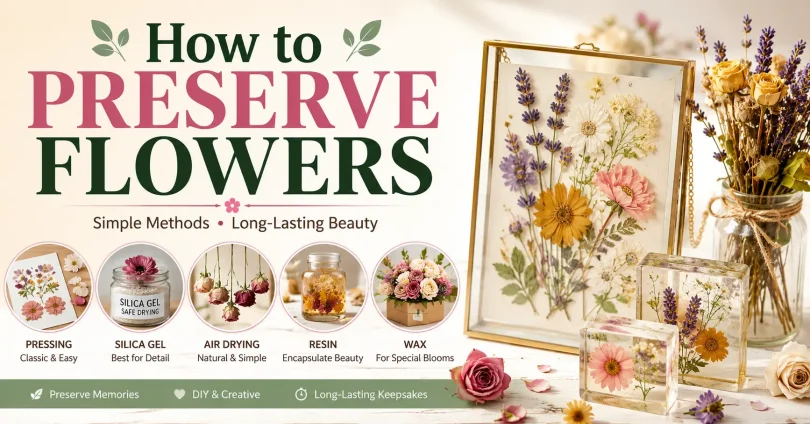
How to Preserve Flowers is easier than most people think, and there is a method for every skill level, budget, and type of flower. This guide covers 10 proven preservation methods, the best flowers to use for each, common mistakes to avoid, and creative ideas for displaying your preserved blooms.
Whether you are a total beginner or have tried preserving flowers before with mixed results, this guide gives you everything you need.
When to Pick Flowers for Preservation
Most people wait too long. By the time a flower is fully open and on display, it has already passed its ideal preservation window. Here is what you need to know:
- Pick flowers when they are about three-quarters open, not fully bloomed.
- Harvest in the morning after the dew has dried but before the afternoon heat sets in.
- Avoid picking on rainy days or right after watering, as excess moisture encourages mold during drying.
- For gifted bouquets, start the preservation process as soon as possible after receiving them.
Best and Worst Flowers for Preservation
Not every flower preserves equally well. Knowing which ones to choose saves you time and disappointment.
Flowers That Preserve Very Well
- Roses (especially bud stage)
- Lavender
- Baby’s breath (gypsophila)
- Statice
- Strawflower (helichrysum)
- Pansies and violas (for pressing)
- Hydrangeas
- Eucalyptus (for glycerin method)
Flowers That Are Harder to Preserve
- Orchids (lose shape easily when dried by air)
- Daffodils (high water content)
- Tulips (petals fall quickly during air drying)
- Large dahlias (best with silica gel only)
10 Methods to Preserve Flowers
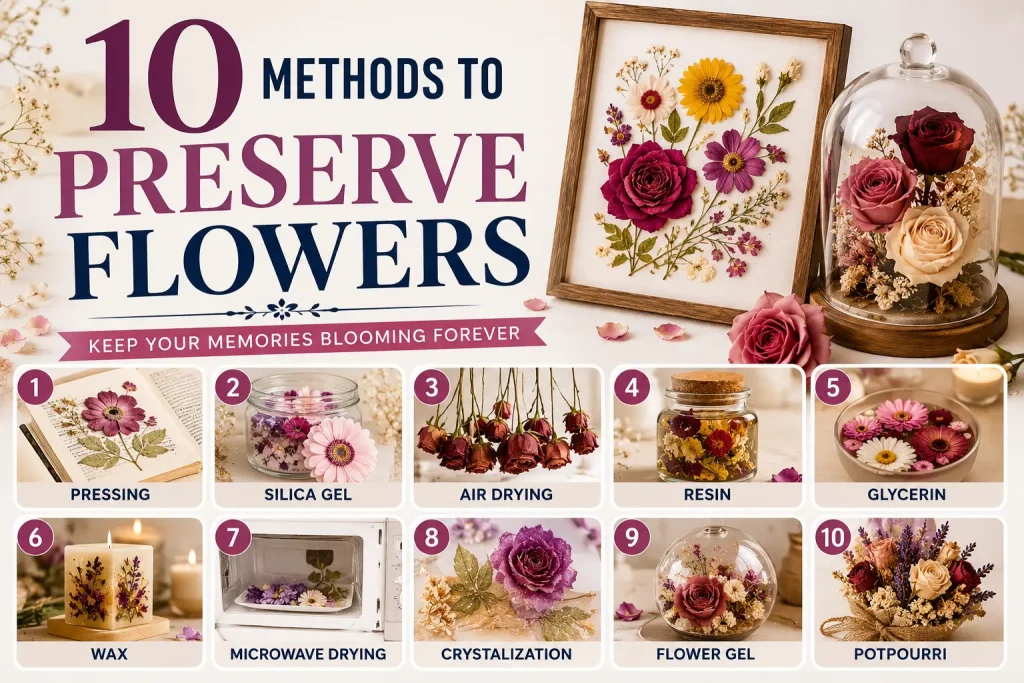
Method 1: Air Drying (Hanging Upside Down)
Air drying is the oldest and simplest method. It requires no special tools and works well for roses, lavender, and baby’s breath. The upside-down hanging position prevents petals from drooping as they dry.
What you need: Twine or rubber bands, a hook or nail, scissors.
How to do it:
- Remove all leaves from the lower two-thirds of each stem to prevent mold.
- Group three to five stems together and secure them at the base with a rubber band.
- Hang the bundles upside down in a cool, dark, and well-ventilated room.
- Keep them away from direct sunlight to prevent color fading.
- Wait two to three weeks. The flowers are ready when they feel papery and stiff.
Pro tip: Rubber bands are better than twine because they tighten as the stems shrink during drying, keeping bundles secure.
Drying time: 2 to 3 weeks.
Best for: Roses, lavender, baby’s breath, statice, strawflower, and most herbs.
Method 2: Silica Gel Drying
Silica gel is a desiccant that absorbs moisture rapidly and produces beautifully preserved flowers with vivid color and shape intact. It is faster than air drying and gives professional-quality results.
What you need: Silica gel crystals (available at craft stores), an airtight container, scissors.
How to do it:
- Pour a one-to-two-inch layer of silica gel into an airtight container.
- Trim flower stems short (about one inch) and place flowers face-up in the gel.
- Gently spoon more silica gel around and over the petals, working from the outside inward.
- Seal the container and leave it undisturbed for two to seven days depending on flower thickness.
- Remove flowers carefully and brush away any remaining crystals with a soft paintbrush.
Safety note: Silica gel is harmful if swallowed. Keep it away from children and pets. Wash hands thoroughly after use.
Money-saving tip: Silica gel is reusable. Spread used crystals on a baking sheet and heat in the oven at 120 degrees Celsius for one hour to restore them.
Drying time: 2 to 7 days.
Best for: Roses, peonies, zinnias, gerbera daisies, and any flower where color and shape retention matters most.
Method 3: Pressing Flowers
Pressing is one of the oldest flower preservation techniques in the world. It creates flat, two-dimensional blooms perfect for framing, cards, resin art, and journals.
What you need: Heavy books or a flower press, absorbent paper (blotting paper, parchment, or newspaper).
How to do it:
- Select flat, thin flowers such as pansies, violas, daisies, or individual petals from larger blooms.
- Place the flowers face-down between two sheets of absorbent paper.
- Slide the paper into a heavy book or flower press, ensuring flowers do not overlap.
- Stack additional heavy books on top for extra pressure.
- Check weekly and change the absorbent paper if it becomes damp.
- After two to four weeks, carefully remove the pressed flowers.
Microwave pressing shortcut: Place flowers between paper towels in a microwave-safe dish. Microwave on the lowest setting in 30-second intervals until dry. This can work in under 10 minutes but requires careful monitoring to avoid scorching.
Drying time: 2 to 4 weeks (traditional) or under 10 minutes (microwave).
Best for: Pansies, violas, daisies, ferns, and flat single-petal flowers.
Method 4: Glycerin Preservation
Glycerin is a natural liquid that replaces water inside a flower’s cells, keeping petals and leaves soft, flexible, and lifelike for years. Unlike dried flowers, glycerin-preserved blooms do not become brittle.
What you need: Vegetable glycerin (from a pharmacy or craft store), warm water, a vase or deep container.
How to do it:
- Mix one part glycerin with two parts warm water and stir until fully combined.
- Trim stems at a 45-degree angle and remove any leaves that will be submerged.
- Place stems into the glycerin solution and allow flowers to absorb it.
- Leave in a cool location for two to four weeks, checking occasionally.
- Once the petals take on a slightly darker, more translucent appearance, remove and pat gently dry.
Important: Colors may deepen or shift slightly with glycerin. Roses may turn a deep burgundy. This is normal and often looks beautiful.
Drying time: 2 to 4 weeks.
Best for: Eucalyptus, roses, hydrangeas, magnolia leaves, and ferns.
Method 5: Resin Encapsulation
Encasing flowers in clear resin is one of the most visually stunning preservation methods. The result is a hard, glass-like piece that can become jewelry, paperweights, coasters, or decorative objects. Resin preservation is largely absent from most competitor guides, yet it is one of the most searched and trending methods.
What you need: Epoxy resin kit (two-part resin and hardener), silicone molds, mixing cups, a stirring stick, gloves, and a well-ventilated area.
Important: Flowers must be fully dried before encasing in resin. Any moisture will cause cloudiness and bubbling.
How to do it:
- Dry your flowers completely using silica gel or pressing first.
- Mix the resin and hardener according to the kit’s instructions, stirring slowly to minimize bubbles.
- Pour a base layer of resin into your mold and allow it to partially set (gel stage).
- Place your dried flower face-down on the gel layer, pressing gently to secure.
- Pour the remaining resin over the flower and allow it to cure fully (24 to 72 hours).
- Demold, sand edges if needed, and polish for a crystal-clear finish.
Drying time after casting: 24 to 72 hours.
Best for: Wedding flowers, sentimental bouquets, small blooms, and individual petals.
Method 6: Freeze Drying
Freeze drying is the gold standard for professional flower preservation. It produces the most realistic results, maintaining the three-dimensional shape, color, and even fragrance of fresh flowers. The process removes moisture by freezing the flowers and then converting ice directly to vapor, bypassing the liquid stage entirely.
This method requires professional equipment and is typically done by specialized florists or preservation services. The cost usually ranges from $100 to $400 depending on the size of the bouquet.
If you want to preserve a wedding bouquet in its most lifelike form, freeze drying is worth the investment. The flowers can last for decades when stored properly away from light and humidity.
Drying time: 1 to 2 weeks (done by a professional service).
Best for: Wedding bouquets, once-in-a-lifetime arrangements, and any bloom where lifelike appearance is the priority.
Method 7: Microwave Drying
For those who want quick results, the microwave offers a fast-track drying option. It works best combined with silica gel and is ideal for small flowers or when you need preserved flowers in a short time.
How to do it:
- Place a layer of silica gel in a microwave-safe container.
- Place flowers in the gel, cover with more gel, and leave the container slightly open (do not fully seal).
- Microwave on medium-low power for one to two minutes.
- Allow to cool for 24 hours inside the container before removing.
- Gently brush away silica and inspect the flowers.
Warning: Every microwave runs at a different power level. Start low and check frequently. Overheating will scorch petals.
Drying time: A few hours plus 24 hours cooling.
Best for: Small blooms, thin petals, and situations requiring quick results.
Method 8: Oven Drying
Oven drying is a budget-friendly method that works on a similar principle to silica gel drying but uses heat to evaporate moisture. It is faster than air drying but slower than microwave drying.
How to do it:
- Preheat your oven to the lowest possible temperature, ideally 40 to 50 degrees Celsius (100 to 120 degrees Fahrenheit).
- Arrange flowers on a baking sheet lined with parchment paper.
- Place in the oven and prop the door open slightly to allow moisture to escape.
- Check every 30 minutes, turning flowers gently for even drying.
- Remove when petals feel dry and papery, typically within one to two hours.
Note: High heat causes faster color loss. Keep the temperature as low as your oven will allow.
Drying time: 1 to 2 hours.
Best for: Sturdy blooms like roses, zinnias, and lavender.
Method 9: Hairspray Preservation
Hairspray is the quickest and most accessible preservation technique. While it does not preserve flowers as long as other methods, it can extend the life of cut flowers by a few extra days to weeks and is ideal for temporary displays or last-minute needs.
How to do it:
- Allow your flowers to air dry partially, either naturally or upside down for a few days.
- Hold the hairspray can about 30 centimeters away from the flower.
- Apply a light, even coat to all sides of the petals and leaves.
- Allow to dry completely, then apply a second coat if desired.
Limitation: Hairspray is not a long-term solution. Flowers preserved this way typically last weeks to a few months, not years.
Best for: Short-term preservation, event decor, or as a protective coating over already-dried flowers.
Method 10: Sand Drying
Sand drying is a centuries-old technique that predates silica gel and remains a perfectly functional, budget-friendly alternative. Fine, dry sand acts as a natural desiccant.
How to do it:
- Use fine-grained, dry sand such as builder’s sand or craft sand. Bake it in the oven first at 120 degrees Celsius for one hour to ensure it is completely moisture-free.
- Pour a two-to-three-inch layer into a box or container.
- Place flowers face-up on top, then slowly pour more sand around and over the petals.
- Leave undisturbed for two to three weeks before carefully removing.
Drying time: 2 to 3 weeks.
Best for: Roses, carnations, and sturdy blooms. A great alternative when silica gel is not available.
Quick Comparison: Which Method Is Right for You?
Use this table to choose the best preservation method based on your situation.
| Method | Difficulty | Time | Lifespan | Best For |
| Air Drying | Easy | 2-3 weeks | 1-3 years | Rustic decor |
| Silica Gel | Medium | 2-7 days | 3-5 years | Color & shape |
| Pressing | Easy | 2-4 weeks | Years | Art & crafts |
| Glycerin | Medium | 2-4 weeks | Years | Flexible blooms |
| Resin | Medium | 1-3 days | Decades | Jewelry & keepsakes |
| Freeze Dry | Professional | 1-2 weeks | Decades | Wedding bouquets |
| Microwave | Medium | Hours | 1-2 years | Quick results |
| Oven | Easy | 1-2 hours | 1-2 years | Sturdy flowers |
| Hairspray | Very Easy | Minutes | Weeks-months | Short-term display |
| Sand | Easy | 2-3 weeks | 1-3 years | Budget option |
How to Store Preserved Flowers
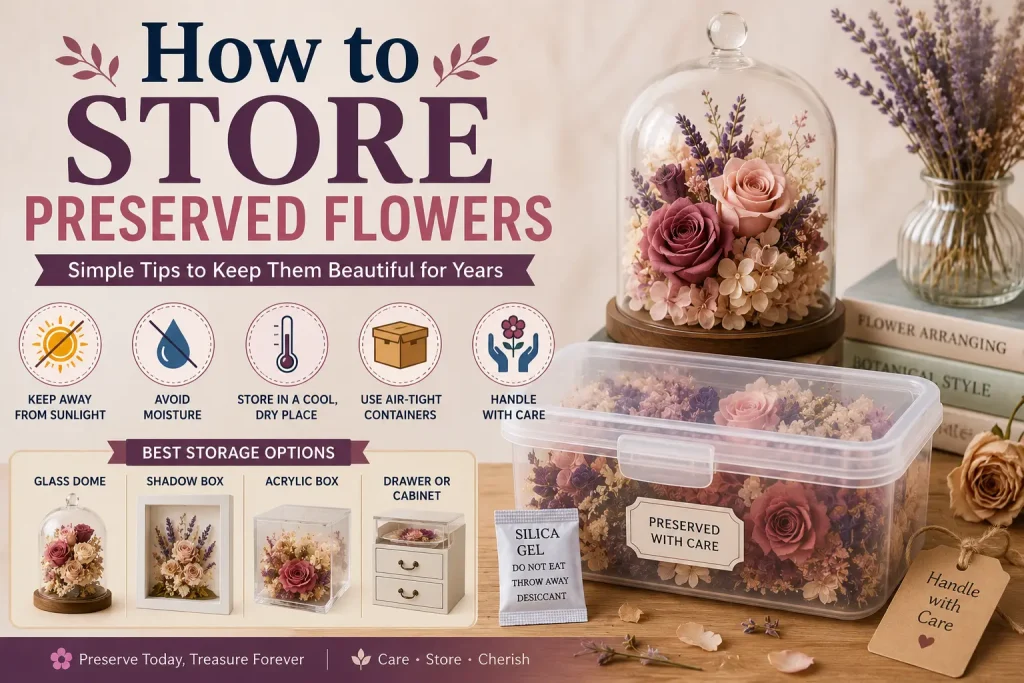
Preservation is only half the work. Proper storage is what makes preserved flowers last for years instead of months.
- Keep away from direct sunlight: UV light bleaches colors. Store or display in a shaded area.
- Control humidity: High humidity causes mold and softening. Keep preserved flowers in a room with less than 50% relative humidity.
- Use airtight containers for long-term storage: Glass domes, shadow boxes, or sealed display cases protect flowers from dust and moisture.
- Add silica gel packets to storage boxes: These absorb ambient moisture and extend the life of your preserved flowers significantly.
- Avoid kitchens and bathrooms: Steam, heat, and humidity fluctuations in these rooms degrade preserved flowers quickly.
- Handle gently: Dried flowers are brittle. Always support the head of the flower when moving or arranging.
Creative Ways to Use Preserved Flowers
Once you have mastered preservation, the creative possibilities are wide open. Here are ideas that go beyond simply placing flowers in a vase:
- Framed pressed flower art: Arrange pressed flowers in a picture frame for botanical wall art.
- Resin jewelry: Encase small dried flowers in resin pendants, rings, or earrings.
- Handmade greeting cards: Press flowers and use them to decorate homemade cards.
- Scented sachets: Fill small fabric pouches with dried lavender or rose petals for natural fragrance.
- Candle embedding: Press small dried flowers onto the outside of pillar candles using a heat gun.
- Bookmarks: Laminate pressed flowers between clear laminate sheets for unique bookmarks.
- Wedding keepsakes: Preserve your bouquet and display it under a glass dome as a lasting memory.
- Potpourri: Combine dried petals with essential oils and dried herbs for a natural home fragrance.
Common Mistakes and How to Avoid Them
These are the mistakes most beginners make, and how to avoid them.
- Waiting too long to start: The sooner you begin preservation, the better the results. Do not wait for flowers to be fully open or starting to wilt.
- Not removing leaves: Leaves left on stems during air drying trap moisture and cause mold. Strip them before hanging.
- Overcrowding bundles: Bundles that are too large or too tightly packed dry unevenly and encourage rot in the center.
- Using wet flowers in resin: Any moisture trapped in resin causes cloudiness. Always fully dry before encasing.
- Storing in sunlit areas: Even brief daily exposure to direct sunlight will bleach colors over weeks.
- Skipping the humidity check: Humidity is the silent killer of preserved flowers. A simple hygrometer is inexpensive and helps you monitor storage conditions.
Frequently Asked Questions
How long do preserved flowers last?
It depends on the method. Air-dried and sand-dried flowers typically last one to three years. Silica gel and glycerin preservation extends this to three to five years. Resin and freeze-dried flowers can last decades when stored correctly.
Can you preserve flowers with hairspray?
Yes, hairspray can slow wilting and add a light protective layer, but it is not a long-term solution. It works best as a finishing coat over already-dried flowers or for short-term display purposes.
What is the easiest method to preserve flowers at home?
Air drying is the easiest method. It requires no special equipment, and most flowers respond well to it. For beginners, start with lavender, baby’s breath, or roses.
How do you preserve a wedding bouquet?
For the most lifelike result, use a professional freeze-drying service. If you prefer a DIY approach, silica gel produces excellent results at home. Begin the process within 24 hours of the wedding for best color and shape retention.
Do preserved flowers smell?
Air-dried flowers retain a faint natural scent that fades over time. Freeze-dried flowers retain scent much better. Glycerin-preserved flowers tend to lose their fragrance. Adding a few drops of essential oil to dried flower arrangements can restore a pleasant scent.
Can you preserve flowers in a book?
Yes. Pressing flowers in a heavy book is a classic and effective method. Place flowers between sheets of absorbent paper and leave under heavy books for two to four weeks. Replace the paper every few days if it gets damp.
Final Thoughts
Preserving flowers is a deeply personal and rewarding skill. Whether you choose the simplicity of air drying, the precision of silica gel, the artistry of resin, or the professional quality of freeze drying, there is a method that fits your time, budget, and goal.
The key is to start early, choose the right method for your flower type, and store your preserved blooms with care. With the right approach, a single bouquet can carry its beauty and meaning for years, even decades, to come.
Pick your method, gather your flowers, and get started today.
You May Also Like It: