
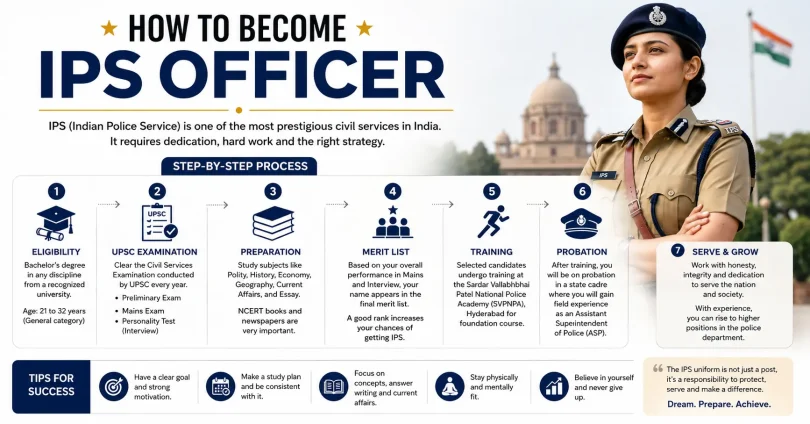
How to Become an IPS Officer an Indian Police Service (IPS) officer is one of the most respected goals in India. It is a position that carries real power and real responsibility. An IPS officer protects communities, commands police forces, and shapes law and order across the country.
But how exactly do you get there? Many articles answer this question with vague advice. This guide gives you a clear, step-by-step roadmap — from eligibility and exam stages to physical standards, training, salary, and the daily life of an IPS officer. Whether you are a school student, a college graduate, or someone who has already started UPSC preparation, this guide covers everything you need to know.
What Is the Indian Police Service (IPS)?
The Indian Police Service is one of the three All India Services, along with the Indian Administrative Service (IAS) and the Indian Forest Service (IFS). IPS officers are recruited by the central government but work under state governments. They hold some of the most powerful positions in India’s law enforcement structure.
IPS officers lead the police force at every level — from a district’s Superintendent of Police (SP) to the Director General of Police (DGP) of an entire state. At the national level, senior IPS officers serve as Director of the Central Bureau of Investigation (CBI), the Intelligence Bureau (IB), and the National Security Guard (NSG).
What Does an IPS Officer Actually Do?
This is one part that most competitor articles skip. Here is what IPS officers do on a daily basis:
- Maintain law and order in their jurisdiction
- Lead criminal investigations and coordinate with the CBI or state crime branches
- Handle anti-terrorism operations and internal security
- Supervise traffic management, cybercrime units, and special task forces
- Manage VIP and critical infrastructure security
- Handle disaster response and crowd control during civil emergencies
- Liaise with central agencies like RAW, IB, and CRPF on national security matters
- Draft and implement policing policies at the state level
The role is dynamic, demanding, and different every day. No two postings are alike. One year you may be handling rural crime in a small district; the next, you could be leading a state anti-narcotics division.
IPS Officer Eligibility Criteria
Before you start preparing, confirm that you meet all eligibility conditions. Here is the full breakdown:
1. Nationality
You must be a citizen of India. Subjects of Nepal and Bhutan, or Tibetan refugees who migrated to India before January 1, 1962, may also be eligible in certain cases. However, the standard requirement is Indian citizenship.
2. Educational Qualification
You must hold a bachelor’s degree from any recognized university. Your stream does not matter — engineering, arts, science, commerce, or any other discipline all qualify. Even those in their final year of graduation can apply provisionally, but they must submit proof of graduation before the mains exam.
3. Age Limit and Number of Attempts
| Category | Age Limit and Attempts |
| General / EWS | 21 to 32 years | 6 attempts |
| OBC | 21 to 35 years | 9 attempts |
| SC / ST | 21 to 37 years | Unlimited attempts (within age limit) |
| Disabled Defence Service Personnel | Up to 42 years | As per category |
| Ex-Servicemen (OBC) | Up to 38 years |
| Ex-Servicemen (General) | Up to 35 years |
4. Physical Standards for IPS
IPS officers are required to meet specific physical standards. These are tested during the medical examination stage. Here is the full requirement:
| Standard | Requirement |
| Height (Men — General / OBC / SC) | 165 cm |
| Height (Men — ST) | 160 cm |
| Height (Women — General / OBC / SC) | 150 cm |
| Height (Women — ST) | 145 cm |
| Chest (Men — unexpanded) | 84 cm |
| Chest (Men — expanded) | Minimum 5 cm expansion required |
| Chest (Women) | Not specified — overall fitness assessed |
| Eye Sight (Distance Vision) | 6/6 or 6/9 in one eye; 6/12 or 6/9 in the other |
| Eye Sight (Near Vision) | J1 in one eye; J2 in the other |
| Colour Vision | CP III by Ishihara (no Colour Blindness) |
Note: Candidates who wear spectacles or contact lenses may still qualify if their corrected vision meets the above standards. Myopia up to minus 4.00D and hypermetropia up to plus 4.00D is generally acceptable. Consult the official UPSC notification for the most current medical standards.
How to Become an IPS Officer: The UPSC CSE Process
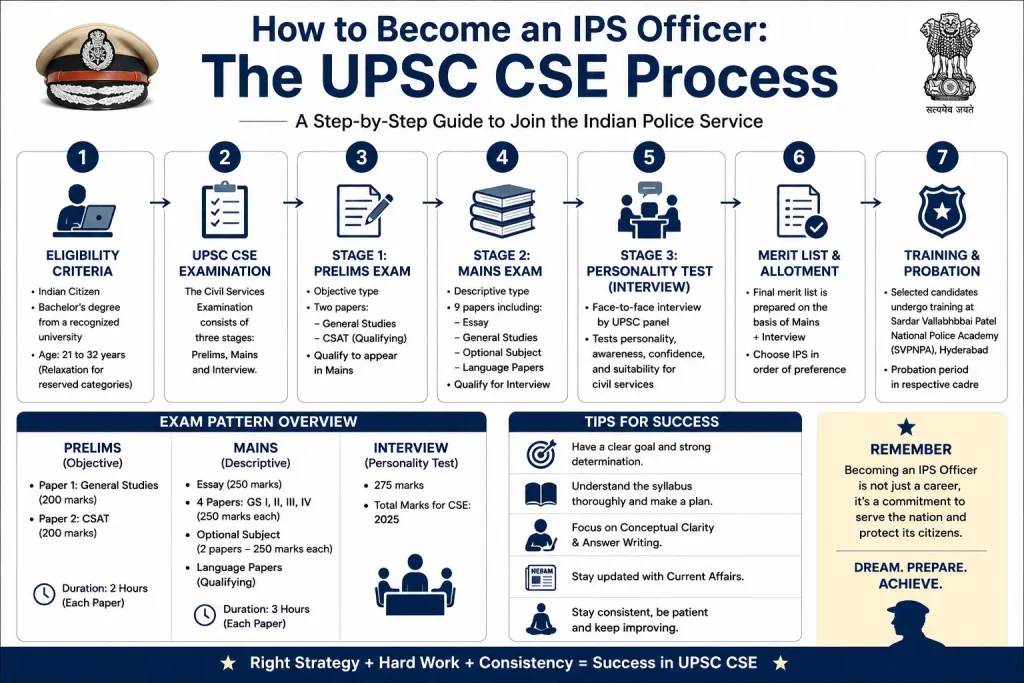
The only way to join the IPS (apart from the state police promotion route, which is rare) is through the UPSC Civil Services Examination (CSE). This is a multi-stage exam conducted every year by the Union Public Service Commission.
Here are the three stages you must clear:
Stage 1: UPSC Preliminary Examination (Prelims)
The Prelims is a screening test with two objective-type papers. Only those who clear it are called for the Mains. Prelims marks are not counted in the final merit list — it is purely a qualifying round.
| Paper | Details |
| Paper 1 — General Studies I | 100 questions | 200 marks | 2 hours |
| Paper 2 — CSAT (Aptitude) | 80 questions | 200 marks | 2 hours (qualifying, 33% cutoff) |
| Negative Marking | 1/3rd mark deducted per wrong answer |
| Medium | English or Hindi |
Paper 1 covers history, geography, polity, economy, environment, science, and current affairs. Paper 2 (CSAT) tests comprehension, logical reasoning, and basic numeracy. You must score at least 33% in Paper 2 to have Paper 1 evaluated.
Stage 2: UPSC Mains Examination
The Mains is a written exam with nine papers, of which seven are merit-based. It tests depth of knowledge, analytical ability, and writing skill. The total marks for Mains that count in the final ranking are 1,750.
| Paper | Marks |
| Essay Paper | 250 marks |
| GS Paper I (History, Culture, Geography) | 250 marks |
| GS Paper II (Polity, Governance, IR) | 250 marks |
| GS Paper III (Economy, Environment, Science) | 250 marks |
| GS Paper IV (Ethics, Integrity, Aptitude) | 250 marks |
| Optional Paper I | 250 marks |
| Optional Paper II | 250 marks |
| Language Paper A (Indian Language) | 300 marks (qualifying only) |
| Language Paper B (English) | 300 marks (qualifying only) |
Choosing the right optional subject is critical. Popular optional subjects for IPS aspirants include Public Administration, Political Science and International Relations (PSIR), Sociology, History, and Geography. The right optional subject depends on your academic background and genuine interest — not what is trending.
Stage 3: Personality Test (UPSC Interview)
The Interview, or Personality Test, carries 275 marks. It is conducted by the UPSC Board in New Delhi. The board assesses your mental alertness, communication skills, leadership potential, social awareness, and ability to handle pressure.
Contrary to popular myth, the interview is not just about general knowledge. The board focuses heavily on your optional subject, your work experience (if any), your hometown and district, current affairs, and ethical dilemmas. The board wants to see if you have the temperament to become a civil servant.
The final merit list is based on Mains (1,750 marks) + Interview (275 marks) = 2,025 marks total.
UPSC IPS Syllabus: Key Topics to Master
The UPSC CSE syllabus is vast but structured. Here is a subject-wise breakdown of the most critical areas:
General Studies Paper I (Prelims and Mains)
- Indian History: Ancient, Medieval, and Modern India
- Indian National Movement: Key events, leaders, and ideologies
- Indian and World Geography: Physical, economic, and human geography
- Indian Polity: Constitution, Parliament, Judiciary, Federalism, Governance
- Economy: Planning, poverty, banking, inflation, fiscal policy
- Environmental Ecology: Biodiversity, climate change, conservation
- Science and Technology: Space, biotechnology, IT, defence
- Current Affairs: National and international events of the last 12 months
GS Paper IV: Ethics (Especially Important for IPS)
Ethics Paper is particularly important if you want to serve in the police service. The paper tests your understanding of integrity, public service values, moral dilemmas, and code of conduct. Many interview questions for IPS aspirants also revolve around ethical decision-making — what would you do if ordered to file a false case, or how would you handle political pressure.
Optional Subject
Choose one optional subject from the UPSC-approved list. Study it for both Paper I and Paper II. The optional subject contributes 500 marks to your total. A strong optional can significantly boost your rank and your chances of getting the IPS.
How to Prepare for IPS: A Realistic Strategy
This is the section that most aspirants need most — not what to study, but how to approach the preparation. Here is a practical, honest strategy:
Year 1: Build Your Foundation
- Read NCERT textbooks from Class 6 to Class 12 for History, Geography, Polity, and Economy — this gives you the conceptual base
- Follow a good daily newspaper (The Hindu or Indian Express) for current affairs
- Start your optional subject — go through the syllabus and identify standard books
- Do not attempt mock tests yet — your focus should be reading and understanding
Year 2: Structured Revision and Practice
- Take subject-wise tests regularly to identify weak areas
- Start solving previous years’ Prelims papers — at least 10 years’ worth
- Begin answer-writing practice for Mains — this is a skill that takes months to develop
- Join a test series with evaluation and feedback, not just scores
- Revise your notes at least three times before Prelims
Year 3 (If Needed): Focused Refinement
- Identify your weak GS papers and spend extra time there
- Build a current affairs compilation from the past 12 months
- Practice mock interviews with structured feedback
- Work on your answer-writing speed — aim for 150 to 180 words per 10-mark answer
Books Every IPS Aspirant Should Read
| Subject | Recommended Book |
| Indian Polity | M. Laxmikanth |
| Modern Indian History | Bipin Chandra |
| Certificate Physical and Human Geography | G.C. Leong |
| Indian Economy | Ramesh Singh |
| Ethics, Integrity and Aptitude | G. Subba Rao |
| Environment and Ecology | Shankar IAS |
| Current Affairs | Vision IAS / Vajiram Monthly |
| NCERT Class 6–12 | All subjects (Start here first) |
IPS Training: What Happens After Selection
One aspect that virtually no competitor article covers in detail is the training process. This is where raw recruits are transformed into IPS officers. Understanding training helps you prepare mentally for what lies ahead.
Phase 1: Foundation Course at LBSNAA (Mussoorie)
After clearing the UPSC exam and the medical test, all newly selected civil servants — IAS, IPS, and IFS — undergo a joint Foundation Course at the Lal Bahadur Shastri National Academy of Administration (LBSNAA) in Mussoorie. This lasts approximately three months. It covers the basics of administration, constitutional values, national integration, and physical fitness training.
Phase 2: Basic Training at SVPNPA (Hyderabad)
IPS probationers then move to the Sardar Vallabhbhai Patel National Police Academy (SVPNPA) in Hyderabad for their main professional training. This phase lasts approximately 44 weeks and covers:
- Law — Criminal Procedure Code (CrPC), Indian Penal Code (IPC), and Evidence Act
- Police science, forensics, and crime investigation methods
- Traffic management and disaster management
- Weapons training, physical fitness, and horse riding
- Human rights, ethics, and community policing
- State-specific laws and administration
Phase 3: District Training
After Hyderabad, probationers undergo practical field training in their allotted state cadre. They are posted with senior IPS officers in districts to learn real-world policing. This phase typically lasts several months and involves working directly at police stations, criminal courts, and district administration.
Phase 4: Return to SVPNPA
Probationers return to the National Police Academy for a final phase of training before they receive their formal posting orders. They are then given their first official posting — usually as an Assistant Superintendent of Police (ASP).
IPS Rank Structure: From ASP to DGP
Understanding the rank hierarchy helps you plan your career trajectory. Here is the complete rank structure of IPS:
| Rank | Role |
| Assistant Superintendent of Police (ASP) | Entry-level posting after training |
| Deputy Superintendent of Police (DSP) | After confirmation |
| Superintendent of Police (SP) | District head of police |
| Senior Superintendent of Police (SSP) | Senior district-level posting |
| Deputy Inspector General of Police (DIG) | Range-level command |
| Inspector General of Police (IG) | Zone-level command |
| Additional Director General of Police (ADG) | Near-apex state-level post |
| Director General of Police (DGP) | Top state police post |
| Director General / Special Director (Central) | CBI, IB, NSG, CRPF leadership |
IPS Officer Salary, Perks, and Benefits
Here is a comprehensive overview of the salary and perks that come with the IPS posting — something most competitors only partially cover:
IPS Salary by Pay Level
| Rank | Approximate Basic Pay (7th Pay Commission) |
| ASP / DSP | Pay Level 10 | Rs. 56,100 per month basic |
| SP / SSP | Pay Level 12 | Rs. 78,800 per month basic |
| DIG | Pay Level 13 | Rs. 1,18,500 per month basic |
| IG | Pay Level 13A | Rs. 1,31,100 per month basic |
| ADG | Pay Level 14 | Rs. 1,44,200 per month basic |
| DGP | Pay Level 15–17 | Rs. 1,82,200 and above |
Non-Monetary Benefits
The real value of an IPS posting goes beyond salary. Here are the perks that come with the job:
- Official government accommodation (bungalow with staff)
- Official vehicle with driver
- Orderly / personal assistant support
- Free or subsidized medical care for self and family
- Children’s education allowance
- Armed security personnel (at senior ranks)
- Pension under the National Pension System (NPS)
- Access to government guesthouses across India during official travel
- Significant social status and public respect
IPS Cadre Allotment: Where Will You Be Posted?
After selection, UPSC assigns each IPS officer a state cadre. This is important because it determines where you will spend the majority of your career. The cadre is allotted based on your rank in the merit list, your home state preference, and the availability of vacancies.
India has 26 cadres for the IPS, including combined cadres. Major cadres include AGMUT (Arunachal Pradesh, Goa, Mizoram, and Union Territories), Uttar Pradesh, Maharashtra, Rajasthan, Karnataka, Tamil Nadu, and others.
One important fact: Unlike the IAS, IPS officers have a slightly different cadre transfer policy. Officers can be deputed to central security forces like CRPF, BSF, NSG, and IB, which gives IPS officers broader national-level career opportunities.
The Real Life of an IPS Officer: What No One Tells You
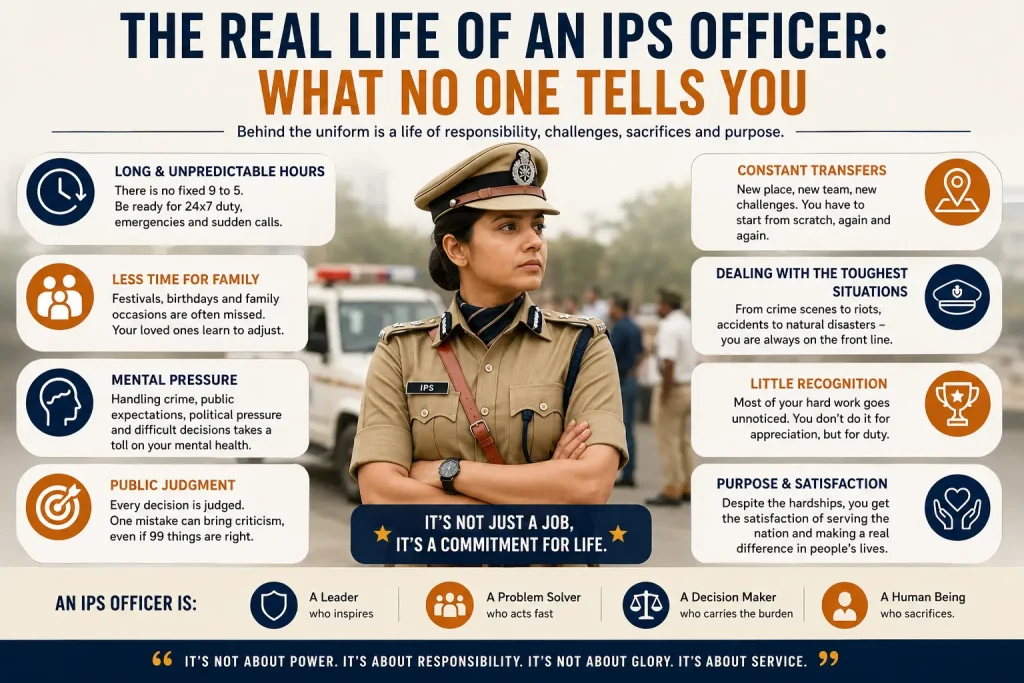
Here is the honest, ground-level picture that most guides never provide:
The Challenges
- Long and irregular working hours — there is no fixed 9 to 5
- Frequent transfers — sometimes once every two to three years
- Political pressure — staying neutral under influence is a constant test of character
- Public accountability — every major crime or disorder in your area is your responsibility
- Personal safety risks in sensitive postings like conflict zones or anti-Naxal operations
- Family disruption due to transfers, especially for children’s schooling
The Rewards
- Unmatched authority to make real, immediate change in communities
- Respect and recognition from the public and colleagues
- Exposure to diverse cultures, regions, and challenges across India
- Opportunity to work with national agencies like CBI, RAW, and NSG
- Long-term career stability and post-retirement benefits
- The satisfaction of public service — of genuinely protecting people
Alternative Paths to the Police Service
Apart from UPSC CSE, there are two other routes to become a police officer, though they do not lead directly to the IPS:
State Police Service (SPS) and Promotion
State governments recruit officers through State Public Service Commission (SPSC) exams for the State Police Service. Exceptional SPS officers may be promoted to the IPS after 8 to 10 years of service. However, this route is slow, competitive within the state cadre, and not guaranteed. Most career IPS officers come through UPSC CSE.
Limited Departmental Competitive Examination (LDCE)
There is also an LDCE route for serving police officers. A small percentage of IPS vacancies are filled through this internal examination. However, this is only open to those already in state police service.
How to Start After 10th Standard
Many students start thinking about IPS as early as Class 10. Here is what you should do at each stage:
Class 10 to 12
- Choose a stream you are strong in — any stream qualifies for UPSC
- Build a habit of reading newspapers every day
- Participate in debates, public speaking, and mock competitions to build communication skills
- Stay physically active — build stamina, since IPS training is physically demanding
Graduation
- Choose a subject you are genuinely interested in — it may become your UPSC optional
- Appear for your graduation seriously — UPSC requires a genuine degree, not just enrollment
- Start UPSC preparation in the second year of graduation at the latest
- Read standard UPSC books alongside your college curriculum
After Graduation
- Register for UPSC CSE and begin structured preparation immediately
- Join a reliable test series for feedback-based improvement
- Focus on your optional subject and GS equally
Common Mistakes IPS Aspirants Make
Avoiding these mistakes can save you years of effort:
- Ignoring CSAT: Many candidates fail Prelims because of poor Paper 2 preparation. CSAT requires regular practice.
- Changing optional subject too often: Stick to one optional and master it completely before switching.
- Neglecting answer writing: Reading alone is not enough. Write answers daily from Year 1.
- Treating current affairs casually: At least 25 to 30 percent of Prelims questions are from the current year. Do not underestimate this section.
- Skipping physical preparation: IPS medical standards are strict. Start working on your physical fitness early.
- Not appearing for mock interviews: The personality test can make or break your final rank. Practice rigorously.
UPSC CSE Important Dates (Approximate Annual Timeline)
| Event | Approximate Timeline |
| UPSC Notification Release | February (every year) |
| Last Date to Apply | March (approximately 3 weeks after notification) |
| Prelims Examination | May / June |
| Prelims Result | June / July |
| Mains Examination | September / October |
| Mains Result | January / February (next year) |
| Personality Test (Interview) | February / March / April |
| Final Result and Rank List | April / May |
Note: UPSC announces official dates through its website (upsc.gov.in). Always verify exact dates from the official notification.
Frequently Asked Questions
Can a private sector professional become an IPS officer?
Yes. Any Indian citizen who meets the age and educational eligibility can appear for UPSC CSE, regardless of their current occupation.
Is it mandatory to choose an optional subject related to police or law?
No. You can choose any optional subject from the UPSC-approved list. Many successful IPS officers have chosen subjects like Sociology, History, or Political Science.
How many IPS officers are selected each year?
Approximately 150 to 200 IPS officers are selected each year through UPSC CSE, depending on the vacancies notified. The exact number varies annually.
Can women become IPS officers?
Yes. Women can appear for UPSC CSE and join the IPS. Height requirements are lower for women (150 cm for general category). Several women IPS officers have served in high-profile positions, including as Director General of Police in states.
What is the role of UPSC in IPS selection?
UPSC conducts the entire Civil Services Examination — Prelims, Mains, and Interview. Based on the final merit list and the preferences submitted by candidates, UPSC recommends names to the Department of Personnel and Training (DoPT), which allocates cadres and confirms appointments.
How long does IPS training last?
The complete training period — from the Foundation Course at LBSNAA to field training and return to SVPNPA — lasts approximately two years before the officer receives a formal posting.
What happens if I fail the medical test?
If you fail the medical test, you may be considered for other services that have less stringent physical requirements. You can also request a re-medical examination if you believe the initial findings were inaccurate. Consult the UPSC guidelines for the appeals process.
Final Word
The IPS is not just a job — it is a calling. It demands sacrifice, discipline, and a genuine commitment to public service. Officers face pressure from politicians, criminals, and the media simultaneously. But those who stay the course find themselves in one of the most powerful and fulfilling positions in the country.
If you are motivated by the opportunity to protect communities, lead teams, and make a direct impact on law and order, then the IPS is worth every year of preparation. Start early, be consistent, and trust the process.
The exam is tough. The training is harder. But the work — the actual work of an IPS officer — is one of the most meaningful things a person can do in public life in India.
You May Also Like It:
How to Stop Diarrhea in Babies Fast