
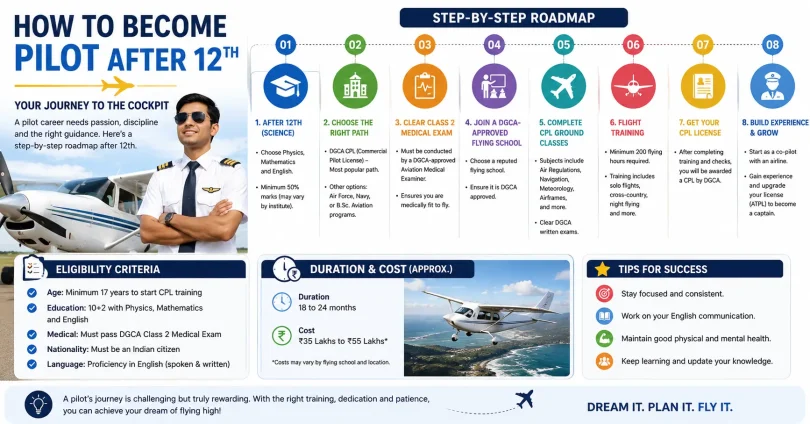
Every aspiring pilot asks the same question how to become a pilot after 12th in India results arrive: what now? The path from a 12th-pass certificate to a Commercial Pilot License (CPL) is well defined, but it is also expensive, regulated, and easy to get wrong if you do not understand the sequence. This guide walks through the eligibility rules, the 2026 DGCA updates, the realistic timeline, the actual cost, and the salary you can expect, so you can plan your aviation career with facts instead of guesswork.
Quick Answer
- Complete 12th with Physics and Mathematics, or clear these subjects through NIOS if you are from a Commerce or Arts background.
- Get a DGCA Class 2 Medical Certificate and register for a DGCA Computer Number on the Pariksha portal.
- Join a DGCA-approved Flying Training Organization (FTO) for ground school and flight training.
- Log a minimum of 200 flying hours and clear all DGCA theory and skill tests.
- Apply for your Commercial Pilot License (CPL) and start applying to airlines or cadet programs.
- Total cost: roughly ₹40 to ₹85 lakh. Total time: roughly 18 to 30 months.
What Does Becoming a Pilot After 12th Actually Involve?
Becoming a pilot is not a single exam or a single course. It is a regulated, multi-stage process supervised by the Directorate General of Civil Aviation (DGCA), India’s aviation authority. Between your 12th-grade results and your first paycheck as a First Officer, you will pass through several checkpoints: medical clearance, ground school theory, flight training, a government skill test, and finally license issuance.
Most students target the Commercial Pilot License (CPL), the license that lets you fly for a salary. Along the way, you will also hold two interim licenses, the Student Pilot License (SPL) and the Private Pilot License (PPL), which are explained in detail later in this guide.
The two biggest variables that decide how smooth this journey is are which flying school you choose and how well you plan your finances and timeline in advance. Both are covered below.
Eligibility Criteria for Pilot Training After 12th
Before you spend a single rupee on training, confirm that you meet the DGCA’s baseline requirements. These apply regardless of which flying school or city you choose.
| Requirement | Detail |
| Educational qualification | 10+2 (Class 12) from a recognized board, with Physics and Mathematics |
| Non-science students | Can qualify by clearing Physics and Mathematics through NIOS (see Section 3) |
| Minimum age | 16 years for SPL, 17 years for PPL, 18 years for CPL |
| Medical fitness | DGCA Class 2 Medical Certificate to begin training; Class 1 Medical Certificate before CPL issuance |
| English proficiency | DGCA English Language Proficiency (ELP) Level 4 or higher |
| Nationality | Indian citizens train freely at DGCA-approved schools; international students need a valid visa |
| Background | No record of substance abuse or legal disqualification |
A Class 2 Medical Certificate is issued by a DGCA-empanelled examiner and checks your vision, hearing, cardiovascular health, and general fitness. Book this early. It is the cheapest and fastest way to confirm you are physically fit before you commit lakhs of rupees to flight training.
Practical tip: Complete your Class 2 medical and DGCA Computer Number registration in the same month you receive your 12th results. Both can be done before you even shortlist a flying school, and doing them early prevents months of delay later.
The 2026 DGCA Update Every Aspirant Should Know
Aviation regulations change more often than most career guides admit. Three updates from the DGCA directly affect anyone starting training in 2026, and ignoring them can cost you both time and money.
Non-science students: where the rule actually stands
For decades, only students with Physics and Mathematics in Class 12 could qualify for CPL training. In April 2025, the DGCA formally recommended scrapping this requirement and sent the proposal to the Ministry of Civil Aviation and the Ministry of Law for approval. As of mid-2026, this reform has been recommended but has not yet been formally notified.
Until the new rule takes effect, the working pathway for Commerce and Arts students remains the National Institute of Open Schooling (NIOS) bridge route. You do not need to repeat your entire Class 12 year. You can register directly for the Senior Secondary-level Physics and Mathematics papers through NIOS and clear them as standalone subjects, which DGCA accepts as equivalent to a regular board result for the Computer Number application.
- Action point: If you are from a non-science stream, register for the NIOS Physics and Mathematics papers as soon as possible. Waiting for the reform to be formally notified before starting only delays your entire timeline.
DGCA theory exams now require 70 percent per subject
Recent DGCA guidelines have moved away from an aggregate passing score. Each ground school subject, including Air Navigation, Meteorology, Air Regulations, and Technical General and Specific, must individually clear 70 percent. A strong score in one paper can no longer offset a weak one in another, so plan your ground school revision subject by subject rather than averaging your effort.
FTO Ranking System: a new way to compare flying schools
In April 2026, the DGCA introduced an official ranking system for Flying Training Organizations (FTOs). Every DGCA-approved flying school now carries a public quality rating based on factors such as aircraft availability, instructor strength, and training outcomes. Before shortlisting a school, ask for its current FTO ranking rather than relying only on brochures, testimonials, or sales calls. This is covered in more detail in Section 9.
Types of Pilot Licenses Explained
You will hold more than one license on the way to a flying career. Here is what each one means and what it allows you to do.
| License | Minimum Age | Minimum Flying Hours | What It Allows |
| Student Pilot License (SPL) | 16 years | None (training begins) | Fly dual, with an instructor, as the first formal step |
| Private Pilot License (PPL) | 17 years | 40 to 50 hours | Fly aircraft for personal, non-paid use |
| Commercial Pilot License (CPL) | 18 years | 200 hours | Fly commercially and draw a salary from an airline or charter operator |
| Airline Transport Pilot License (ATPL) | 21 years | 1,500 hours | Act as Captain (Pilot-in-Command) on scheduled airline flights |
Most students treat SPL and PPL as stepping stones and focus their planning on the CPL, since that is the license that opens the door to a paying job. The ATPL typically comes years later, once you have built sufficient hours as a First Officer.
Step-by-Step Process to Become a Pilot After 12th
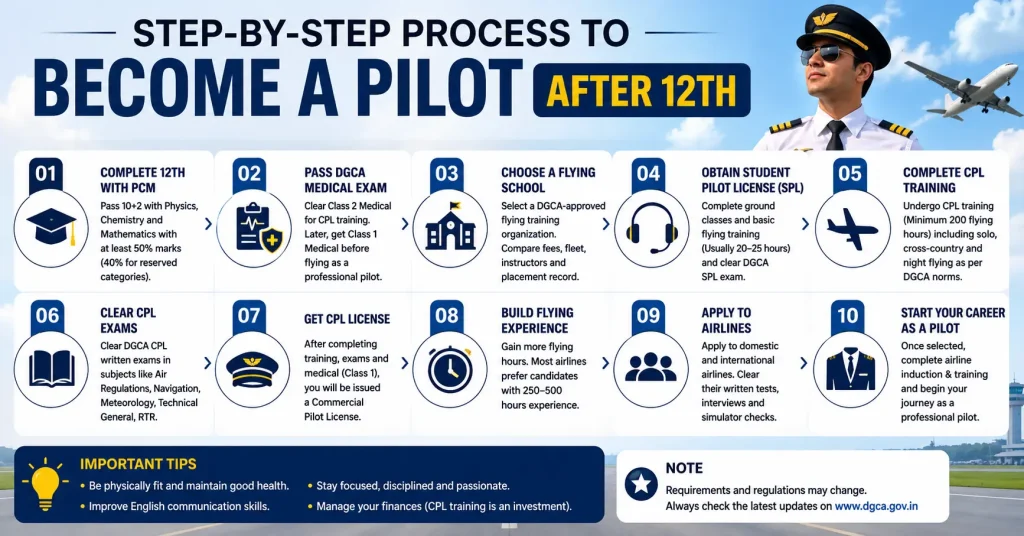
Step 1: Clear 12th with Physics and Mathematics (or complete the NIOS bridge course)
If you already have Physics and Mathematics, you can move straight to Step 2. If not, register for the NIOS Senior Secondary papers in these two subjects as described in Section 3.
Step 2: Get your DGCA Class 2 Medical Certificate
Visit a DGCA-empanelled medical examiner for a Class 2 medical examination, which checks eyesight, hearing, cardiovascular health, and overall fitness. Once cleared, you receive a File Number, your official DGCA student identity used for every future license application.
Step 3: Apply for your DGCA Computer Number
Register on the Pariksha DGCA portal and apply for a Computer Number, the unique identifier you will use for every theory exam and license application going forward. You will need your 12th mark sheet (or NIOS certificate), identity proof, and a passport-size photograph.
Step 4: Enroll in a DGCA-approved Flying Training Organization (FTO)
Choose a flying school with a current DGCA approval and, ideally, a strong FTO ranking. The school will provide both ground classes and flight training under licensed instructors.
Step 5: Complete ground school
Ground training covers six core DGCA subjects:
- Air Navigation
- Aviation Meteorology
- Air Regulations
- Aircraft Technical General and Specific
- Airframes and Engines
- Radio Telephony (RTR), examined separately by the WPC
Remember the 70 percent per-subject rule from Section 3 when you plan your revision schedule.
Step 6: Log your flying hours
DGCA requires a minimum of 200 flying hours for a CPL (Aeroplane). This includes solo flying, cross-country navigation, night flying, and instrument flying, typically broken down as follows:
- 100 hours as Pilot-in-Command (PIC)
- 50 hours of solo cross-country flying
- 10 hours of instrument flight time
- 5 hours of night flying
Step 7: Pass the DGCA theory exams and flying skill test
Once your ground school and flight hours are complete, you sit the DGCA CPL theory papers and a practical flying skill test, also called a check ride, with a DGCA-appointed examiner.
Step 8: Upgrade to a Class 1 Medical Certificate
A Class 1 Medical Certificate, a more thorough version of the Class 2 exam, is mandatory before your CPL can be issued.
Step 9: Apply for and receive your Commercial Pilot License
Submit your completed flight records, exam results, and Class 1 medical through the DGCA’s eGCA portal to receive your CPL. This is the license that qualifies you to work as a professional pilot.
Step 10: Add ratings and apply for jobs
With a CPL in hand, most pilots add a Multi-Engine Rating and an Instrument Rating to widen their job options, then apply to airline cadet programs, charter operators, or build hours as a flight instructor while they wait for a Type Rating opportunity.
Realistic Timeline: Month-by-Month Roadmap
Most marketing material understates how long this process actually takes. Here is a realistic month-by-month breakdown based on typical DGCA processing times and flying school throughput.
| Phase | Approximate Duration | What Happens |
| 1. Eligibility and registration | Month 1 to 2 | Clear 12th or start NIOS, get Class 2 medical, apply for DGCA Computer Number |
| 2. Ground school | Month 2 to 7 | Study the six DGCA subjects, attempt theory exams (70 percent per subject) |
| 3. Flight training | Month 6 to 18 | Join an FTO, complete 200 flying hours including solo, night, and instrument flying |
| 4. Skill test and CPL issuance | Month 18 to 21 | Clear the flying skill test, upgrade to Class 1 medical, apply for CPL via eGCA |
| 5. Ratings and job search | Month 21 onward | Add Multi-Engine and Instrument Ratings, apply to airlines or cadet programs |
In total, most students complete the journey from 12th-grade results to a CPL in 18 to 24 months. Weather disruptions, aircraft availability, and DGCA exam scheduling can extend this to 30 months, so build a buffer into your own planning rather than assuming the fastest-case timeline.
Two Paths to the Cockpit: Conventional Training vs. Cadet Programs
Once you understand the process, you still need to choose how to fund and structure it. Most students pick between a conventional flying school and an airline-sponsored cadet program.
| Factor | Conventional Flying School | Airline Cadet Program |
| Cost | Lower, pay-as-you-train | Higher, often bundled with Type Rating |
| Job certainty | None; job search begins after CPL | Many programs include a Letter of Intent from the airline |
| Flexibility | Choose your own school, pace, and location | Fixed curriculum and timeline set by the airline |
| Selection process | Open admission, subject to eligibility | Highly competitive, multi-round selection |
| Best suited for | Students who value flexibility and lower upfront cost | Students who want a clearer, faster route into one specific airline |
A third route exists for students who want to fly fighter jets, transport aircraft, or helicopters in the Indian Armed Forces. This is the Defence Pilot route, accessed through the NDA or CDS examinations followed by training at the Air Force Academy. It is a separate process with its own age limits and selection criteria, and is best researched through official Indian Air Force recruitment resources if it interests you.
Cost of Becoming a Pilot After 12th in 2026
Pilot training is one of the largest financial commitments a student makes straight out of school. Here is a realistic, itemized breakdown so you can plan rather than be surprised.
| Expense | Approximate Cost (2026) |
| Ground school and DGCA exam fees | ₹2 to ₹5 lakh |
| Flight training for CPL (200 hours, in India) | ₹35 to ₹55 lakh |
| Multi-Engine Rating | ₹8 to ₹15 lakh |
| Type Rating (Airbus A320 or Boeing 737) | ₹12 to ₹25 lakh |
| DGCA exam re-attempt (per paper, if needed) | ₹5,000 |
| Total: CPL only, trained in India | ₹40 to ₹60 lakh |
| Total: CPL plus Type Rating, fully job-ready | ₹55 to ₹85 lakh |
Training abroad: is it cheaper?
Some students train in the United States, South Africa, or Canada, where better weather can mean faster hour-building. Training abroad typically costs ₹35 to ₹60 lakh, but you must also budget ₹6 to ₹8 lakh to convert your foreign license to a DGCA CPL once you return, plus living and visa costs that Indian training does not require. Always confirm that your chosen overseas school meets DGCA conversion requirements before enrolling, since not every foreign license converts smoothly.
Ways to manage the cost
- Apply for education loans specifically designed for pilot training; most nationalized and private banks offer them.
- Look into merit-based scholarships offered by some DGCA-approved academies and entrance platforms.
- Consider an integrated PPL-to-CPL package, which can be more cost-efficient than booking each stage separately.
- Compare flying schools in smaller aviation hubs, which often have lower per-hour flying costs than metro-based academies.
How to Choose the Right Flying School
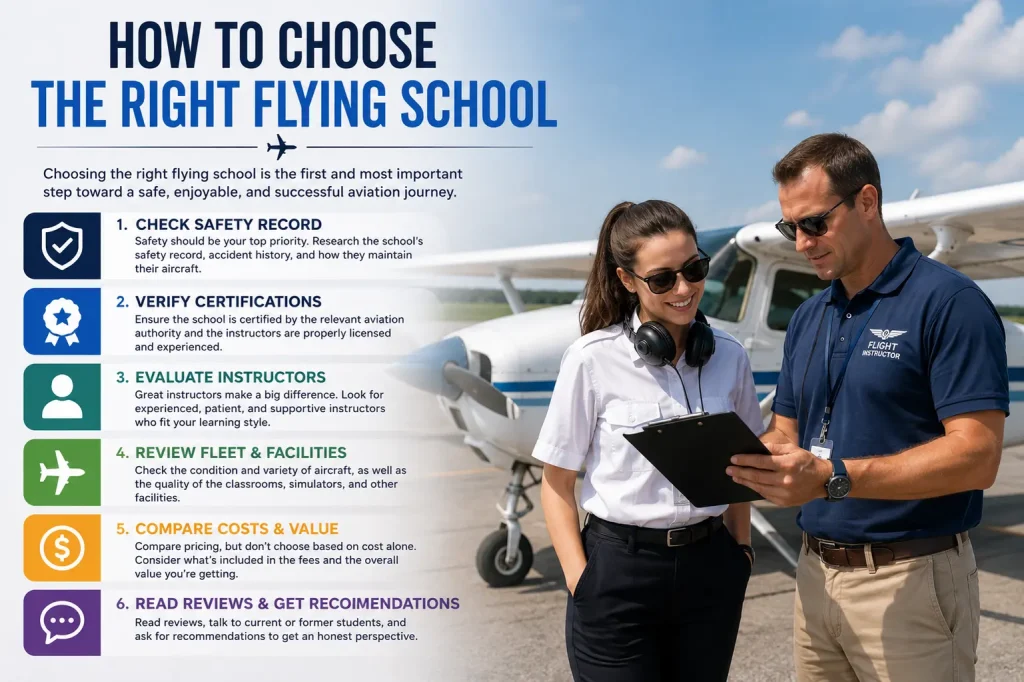
Your choice of flying school affects your cost, your timeline, and ultimately your employability. Use the DGCA’s 2026 FTO ranking system as your starting filter, then verify these factors directly with each shortlisted school.
- Current DGCA approval status and FTO ranking
- Fleet size, aircraft type, and aircraft-to-student ratio
- Average number of flying days per month at that location (weather matters more than most students expect)
- Instructor experience and instructor retention, not just instructor count
- Transparent, itemized fee structure with no vague add-on charges
- Placement record and tie-ups with airline cadet programs
- Simulator access for instrument and emergency procedure training
Practical tip: Ask any shortlisted school for their FTO ranking certificate and their last twelve months’ average flying-hour completion rate per student. A school that cannot produce this data quickly is one to question further.
Pilot Salary in India in 2026
Pilot pay scales by experience, aircraft type, and employer. Here is what you can realistically expect at each career stage.
| Role | Approximate Monthly Salary |
| Fresh CPL holder / Trainee First Officer | ₹1.5 to ₹3 lakh |
| Experienced First Officer | ₹3 to ₹6 lakh |
| Airline Captain | ₹8 to ₹15 lakh |
| Charter or Corporate Pilot | ₹2 to ₹5 lakh |
| Flight Instructor | ₹80,000 to ₹2 lakh |
Senior captains on international long-haul routes can earn significantly more than the figures above, and several airlines have introduced additional layover, night-flying, and retention allowances in 2026 to attract experienced pilots amid the hiring environment described in the next section.
Why 2026 Is a Strong Time to Start
India’s aviation sector is expanding faster than its pilot supply. Industry estimates put India’s pilot requirement at around 7,000 new pilots between 2024 and 2026 alone, with longer-term projections of 35,000 to 40,000 new pilots needed over the next decade as airlines take delivery of more than a thousand new aircraft on order. IndiGo and Air India together are projected to need over 16,000 pilots in the coming years to support their expansion plans.
This shortage has already pushed airlines to widen recruitment and improve pay and retention packages for both new and experienced pilots. For a student starting training today, this means the job market you will graduate into in 2027 to 2028 is likely to remain a hiring market rather than a saturated one, though this can shift as more students complete training and supply catches up.
Common Mistakes Aspiring Pilots Should Avoid
- Choosing a school on price alone: the cheapest quote often hides costs in simulator fees, exam re-attempts, or aircraft downtime later. Compare total cost-to-CPL, not just the headline figure.
- Skipping the Class 2 medical until later: get medically cleared before paying significant training fees. A late medical disqualification after lakhs are spent is one of the most painful and avoidable mistakes in this field.
- Underestimating weather delays: monsoon and fog seasons can stall flying hours for weeks. Build this into your timeline expectations rather than assuming continuous progress.
- Forgetting to budget for Type Rating: many students treat the CPL as the finish line and are caught off guard when an airline interview requires a Type Rating they have not saved for.
- Delaying the NIOS bridge course: non-science students who wait to see if the DGCA reform gets notified often lose six months or more that could have been used clearing Physics and Mathematics.
- Ignoring English Language Proficiency early: ELP Level 4 is mandatory for license issuance. Start improving aviation English communication during ground school, not after.
Skills Every Pilot Needs Beyond Academics
Strong marks in Physics and Mathematics get you into training. They do not, by themselves, make you a safe pilot. Airlines and examiners also look for:
- Situational awareness: processing multiple streams of information (instruments, radio calls, weather) at once
- Clear communication: staying calm and precise while talking to Air Traffic Control, especially under pressure
- Decisiveness: making a call quickly in an emergency and committing to it
- Discipline: following checklists and standard procedures exactly, every single time, with no shortcuts
- Crew Resource Management: working effectively with a co-pilot and cabin crew as a coordinated team
Documents You Will Need
Keep these ready before you start applying, since most delays at the registration stage come from missing paperwork rather than missing eligibility.
| Document | Purpose |
| Birth certificate or valid ID proof | Confirms age and identity |
| 10th and 12th mark sheets (or NIOS certificate) | Verifies educational eligibility and subjects |
| Class 1 and Class 2 medical certificates | Confirms medical fitness to fly |
| Flight training logbook | Records flying hours, solo and dual instruction |
| Passport-size photographs | Used for DGCA and FTO records |
| DGCA exam scorecards | Proof of clearing theory examinations |
| Valid passport | Required for international operations and some FTOs |
| Residential proof | Verifies address for DGCA records |
Is Becoming a Pilot After 12th Worth It?
The honest answer depends on your financial position and risk tolerance, not just your passion for flying. On the cost side, you are looking at ₹40 to ₹85 lakh and 18 to 30 months before your first paycheck. On the return side, a fresh First Officer already earns ₹1.5 to ₹3 lakh a month, rising to ₹8 lakh or more as a Captain, and India’s current pilot shortage means demand for trained CPL holders is unusually strong through the late 2020s.
Most full-time airline pilots recover their training investment within three to five years of steady flying, though this is not guaranteed and depends on how quickly you secure airline placement after your CPL. Treat the cost as a long-term investment decision, talk to currently flying pilots if you can, and avoid financing the entire course through debt without a realistic backup plan.
Frequently Asked Questions
Can I become a pilot after 12th without Physics and Maths?
Yes. Clear Physics and Mathematics through NIOS at the Senior Secondary level. This remains the accepted route until the DGCA’s proposed science-requirement removal is formally notified.
Is NEET or JEE required to become a pilot?
No. Neither NEET nor JEE is required. You need 12th with Physics and Mathematics (or the NIOS equivalent), a DGCA medical clearance, and completed flight training.
How long does it take to become a pilot after 12th?
Most students complete the journey to a CPL in 18 to 24 months, though weather and scheduling can extend this to around 30 months.
How much does pilot training cost in India?
A CPL trained entirely in India typically costs ₹40 to ₹60 lakh. Adding a Type Rating brings the job-ready total to roughly ₹55 to ₹85 lakh.
Can girls become pilots in India?
Yes. The eligibility criteria are identical for men and women, and India has one of the highest shares of female commercial pilots in the world.
What is the minimum age to start pilot training?
You can start training for a Student Pilot License at 16. A CPL cannot be issued before age 18.
Is pilot training abroad cheaper than in India?
The training itself can cost slightly less abroad, but DGCA license conversion fees of ₹6 to ₹8 lakh, plus living and visa costs, often close the gap with training fully in India.
Can I become a pilot if I wear glasses?
Usually yes. DGCA medical standards generally accept corrected vision of 6/6 with glasses or contact lenses, provided your eyes are otherwise healthy. Confirm specifics with a DGCA-approved medical examiner.
Conclusion
Becoming a pilot after 12th in India is a structured, achievable goal, not a mysterious one, once you understand the sequence: eligibility, medical clearance, ground school, flight hours, exams, and license issuance. The 2026 changes around non-science eligibility, stricter per-subject exam scoring, and the new FTO ranking system make this one of the more transparent years to start, provided you plan your school choice and budget with real numbers rather than marketing promises.
Your first concrete step costs nothing to plan: book your DGCA Class 2 medical and register for your DGCA Computer Number on the Pariksha portal. Both can be done before you choose a single flying school, and both move your timeline forward immediately.
You May Also Like It:
How to Stop Diarrhea in Babies Fast