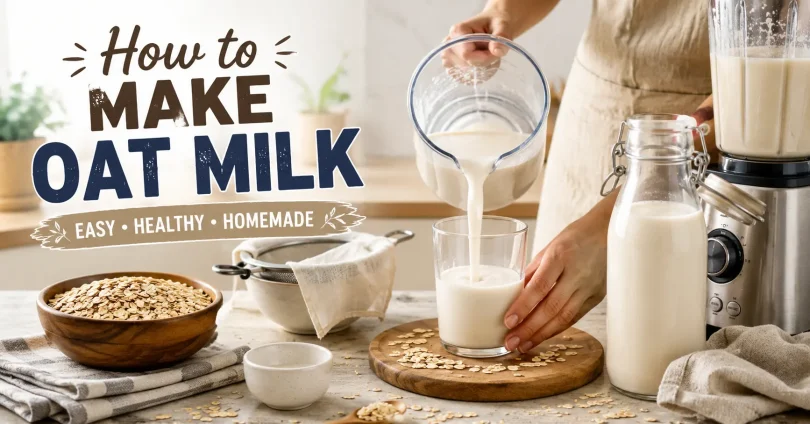
How to Make Oat Milk has become one of the most popular plant-based milks on the market, and for good reason. It is creamy, naturally sweet, budget-friendly, and remarkably easy to make at home. Whether you are new to dairy-free living or just looking to cut back on processed store-bought options, this complete guide covers everything you need to know about making oat milk from scratch.
Unlike other non-dairy milks, oat milk requires no soaking, no expensive nuts, and no complicated equipment. In under 10 minutes, you can produce a fresh, smooth, and delicious batch using ingredients you likely already have at home.
| Quick Recipe Overview | Details |
|---|---|
| Prep Time | 5–10 minutes |
| Cook Time | 0 minutes |
| Total Time | 10 minutes |
| Yield | Approximately 3 to 4 cups |
| Shelf Life | 4 to 5 days refrigerated |
| Equipment | Blender, fine-mesh strainer or nut milk bag |
What Is Oat Milk and Why Make It at Home?
Oat milk is a plant-based beverage made by blending oats with water and straining out the solids. The result is a naturally creamy liquid with a mild, slightly sweet flavor that works well in coffee, cereal, smoothies, and baking.
Store-bought oat milk, including popular brands like Oatly, often contains added oils, emulsifiers, thickeners, and preservatives. Making oat milk at home gives you full control over the ingredients, the sweetness level, and the thickness. It is also significantly cheaper. A small carton of commercial oat milk costs between $4 and $6, while you can make the same amount at home for under $0.50.
Ingredients You Need to Make Oat Milk
You only need two core ingredients. Everything else is optional but adds flavor and character to your finished milk.
Core Ingredients
- 1 cup (90g) old-fashioned rolled oats
- 3 to 4 cups cold filtered water
Optional Flavor Add-ins
- 1 to 2 tablespoons maple syrup or agave (for sweetness)
- 1/2 teaspoon vanilla extract (for warmth)
- 1/8 teaspoon sea salt (enhances overall flavor)
- 1 to 2 tablespoons unsweetened cocoa powder (for chocolate oat milk)
- 1/2 teaspoon cinnamon or a pinch of cardamom (for a spiced version)
- 1 tablespoon cashew butter or sunflower seed butter (for added creaminess and fat)
Choosing the Right Type of Oats
The type of oat you use matters more than most articles tell you. Here is a breakdown:
| Oat Type | Result | Recommendation |
| Old-fashioned rolled oats | Creamy, smooth, ideal texture | Best choice |
| Quick oats | Slightly more starchy, can get slimy faster | Acceptable in a pinch |
| Steel-cut oats | Gritty, does not blend well | Not recommended |
| Instant oats | Over-processed, slimy texture | Not recommended |
| Oat flour | No straining needed, naturally smooth | Good for creamy barista style |
Equipment Required
- A high-speed blender (a Vitamix, Blendtec, or similar works best, but a regular blender works fine)
- A fine-mesh strainer, nut milk bag, or a double layer of cheesecloth
- A large bowl to strain into
- A glass jar, bottle, or airtight container for storage
You do not need a nut milk bag specifically, though it does give an exceptionally smooth result. A fine-mesh strainer is sufficient for most home kitchens.
How to Make Oat Milk: Step-by-Step Instructions
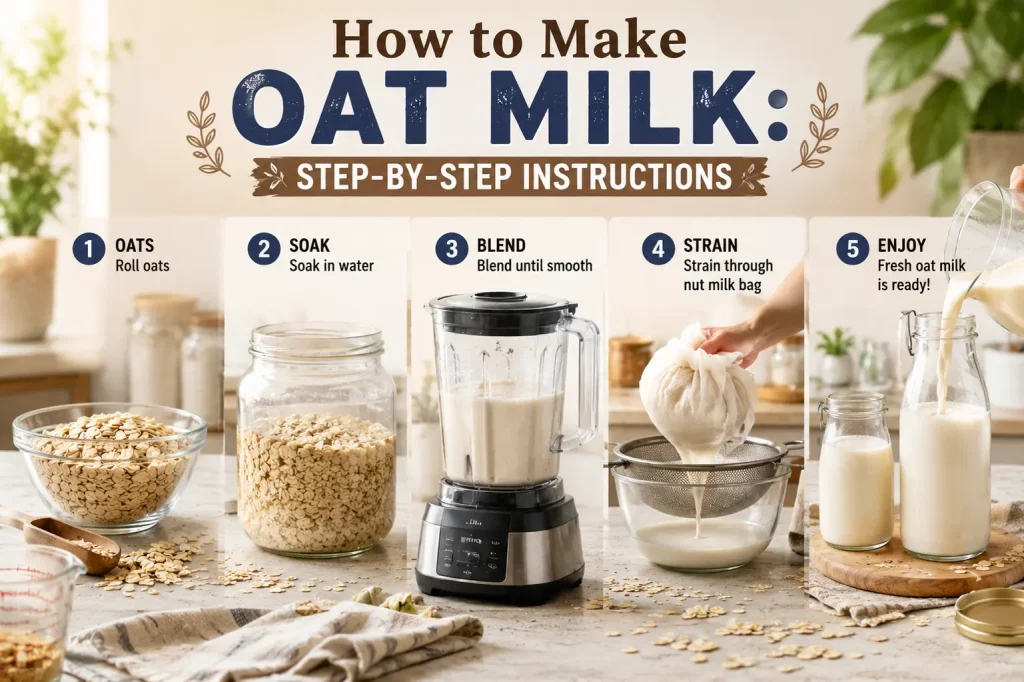
Follow these steps carefully. The key differences between a smooth, creamy result and a slimy, unpleasant one come down to just a few simple but critical choices.
- Step 1: Add the Oats. Add 1 cup of dry rolled oats to your blender. Do not pre-soak them. Soaking activates the starches prematurely and leads to a slimy texture.
- Step 2: Use Cold Water. Pour in 3 to 4 cups of cold water. Cold water is essential. Warm water activates the starch in the oats during blending, which causes a thick, gelatinous, slimy result. If your tap water is not cold enough, add two or three ice cubes. If using ice cubes, reduce your water slightly to compensate.
- Step 3: Blend Briefly. Blend for exactly 25 to 30 seconds. This is long enough to fully blend the oats into the water but short enough to avoid over-processing. Over-blending generates heat and breaks down starch further, causing sliminess. Do not blend for a full minute. More blending does not mean better milk here.
- Step 4: Strain Without Pressing. Place a fine-mesh strainer over a large bowl. Pour the blended mixture through it slowly. Do not press, squeeze, or push the pulp. Let gravity do all the work. Pressing the pulp forces starch-heavy particles through the strainer, ruining the texture. Discard the leftover pulp (or save it, as discussed later).
- Step 5: Strain a Second Time. Pour the strained milk back through the strainer a second time. This double-straining removes any remaining fine oat particles and gives you a much smoother, more refined milk.
- Step 6: Add Flavoring. Add your optional sweetener, vanilla, and salt at this stage. Stir gently or shake to combine. Taste and adjust.
- Step 7: Chill and Store. Transfer the finished oat milk to a sealed glass jar or bottle and refrigerate. It keeps well for 4 to 5 days. Allow at least 30 minutes to chill before drinking for the best flavor.
Why Does Homemade Oat Milk Turn Slimy? (And How to Prevent It)
This is the most common problem people face and one that most competitor articles only partially explain. Sliminess in oat milk comes from the gelatinization of beta-glucan, a soluble fiber found in oats. When oats are exposed to heat or blended for too long, the beta-glucan turns gluey, exactly as it does when you cook oatmeal.
Here are all the ways sliminess happens and how to avoid each one:
- Problem: Soaking oats beforehand. Do not soak the oats before blending. Soaking begins the starch-release process before you even start.
- Problem: Using warm or room-temperature water. Always use refrigerator-cold water or add ice cubes. Room-temperature or warm water speeds up starch gelatinization during blending.
- Problem: Over-blending. Keep blending to 25 to 30 seconds maximum. High-speed blenders also generate heat over time.
- Problem: Using quick or instant oats. Use old-fashioned rolled oats. Quick and instant oats are more processed and release starch faster.
- Problem: Pressing the pulp. Never press, push, or squeeze the pulp while straining. This forces starchy particles into the finished milk.
Oat Milk Variations and Flavor Ideas
One advantage of making oat milk at home that few articles explore in depth is just how customizable it is. Here are some tested variations:
Chocolate Oat Milk
Add 2 tablespoons of unsweetened cocoa powder and 2 tablespoons of maple syrup to the blender before blending. Strain as normal. The result is a rich chocolate milk that rivals any store-bought version.
Barista-Style Oat Milk
To get oat milk that froths well for lattes and cappuccinos, use oat flour instead of rolled oats. Blend 3 tablespoons of oat flour with 3 cups of cold water and a teaspoon of sunflower or coconut oil. No straining is needed. The oil content mimics the emulsifiers used in commercial barista oat milk and allows it to foam without separating in hot espresso.
Spiced Oat Milk
Blend in 1/2 teaspoon cinnamon, 1/4 teaspoon cardamom, and a pinch of nutmeg. This makes an excellent base for a homemade oat milk chai or warm spiced drink during colder months.
Unsweetened Plain Oat Milk
Leave out all sweeteners and flavorings for a completely neutral milk that works in savory sauces, mashed potatoes, or any dish where you want dairy-free creaminess without a sweet undertone.
Extra-Creamy Oat Milk
Add one tablespoon of raw cashew butter or soaked sunflower seeds before blending. This increases the fat content and creates a noticeably richer, creamier texture similar to whole dairy milk.
Nutritional Information
The nutritional content of homemade oat milk varies depending on how much water you use and whether you add sweeteners. The values below are approximate per 1-cup serving of unsweetened oat milk made with 1 cup oats and 4 cups water, before straining.
| Nutrient | Per 1-Cup Serving (approx.) |
| Calories | 60 to 80 kcal |
| Carbohydrates | 12 to 16g |
| Protein | 2 to 3g |
| Fat | 1 to 1.5g |
| Fiber | 1 to 2g |
| Calcium (natural) | Trace amounts |
| Beta-glucan | Present (cholesterol-lowering fiber) |
Note: Commercial oat milk is often fortified with calcium, vitamin D, and vitamin B12. Homemade oat milk does not contain these added nutrients unless you specifically add a fortified supplement powder. If oat milk is a primary dairy replacement in your diet, consult a dietitian about fortification.
Homemade Oat Milk vs. Store-Bought: A Real Comparison
| Factor | Homemade | Store-Bought |
| Cost per cup | $0.10 to $0.20 | $1.00 to $1.50 |
| Ingredients | 2 (oats and water) | 10 to 15 ingredients |
| Shelf life | 4 to 5 days (fridge) | 7 to 10 days (opened) |
| Additives | None | Often contains oils, gums, and emulsifiers |
| Froths for coffee? | Partially (barista version froths better) | Yes (barista varieties) |
| Fortified with vitamins? | No | Usually yes |
| Customizable? | Fully | No |
| Environmental impact | Lower | Higher (packaging, transport) |
How to Use Oat Milk
Oat milk is one of the most versatile plant-based milks available. Here is where it works best and where you need to be cautious:
Best Uses for Oat Milk
- Cold brew and iced coffee
- Cold cereal and muesli
- Smoothies and protein shakes
- Pancake batter and waffle recipes
- Baked goods such as muffins, banana bread, and cakes
- Overnight oats
- Oatmeal (to double down on that oat flavor)
- Poured cold over granola
Where to Be Cautious
Oat milk does not perform well in hot applications like lattes, hot chocolate, or cream sauces because the starch activates with heat and the milk thickens and becomes slimy. Commercial barista oat milk uses enzymes to break down these starches and prevent this. For hot drinks at home, use the barista variation described above (with oat flour and a small amount of oil), which handles heat considerably better.
Oat milk also has a noticeable oat flavor. This makes it less suitable for light savory dishes where a neutral dairy flavor is expected.
How to Store Homemade Oat Milk
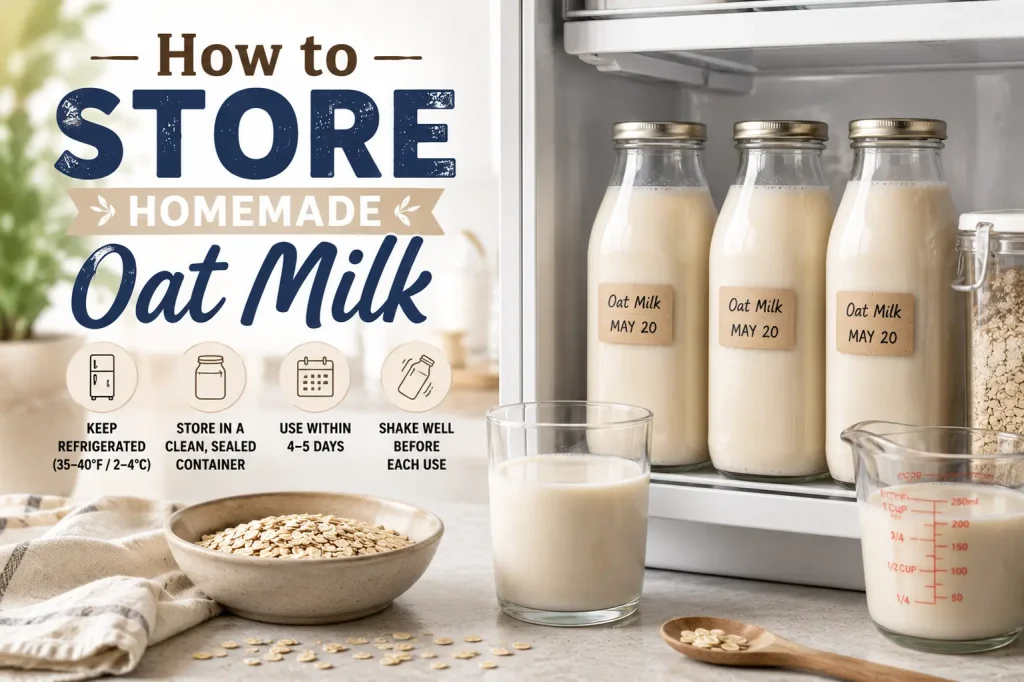
- Store in a sealed glass jar or airtight bottle in the refrigerator.
- Keeps for 4 to 5 days. Always smell before using if stored for more than 3 days.
- Shake or stir before each use. Separation is completely normal and does not mean the milk has gone bad.
- Do not freeze oat milk. Freezing changes the texture and causes permanent separation when thawed.
- Do not store at room temperature. Oat milk has no preservatives and spoils quickly outside the fridge.
What to Do with the Leftover Oat Pulp
Most recipes discard the oat pulp without a second thought. Here are practical ways to use it and reduce waste:
- Mix into overnight oats or regular porridge for added fiber
- Stir into cookie or muffin batter as a partial flour substitute
- Add to smoothies for extra thickness and nutrition
- Mix into pancake batter
- Dehydrate in a low oven (300F / 150C) for 20 to 30 minutes and use in granola or energy balls
- Blend into a face mask (oats are a well-known skin soother)
Is Oat Milk Gluten-Free?
Oats are naturally gluten-free, but they are frequently processed in facilities that also handle wheat, barley, and rye, which leads to cross-contamination. If you have celiac disease or a gluten sensitivity, you must use oats that are certified gluten-free. Look for this certification clearly printed on the packaging. If you are sensitive to avenin (the protein in oats itself), oat milk is not suitable for you regardless of certification.
Pro Tips for the Best Homemade Oat Milk
- Use filtered water for the cleanest, freshest flavor
- Always start with cold water. If your blender runs warm, add 2 or 3 ice cubes
- Strain twice for the smoothest texture without any grit
- Never over-blend. Set a timer and stop at 30 seconds
- Taste the milk after straining and before refrigerating. This is when add-ins blend most easily
- Glass storage containers preserve flavor better than plastic
- If your milk is too thick after straining, simply stir in a small amount of cold water until it reaches your desired consistency
- For a stronger oat flavor, use more oats. For a lighter milk, use less
Troubleshooting Common Problems
| Problem | Likely Cause | Solution |
| Slimy texture | Over-blended, warm water, or squeezed pulp | Use cold water, blend 25-30 sec, never press pulp |
| Too watery | Too much water | Reduce to 3 cups water per cup of oats |
| Too thick | Too little water | Add water gradually after straining |
| Gritty texture | Not strained enough | Strain twice through fine mesh |
| Separates quickly | Normal, no emulsifiers | Shake before each use |
| Tastes bland | No seasoning added | Add salt, vanilla, and a sweetener |
Environmental and Sustainability Benefits
Oat milk has a significantly lower environmental footprint compared to dairy milk and many other plant-based alternatives. Oats require far less water to grow than almonds, which need approximately 1.1 gallons of water per individual almond. A single glass of dairy milk uses roughly 125 liters of water to produce, while oat milk uses around 48 liters for the same volume.
Making oat milk at home eliminates packaging waste entirely. Store-bought cartons, even if they are recyclable, still require energy and resources to produce and transport. Buying a bag of rolled oats once a week and making your milk fresh is a genuinely more sustainable practice.
Cost Breakdown: How Much Does Homemade Oat Milk Actually Cost?
Here is a simple breakdown based on average US grocery prices:
- 1 pound (453g) bag of rolled oats costs approximately $2.50 to $3.50
- One cup of oats weighs roughly 90g, meaning one bag yields approximately 5 batches
- Each batch costs approximately $0.50 to $0.70 in oats (plus tap water, which is negligible)
- Each batch yields 3 to 4 cups of finished oat milk
- Cost per cup of homemade oat milk: approximately $0.13 to $0.20
- Cost per cup of store-bought oat milk: approximately $1.00 to $1.50
You save approximately 80 to 90 percent compared to store-bought, with a fresher product and zero additives.
Frequently Asked Questions
How long does homemade oat milk last?
It lasts 4 to 5 days when stored in a sealed container in the refrigerator. Always smell it before using after day 3.
Why does my oat milk separate?
Separation is normal. Homemade oat milk has no emulsifiers. Simply shake or stir before use.
Can I use oat milk in coffee?
Yes, for cold or iced coffee it works very well. In hot espresso drinks, it may separate or thicken. Use the barista-style version (with oat flour and a small amount of oil) for better frothing and heat stability.
Can I freeze oat milk?
No. Freezing permanently damages the texture. It will separate when thawed and become grainy.
Do I need a nut milk bag?
No. A fine-mesh strainer works well. A nut milk bag gives a slightly finer result but is not essential.
Is oat milk safe for babies or toddlers?
Oat milk is not nutritionally suitable as a primary milk replacement for infants under 12 months. Toddlers over 12 months can have it as part of a varied diet, but consult your pediatrician before replacing dairy or formula.
Can I make oat milk without a blender?
Yes. You can soak oats in cold water for 30 minutes, then shake vigorously in a sealed jar and strain. The result is thinner and less creamy but still works as a lighter milk.
Final Thoughts
Making oat milk at home is one of the simplest, most cost-effective switches you can make in your kitchen. With just two ingredients, 10 minutes, and a basic blender, you get a fresh, additive-free milk that outperforms many store-bought options on flavor and value.
The key is always in the technique: cold water, short blending time, no pressing during straining, and double straining for a silky finish. Once you nail the basic method, the variations are endless. From chocolate to barista-style to spiced, you have full creative control over what goes into your glass.
Try making your first batch this week. You may never go back to the carton.
You May Also Like It: