
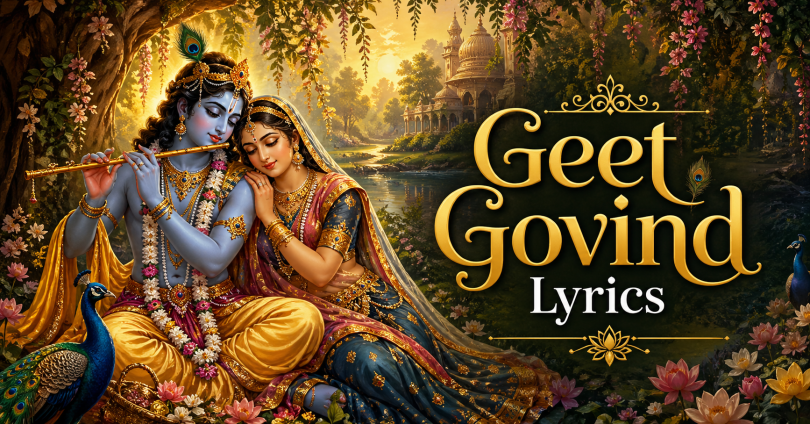
If you are searching for Geet Govind lyrics, you are stepping into a world that goes far beyond words. This composition is over eight hundred years old, yet it feels as alive today as it did in the 12th century. Let’s understand everything about it — the lyrics, their meaning, the structure, and why this text is so extraordinary.
What Is Geet Govind?
Geet Govind is a Sanskrit poetic text written by the poet Jayadeva in the 12th century. Jayadeva was from Bengal, and he had a rare gift — the ability to capture the love story of Radha and Krishna in words that touch the heart directly.
This text is not merely a love story. Hidden within it is the union of the individual soul (aatma) with the Supreme Soul (Paramatma). Radha’s love and longing are not just the story of a woman — they represent every devotee who yearns to be united with God.
Key Facts:
- Author: Jayadeva
- Language: Sanskrit
- Period: 12th century (approximately 1200 AD)
- Structure: 12 Sargas (chapters), 24 Prabandhas (songs), each song containing 8 verses (Ashtapadi)
- Theme: The divine love of Radha and Krishna
Geet Govind Lyrics – The First Ashtapadi (Most Famous)
This Ashtapadi is the most widely recited and sung portion of Geet Govind. It praises Lord Krishna in his form as Vishnu.
Sanskrit / Hindi Lyrics
- श्रितकमलाकुचमण्डल धृतकुण्डल ए।
- कलितललितवनमाल जय जय देव हरे॥
- दिनमणिमण्डलमण्डन भवखण्डन ए।
- मुनिजनमानसहंस जय जय देव हरे॥
- कालियविषधरगंजन जनरंजन ए।
- यदुकुलनलिनदिनेश जय जय देव हरे॥
- मधुमुरनरकविनाशन गरुडासन ए।
- सुरकुलकेलिनिदान जय जय देव हरे॥
- अमलकमलदललोचन भवमोचन ए।
- त्रिभुवनभवननिधान जय जय देव हरे॥
- जनकसुताकृतभूषण जितदूषण ए।
- समरशमितदशकण्ठ जय जय देव हरे॥
- अभिनवजलधरसुन्दर धृतमन्दर ए।
- श्रीमुखचन्द्रचकोर जय जय देव हरे॥
- तव चरणे प्रणता वयमिति भावय ए।
- कुरु कुशलं प्रणतेषु जय जय देव हरे॥
English Transliteration
- Shrita kamala kucha mandala dhrita kundala e Kalita lalita vanamala
- Jaya Jaya Deva Hare
- Dinamani mandala mandana bhava khandana e Munijana manasa hamsa
- Jaya Jaya Deva Hare
- Kaaliya vishadhara ganjana janaranjana e Yadukula nalina dinesha
- Jaya Jaya Deva Hare
- Madhu Mura Naraka vinashana Garuda asana e Surakula keli nidana
- Jaya Jaya Deva Hare
- Amala kamala dala lochana bhava mochana e Tribhuvana bhavana nidhana
- Jaya Jaya Deva Hare
- Janaka suta krita bhooshana jita dooshana e Samara shamita dashakantha
- Jaya Jaya Deva Hare
- Abhinava jaladhara sundara dhrita mandara e Shrimukha chandra chakora
- Jaya Jaya Deva Hare
- Tava charane pranata vayamiti bhaavaya e Kuru kushalam pranateshu
- Jaya Jaya Deva Hare
Meaning of Each Verse – Simple and Clear
This Ashtapadi is not just praise — each verse refers to a specific quality or divine act of Krishna. Let’s go through them one by one:
- Verse 1: “Shrita kamala kucha mandala…”
Meaning: He who rests on the chest of Lakshmi, who wears beautiful earrings and adorns himself with a lovely forest garland — we bow to him again and again. Victory to Lord Hari. - Verse 2: “Dinamani mandala mandana…”
Meaning: He who ornaments even the circle of the sun, who severs the bonds of worldly existence, and who dwells in the minds of sages like a swan on a clear lake — Jaya Jaya Deva Hare. - Verse 3: “Kaaliya vishadhara ganjana…”
Meaning: He who subdued the poisonous serpent Kaaliya and brought joy to the people, who is like the sun to the lotus of the Yadu clan — we offer our salutations. - Verse 4: “Madhu Mura Naraka vinashana…”
Meaning: The destroyer of demons Madhu, Mura, and Narakasura, who rides upon Garuda, and who is the source of delight for the gods — Victory to Lord Hari. - Verse 5: “Amala kamala dala lochana…”
Meaning: He whose eyes are like pure, spotless lotus petals, who liberates souls from the cycle of birth and death, and upon whom all three worlds depend — Jaya Jaya Deva Hare. - Verse 6: “Janaka suta krita bhooshana…”
Meaning: He who is naturally adorned by Janaki (Sita) — here referring to the Rama avatar — who is faultless and who destroyed the ten-headed Ravana in battle — Victory to Lord Hari. - Verse 7: “Abhinava jaladhara sundara…”
Meaning: He who is as beautiful as a fresh dark rain cloud, who lifted the Mandara mountain, and whose radiant face is like the moon that the chakora bird eternally gazes upon — Jaya Jaya Deva Hare. - Verse 8: “Tava charane pranata vayamiti…”
Meaning: “We bow at your feet” — knowing this with full sincerity, bless those who have surrendered to you. Jaya Jaya Deva Hare.
The Complete Structure of Geet Govind
This is something most articles skip or explain poorly — so here it is, clearly laid out.
Geet Govind is divided into 12 Sargas (chapters). Each Sarga represents a different mood or emotional stage:
| Sarga | Title | Theme |
|---|---|---|
| 1 | Saamoda Damodara | The joyful Krishna |
| 2 | Aklesha Keshava | Effortless grace |
| 3 | Mugdha Madhusudana | The first pangs of separation |
| 4 | Snigdha Madhusudana | Tender, gentle love |
| 5 | Sakanksho Pundarikaksha | Deep longing and yearning |
| 6 | Dhrishtavikrama | Bold, daring love |
| 7 | Nagara Narayana | The playful, restless lord |
| 8 | Vilaksha Lakshmipati | Embarrassment and remorse |
| 9 | Mugdha Mukundabhisheka | Radha’s call to her beloved |
| 10 | Catura Chaturjya | The sakhi as messenger |
| 11 | Sananda Damodara | Preparing for reunion |
| 12 | Suprita Pitambara | The final union — love fulfilled |
Each Sarga contains two or three Ashtapadis, meaning songs of eight verses each. Every song maps to an emotional state: love, separation, longing, or union.
Understanding Geet Govind on Three Levels
This is what makes Geet Govind unlike any other text. It can be read on three different levels simultaneously:
- The Literal Level
A love narrative between Radha and Krishna. A heroine waiting, her friend acting as go-between, and ultimately the reunion. A beautiful, deeply felt love story. - The Symbolic Level
Radha represents the individual soul. Krishna is the Supreme. Their separation is the soul’s estrangement from its source. Their reunion is liberation — moksha. - The Spiritual Level
Geet Govind is a complete philosophy of Bhakti Yoga — devotion through love, not fear. It does not ask you to be obedient out of duty. It asks you to love, and in that love, find God.
This layered depth is exactly why scholars, dancers, musicians, and devotees have all found something uniquely their own in this single text for over eight centuries.
Why Read Geet Govind? Real Benefits
People bring Geet Govind into their lives for many different reasons:
- Mental peace: The rhythmic quality of the Ashtapadis has a calming effect on the mind
- Aid in meditation: The lyrics give the mind a beautiful, meaningful object to rest upon
- Emotional balance: The text explores love, longing, and reunion — feeling these emotions fully, in a sacred context, has a healing quality
- Foundation for devotion: For those on the path of Bhakti, this is a complete spiritual practice in itself
- Aesthetic experience: For a lover of literature, this is arguably the most musically beautiful poetry ever written in Sanskrit
How to Begin Reading Geet Govind
If you are starting from scratch, there is no need to feel overwhelmed. Here is a practical approach:
- Week one: Read only the transliteration — one Ashtapadi per day. Try to grasp the general meaning without worrying about every word.
- Week two: Read the Hindi lyrics alongside the English meaning, verse by verse. Notice which divine act or avatar each verse is referring to.
- Week three: Listen to an audio recording while following the text. Hearing it sung by a trained vocalist changes the experience entirely.
- After that: Gradually attempt reading the Sanskrit directly. It will feel difficult at first, but as comprehension grows, a completely different kind of joy opens up.
Consistency matters far more than perfection here. One Ashtapadi read with genuine attention is worth more than a full chapter read mechanically.
Pronunciation Guide – Say It Right
Many people mispronounce these verses when reading them for the first time. Here are the most common corrections:
| Word | Correct Pronunciation |
|---|---|
| Shrita | Shree-tuh (not “shri-taa”) |
| Kucha | Koo-chuh |
| Mandala | Mun-duh-luh |
| Deva Hare | Day-vuh Huh-ray |
| Kaaliya | Kaa-li-yuh |
| Narayana | Nuh-raa-yuh-nuh |
| Ashtapadi | Ush-tuh-puh-dee |
Correct pronunciation matters — not just for linguistic accuracy, but because the sound itself carries a quality that the meaning alone cannot convey.
Geet Govind Compared to Other Bhakti Texts
People often ask what sets Geet Govind apart from the Bhagavad Gita or the Ramayana. Here is a simple comparison:
| Text | Primary Focus | Emotional Tone |
|---|---|---|
| Bhagavad Gita | Knowledge and Karma Yoga | Rational, composed |
| Ramayana | Duty and Dharma | Dignified, solemn |
| Geet Govind | Divine Love | Tender, passionate, devotional |
In Geet Govind, the relationship with God is that of a lover — this is the highest expression of Madhura Bhakti, the devotion of sweetness.
Geet Govind in the Arts
This text was never meant to only be read. It lives across multiple art forms:
- Odissi Dance: The entire classical repertoire of Odissi dance is deeply rooted in Geet Govind. Historically, at the Jagannath Temple in Puri, the Ashtapadis were performed as part of daily worship — they were considered essential to the darshan experience.
- Bharatanatyam: Several compositions in the Bharatanatyam tradition are drawn directly from Geet Govind’s verses.
- Classical Music: Both Carnatic and Hindustani traditions have incorporated Geet Govind Ashtapadis into their performance repertoire.
- Temple Tradition: To this day, Geet Govind is recited as part of ritual worship at the Jagannath Temple in Puri — one of the most important pilgrimage sites in India.
Why Does “Jaya Jaya Deva Hare” Repeat?
Every verse ends with this refrain. Literally it means: “Victory, victory to you, O Lord, O Hari!“
But it is not merely a poetic device. The repetition functions like a mantra — it anchors the mind to a single feeling: complete surrender. Jayadeva designed it so that anyone reading, singing, or simply listening would be brought back, again and again, to the same recognition: everything rests at the feet of the One.
When you hear it for the twentieth time in a single sitting, it stops being a phrase and becomes a feeling.
Frequently Asked Questions
Is Geet Govind only about Krishna?
Primarily yes, but some Ashtapadis reference the Rama avatar of Vishnu as well. The text presents Krishna as Vishnu in his complete, all-encompassing form.
Can Geet Govind be read at home without a priest or teacher?
Absolutely. If you are starting out, begin with the transliteration and simple meaning. A teacher enriches the experience but is not required to begin
Is it possible to memorize Geet Govind?
Many devotees do memorize it — and those who do report a profound, lasting shift in their inner state. Begin with a single Ashtapadi and let it settle before moving further.
What are the best recordings to listen to?
Pandit Jasraj’s renditions, compositions by Lata Mangeshkar drawn from Jayadeva’s works, and recordings by Padmashri Harihar Rao in the Odissi tradition are widely regarded as exceptional starting points.
A Final Word
Whether you came to Geet Govind lyrics as a student, a devotee, a dancer, a musician, or simply someone curious about Sanskrit literature — this text has something genuine to offer you.
Once you stop reading it as a document and begin experiencing it as something living, you will understand why eight centuries have not dimmed it in the slightest.
Start with one Ashtapadi. Understand its meaning. Then sing it. See what happens.
You May Also Like It: