Modern audiences are overwhelmed by advertising, with consumers scrolling past thousands of slogans, captions, headlines, emails, and promotions every single day — most of which are forgotten within seconds. The brands that remain memorable are rarely the loudest; instead, they are the ones that make people feel something emotionally. This is where Branded Poetry becomes powerful. Branded Poetry is the strategic use of poetic language, rhythm, imagery, emotion, symbolism, and narrative compression to create deeper emotional connections between brands and audiences. It is not simply about writing poems for advertisements, but about transforming communication into an experience. From Nike’s emotionally driven storytelling to Apple’s minimalist yet meaningful messaging, many of the world’s strongest brands already use poetic principles, even if they never describe it as “poetry.” As AI-generated content continues flooding the internet, emotionally distinctive language is becoming one of the few remaining competitive advantages. Brands that sound human will always outperform brands that sound automated — because poetry, at its core, is fundamentally human.
What Is Branded Poetry?
Branded Poetry is the use of poetic techniques in branding, marketing, and communication to create emotionally resonant experiences.
These techniques include:
- metaphor
- rhythm
- cadence
- symbolism
- imagery
- repetition
- emotional compression
- lyrical storytelling
- sensory language
- narrative flow
Unlike traditional copywriting, which often focuses only on conversion, poetic branding focuses on emotional memory.
Good advertising may persuade.
Poetic branding stays with people.
Why Branded Poetry Works
Human Brains Remember Emotion More Than Information
People rarely remember exact marketing claims.
They remember:
- feelings
- images
- atmosphere
- tone
- emotional tension
Poetic language activates imagination.
It forces the brain to participate.
This creates stronger memory encoding.
A poetic phrase often becomes more memorable because the audience completes part of the meaning themselves.
Poetry Creates Cognitive Compression
Poetry says more with fewer words.
A single metaphor can communicate:
- identity
- aspiration
- emotion
- philosophy
- brand values
in seconds.
This makes poetic messaging highly efficient in:
- advertising
- social media
- packaging
- brand slogans
- video campaigns
Rhythm Improves Recall
Humans naturally respond to rhythm.
Rhythmic language improves:
- memorability
- emotional impact
- verbal fluency
- speech retention
This is why many iconic taglines feel musical.
Examples:
- “Just Do It.”
- “Think Different.”
- “Because You’re Worth It.”
They are concise, rhythmic, emotionally suggestive, and psychologically sticky.
Poetry Creates Brand Distinction
Most modern brand copy sounds identical.
Corporate language is often:
- generic
- over-optimized
- predictable
- emotionally flat
Poetic branding introduces personality.
It gives brands:
- texture
- emotional depth
- humanity
- originality
In crowded markets, distinct language becomes a competitive advantage.
The Psychology Behind Poetic Branding
Emotional Processing
Research in cognitive psychology shows that emotionally charged language activates stronger neurological responses than purely informational language.
Poetic writing encourages:
- visualization
- emotional simulation
- sensory imagination
This increases audience engagement.
Metaphorical Thinking
Humans understand complex ideas through metaphor.
Brands that use metaphor effectively become easier to understand emotionally.
Examples:
- Airbnb → belonging
- Nike → inner transformation
- Patagonia → environmental responsibility
- Apple → creativity and rebellion
These brands sell identities and emotions, not just products.
Narrative Transportation
When language creates immersive imagery, readers mentally “enter” the experience.
This psychological phenomenon is called narrative transportation.
Poetic branding strengthens immersion.
And immersed audiences are more likely to:
- trust brands
- remember messages
- share content
- develop loyalty
Branded Poetry vs Traditional Copywriting
| Traditional Copywriting | Branded Poetry |
|---|---|
| Focuses on conversion | Focuses on emotional resonance |
| Often direct and literal | Often symbolic and layered |
| Prioritizes clarity above all | Balances clarity with emotional depth |
| Short-term persuasion | Long-term brand memory |
| Transaction-focused | Identity-focused |
Real-World Examples of Branded Poetry
Nike
Nike rarely talks about shoes.
Instead, it speaks about:
- struggle
- courage
- ambition
- transformation
Its campaigns often feel cinematic and poetic.
The emotional story becomes larger than the product.
Apple
Apple’s language is minimalist but deeply emotional.
“Think Different” is not a technical statement.
It is an identity statement.
The phrase invites consumers into a philosophy.
That is poetic branding.
Oatly
Oatly uses conversational absurdity, wit, and unconventional rhythm to create distinctiveness.
Its packaging often reads like experimental micro-poetry.
This makes the brand highly recognizable.
Airbnb
Airbnb transformed travel marketing from “booking accommodation” into “belonging anywhere.”
This emotional reframing changed the category.
British Library Campaign
Writer Tom Sharp’s celebrated “Research” poster transformed an academic institution into an emotionally alive experience.
Through repetition and rhythm, ordinary acts became emotionally meaningful.
The campaign demonstrated how poetic structure can create warmth and memorability even within institutional communication.
Where Brands Can Use Poetry
Advertising Campaigns
Poetic campaigns often outperform purely informational ads because they create emotional immersion.
Best for:
- fashion
- luxury
- nonprofits
- lifestyle brands
- hospitality
- wellness
- purpose-driven brands
Packaging Design
Packaging is an emotional touchpoint.
A short poetic phrase can dramatically improve:
- unboxing experience
- emotional perception
- memorability
Social Media
Short-form poetic language performs well because it:
- feels human
- stands out visually
- encourages sharing
- creates emotional pause
Brand Manifestos
Manifestos are ideal spaces for poetic storytelling.
They communicate:
- mission
- worldview
- emotional identity
rather than product specifications.
Email Marketing
Emotionally intelligent email copy can increase:
- open rates
- click-through rates
- reader engagement
especially for lifestyle and relationship-driven brands.
Product Launches
Poetic language helps products feel culturally meaningful rather than commercially transactional.
Corporate Culture
Internal storytelling matters too.
Poetic communication can strengthen:
- team identity
- mission alignment
- company culture
- employee engagement
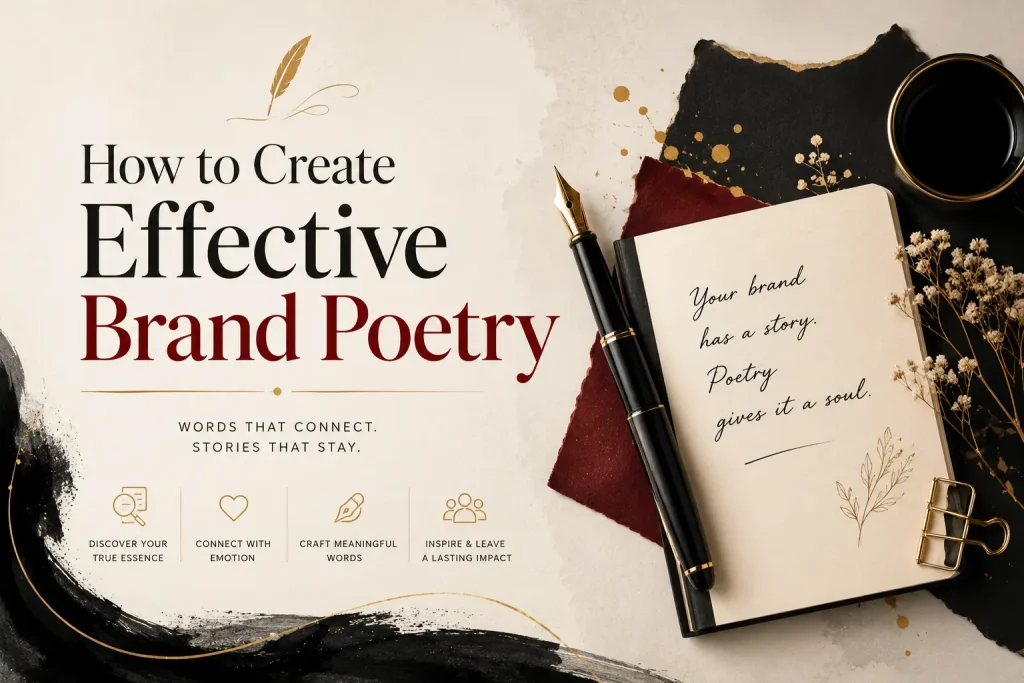
How to Create Effective Branded Poetry
Step 1 — Define Emotional Core
Ask:
What should people feel when they encounter the brand?
Examples:
- freedom
- safety
- rebellion
- nostalgia
- wonder
- confidence
- belonging
Emotion comes before wording.
Step 2 — Build a Sensory Vocabulary
Great poetic branding uses sensory language.
Instead of:
- “high-quality coffee”
Try:
- “dark roasted warmth that slows the morning down.”
Sensory detail creates immersion.
Step 3 — Use Rhythm Intentionally
Read brand language aloud.
Does it:
- flow naturally?
- create cadence?
- feel memorable?
- sound human?
Good Branded Poetry often sounds musical.
Step 4 — Use Metaphor Carefully
Strong metaphors create meaning.
Weak metaphors create confusion.
The best metaphors feel:
- emotionally intuitive
- culturally relevant
- simple but layered
Step 5 — Maintain Clarity
Poetic branding should not become pretentious.
The audience should feel intrigued — not confused.
Emotion without clarity becomes noise.
Common Mistakes in Poetic Branding
Trying Too Hard to Sound Deep
Forced poetic language feels artificial.
Authenticity matters more than complexity.
Sacrificing Clarity
Beautiful language still needs strategic communication.
Confusing messaging damages trust.
Ignoring Brand Identity
Poetry should align with the brand’s personality.
Not every company needs dramatic emotional language.
Overusing Abstract Language
Concrete imagery is usually stronger than vague inspiration.
Branded Poetry in the AI Era
AI is making content abundant.
But abundance reduces distinctiveness.
As automated writing becomes more common, audiences increasingly value:
- originality
- humanity
- emotional nuance
- authentic voice
This makes poetic branding more valuable than ever.
The future of branding may belong to companies that communicate with:
- emotional intelligence
- narrative depth
- linguistic personality
rather than endless generic optimization.
The Future of Marketing Is Emotional
Consumers no longer connect with brands purely because of features.
They connect because brands:
- express identity
- reflect values
- create emotional meaning
- tell compelling stories
Poetry is one of humanity’s oldest emotional technologies.
And in a world increasingly dominated by algorithms, its power may become even more important.
Branded Poetry is not about decoration.
It is about emotional architecture.
It transforms communication from information into experience.
And the brands that master emotional experience are the brands people remember.
Frequently Asked Questions
What is Branded Poetry?
Branded Poetry is the use of poetic language, imagery, rhythm, and emotional storytelling in branding and marketing communication.
Why is poetry effective in marketing?
Poetry improves emotional engagement, memorability, narrative immersion, and brand distinctiveness.
Is Branded Poetry only for luxury brands?
No. Any brand can use poetic techniques if they align with audience expectations and brand personality.
Can poetic branding improve customer loyalty?
Yes. Emotional branding strengthens memory, trust, and long-term emotional connection.
What industries benefit most from poetic branding?
Industries with emotional purchasing behavior often benefit the most, including:
fashion
hospitality
wellness
nonprofits
food and beverage
luxury
lifestyle brands
Suggested Internal Linking Opportunities
- Emotional Branding Strategies
- Brand Storytelling Guide
- How to Create a Brand Voice
- Copywriting vs Content Writing
- Neuromarketing Techniques
- Consumer Psychology in Marketing
Recommended Schema Markup
Use:
- Article Schema
- FAQ Schema
- Breadcrumb Schema
- Author Schema
Final SEO Advantages of This Article
This article improves upon competitors by:
- covering deeper search intent
- including psychology and neuroscience
- providing actionable frameworks
- improving semantic SEO coverage
- increasing topical authority
- using better structure
- improving readability
- addressing modern AI-era branding
- integrating real-world examples
- including FAQs and SEO optimization
- balancing creativity with business value
This creates significantly stronger ranking potential compared to the competing articles.