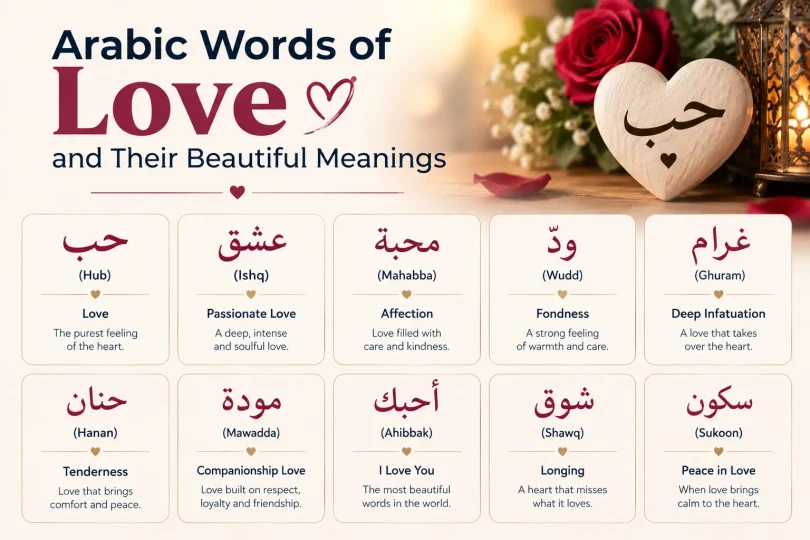
Arabic is a language known for expressive vocabulary, poetic phrases, and words that can communicate affection in only a few syllables. From a simple greeting between friends to a tender phrase shared by family members, Arabic expressions of love often carry meaning beyond a direct English translation. Learning these words can help language learners understand conversations, music, messages, and the cultural context behind familiar expressions.
The key is to look at more than the dictionary definition. Relationship, tone, dialect, and situation all influence how a phrase is understood. A word that sounds romantic in one conversation may be used warmly among relatives or friends in another. By learning a few common expressions and seeing how they work in context, you can build a more accurate understanding of Arabic affection vocabulary.
Why Arabic Expressions of Affection Can Feel So Meaningful
Many Arabic words have roots that connect related meanings. A word associated with love, a heart, a soul, or life can become a personal expression when a possessive ending is added. This structure helps explain why a short word may feel intimate: it does not simply name an emotion; it connects that emotion to a person.
Still, a literal translation cannot always capture the full tone. English speakers might use “dear,” “sweetheart,” “my love,” or “darling” in different situations. Arabic expressions also vary by region and relationship. It is useful to learn both the literal meaning and the way a phrase is commonly used.
1. Habibi: My Love or My Dear
Habibi (حبيبي) is one of the best-known Arabic terms of endearment. It is commonly translated as “my love,” “my beloved,” or “my dear.” In many contexts, it is used when addressing a male, while habibti (حبيبتي) is commonly used when addressing a female.
The word is not automatically romantic. A couple may use it affectionately, but friends and family members can use it too. In some communities, it may also be heard in friendly everyday conversation. The relationship and tone help determine what the speaker means.
For learners, the safest approach is to notice how native speakers use the word rather than assuming every use signals romantic interest. If you want to explore this expression and related vocabulary in more detail, the Habibi Meaning website offers explanations of Arabic words, translations, and everyday usage.
2. Qalbi: My Heart
Qalbi (قلبي) means “my heart.” It is connected to qalb (قلب), the Arabic word for “heart,” with the ending “-i” expressing possession. As a term of affection, qalbi can communicate tenderness, closeness, or emotional importance. Depending on the speaker and situation, it may be used with a romantic partner, a family member, or someone held dear.
You may see the word transliterated as qalbi or albi. Pronunciation and spelling in Latin letters can vary because Arabic sounds do not always map neatly to English letters, and dialects may affect how a word is pronounced. The Arabic spelling قلبي is a useful reference point when learning the term.
The phrase is also a reminder that translation depends on context. “My heart” is the literal meaning, but a natural English translation in conversation might be “dear,” “sweetheart,” or “my love.” For a focused explanation of spelling, meaning, and usage, read this guide to Qalbi meaning in Arabic.
3. Hayati: My Life
Hayati (حياتي) is commonly translated as “my life.” It comes from hayat (حياة), meaning “life,” combined with a possessive ending. It is often used as an affectionate expression for someone who is deeply valued. A romantic partner may use it, but it can also be heard in affectionate family interactions.
As with other terms of endearment, the word should not be interpreted in isolation. Tone, relationship, and local speaking habits matter. A message containing hayati may be romantic, caring, or simply warmly familiar, depending on who sent it and how they usually communicate.
Hayati is particularly common in songs, films, social media, and personal messages, so many learners encounter it before they study Arabic grammar. If you want to understand the word more fully, including its pronunciation and how it differs from other affectionate expressions, see this guide to Hayati meaning in Arabic.
4. Rouhi: My Soul
Rouhi (روحي) is often translated as “my soul.” It is an intimate and poetic expression that can suggest a strong emotional bond. Like other Arabic endearments, its exact tone depends on context. In a romantic message, it may sound deeply affectionate; in a family setting, it can express warmth and closeness.
Learners should avoid treating a list of endearments as a strict ranking of love. Some people may consider one word more intense than another, but usage differs between families, regions, and individuals. The best way to understand a phrase is to observe how it is used in real conversations.
5. Ya Omri: My Dear or My Life
Ya omri (يا عمري) is an affectionate expression that can be translated naturally as “my dear,” “my love,” or “my life,” depending on context. The particle ya is used when directly addressing someone, while omri is related to the idea of a lifetime or life span. Together, the phrase becomes a warm way to address a person who matters.
As with many expressions, the literal translation can sound unusual in English. That does not make it incorrect; it simply shows that languages express emotion in different ways. When learning a phrase like ya omri, it helps to remember its everyday function rather than translating every word mechanically.
6. Habibti: My Beloved When Addressing a Woman
Habibti is commonly used when addressing a female and is often translated as “my love,” “my dear,” or “my beloved.” It shares its general meaning with habibi, but the form differs according to the person being addressed. Learners often encounter both spellings in captions, music, and online conversations.
Transliteration is not always standardized, so you may see small differences in how Arabic words are written using English letters. When possible, learn the Arabic script alongside transliteration. It provides a more consistent reference and can help you recognize the word across different sources.
How to Choose the Right Expression
A common mistake is to choose an expression based only on its English translation. Two words may both be translated as “my love,” yet sound different in a particular situation. Consider these practical guidelines:
- Think about the relationship. A phrase used with a spouse may feel too intimate with a new acquaintance.
- Pay attention to tone. A playful, gentle, serious, or poetic delivery can change how a word is understood.
- Remember regional variation. Arabic is spoken across many countries, and everyday vocabulary differs between dialects.
- Learn the Arabic spelling. Transliteration helps with reading, but English letters cannot represent every Arabic sound precisely.
- Avoid assumptions. An affectionate word does not always prove romantic interest or commitment.
- If you are unsure whether a term is appropriate, start with a neutral greeting and learn how the other person communicates. Respectful language learning means understanding social context as well as vocabulary.
Literal Meaning Versus Natural Translation
A dictionary translation is a useful starting point, but it is not always the best translation for a real conversation. Qalbi literally means “my heart,” while hayati literally means “my life.” In a message, however, a translator might choose “my dear” or “sweetheart” to make the meaning sound natural in English.
This is common in translation. Expressions carry cultural associations that may not have a direct equivalent in another language. Translating word by word can preserve the structure but lose the feeling; translating only the feeling can lose the original image. Good explanations make both parts clear.
A practical way to learn is to write down three things for each expression: its Arabic spelling, its literal meaning, and one example of how it is used. This approach helps you recognize the word and understand its purpose without assuming that every situation is identical.
Using Arabic Endearments in Messages
If you are writing to an Arabic-speaking friend or partner, simplicity is often best. Use a word only when it suits your relationship and feels natural. Do not copy an intimate expression from a song and assume it is suitable for every person. A phrase may sound charming in a lyric but overly personal in a professional or unfamiliar setting.
It is also worth checking the spelling before publishing a caption, tattoo design, greeting card, or public post. Arabic is written from right to left, and small differences in letters or diacritics can affect reading. If accuracy is important, consult a reliable Arabic speaker or language reference rather than relying only on an automatic transliteration.
Build Your Arabic Vocabulary Step by Step
Learning a few common expressions can make Arabic conversations and media easier to understand. Begin with words you encounter frequently, then expand into greetings, everyday phrases, family vocabulary, and regional expressions. Keep notes on where you heard a word and how it was used. Over time, you will become better at noticing differences between literal meaning and conversational tone.
It can also help to study related words together. Learning qalb, qalbi, hayat, and hayati shows how a base word can become a personal expression. This makes vocabulary more memorable than learning each term as an isolated item.
Final Thoughts
Arabic terms of endearment offer a small window into the language’s expressive vocabulary. Habibi, qalbi, hayati, rouhi, and ya omri each have their own meaning and usage, but none should be interpreted without considering context. The person speaking, the relationship, the dialect, and the tone all contribute to the message.
If you are exploring Arabic words because of music, friendships, family, or language study, focus on meaning and respectful use rather than memorizing translations alone. Learning the Arabic script and listening to native speakers will deepen your understanding and help you use these expressions more confidently.